MIG Wire Spool Life Calculator
Estimate how long a MIG wire spool will last from spool weight, wire diameter, wire feed speed, deposition efficiency, duty cycle, weld length, travel speed, waste, and wire density.
1 Welding presets
Start with a common MIG wire and spool setup, then tune the fields to match your welder chart, wire label, and actual travel pace.
2 Spool and welding inputs
MIG spool life estimate
3 Wire and material grid
4 Reference tables
| Wire diameter | Typical wire feed | Common spool | Typical use |
|---|---|---|---|
| .023 in / 0.6 mm | 120 to 250 IPM | 2 lb, 10 lb | Auto body and thin sheet steel |
| .030 in / 0.8 mm | 180 to 360 IPM | 2 lb, 11 lb | General garage MIG and light fabrication |
| .035 in / 0.9 mm | 220 to 450 IPM | 11 lb, 33 lb | Heavier steel, gates, carts, brackets |
| .045 in / 1.2 mm | 250 to 520 IPM | 33 lb, 44 lb | Flux core, dual shield, production steel |
| .052 in / 1.3 mm | 300 to 620 IPM | 33 lb, drum | High-deposition shop work and automation |
| Wire material | Density lb/in³ | Density g/cm³ | Estimating note |
|---|---|---|---|
| ER70S mild steel | 0.283 | 7.85 | Default for solid steel MIG wire |
| E71T flux core steel | 0.260 to 0.283 | 7.20 to 7.85 | Flux fill lowers effective metal density |
| ER308L stainless | 0.289 | 8.00 | Use for common stainless wire estimates |
| ER4043 aluminum | 0.097 | 2.68 | Light wire; spool length is much longer per pound |
| ERCuSi-A silicon bronze | 0.318 | 8.80 | Denser wire, often lower feed speed |
| Deposition process | Efficiency guide | Waste guide | Calculator note |
|---|---|---|---|
| Short-circuit solid wire | 88% to 95% | 8% to 15% | Good default for clean indoor steel work |
| Spray transfer solid wire | 92% to 98% | 5% to 12% | High efficiency when settings are stable |
| Self-shield flux core | 78% to 88% | 12% to 25% | Include slag, spatter, and restarts |
| Dual shield flux core | 82% to 92% | 10% to 20% | High deposition but more process loss |
| Aluminum spool gun | 85% to 94% | 10% to 25% | Add trimming and feed-start allowance |
| Scenario | Wire and spool | Feed speed | What changes life |
|---|---|---|---|
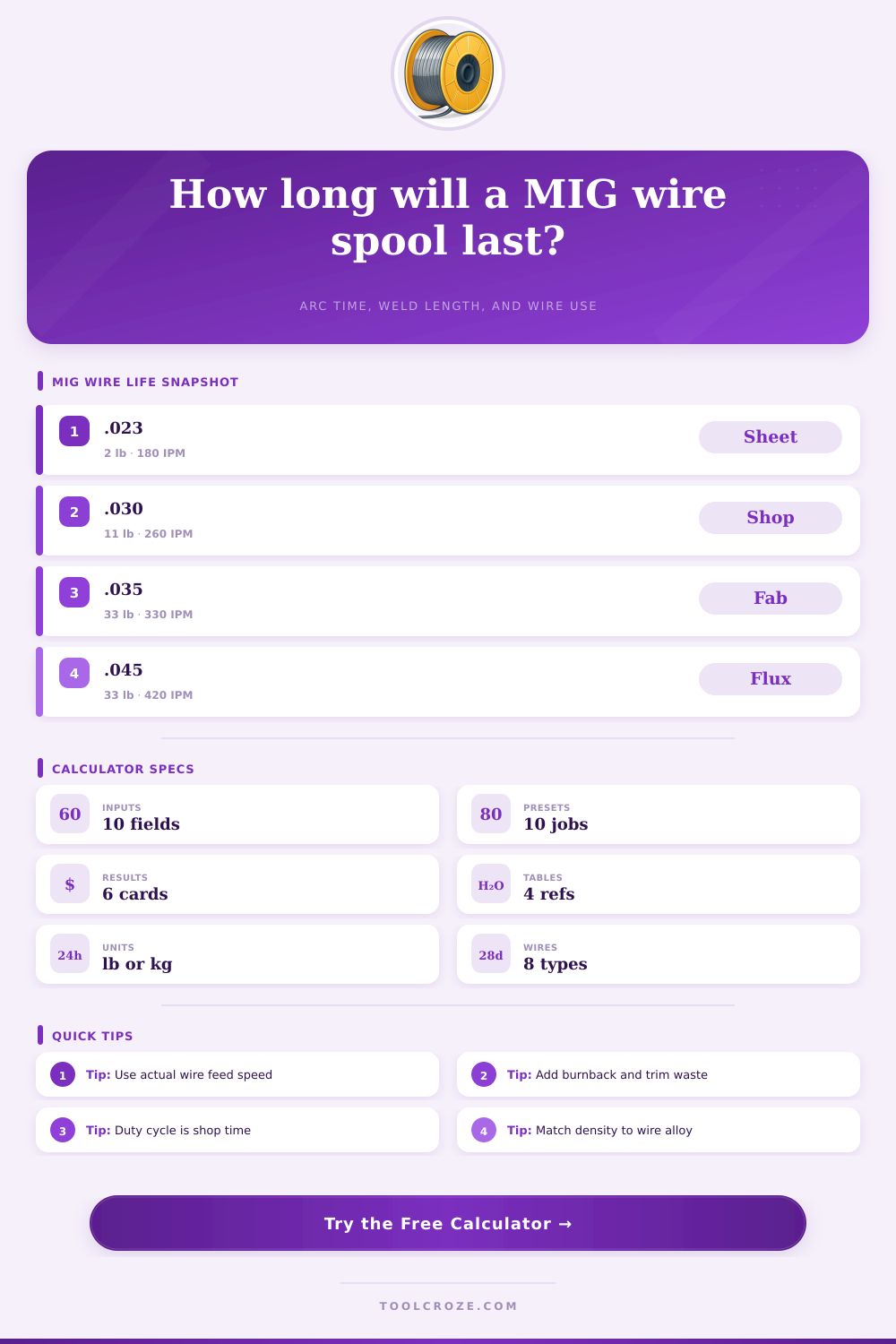
| Patch panels | .023 in, 2 lb | 180 IPM | Low duty cycle extends clock time |
| Shop cart | .030 in, 11 lb | 260 IPM | Moderate speed and normal restart waste |
| Heavy brackets | .035 in, 33 lb | 330 IPM | Higher feed speed shortens arc time |
| Flux core repair | .045 in, 33 lb | 420 IPM | Lower efficiency and more cleanup waste |
| Aluminum spool gun | .035 in, 1 lb | 520 IPM | Light density, high feed speed, small spool |
5 Practical tips
Running out of welding wire in the middle of welding a bead create a problem for welders because the welder will have to stop the welding process in order to clip the welding wire, and the process will have to be started over with welding wire of the same type. A person may want to know for how long a spool of welding wire will last during the welding process. However, the length of time that a spool of welding wire will last is dependent upon a variety of different factors.
The factors that affect the length of time that a spool of welding wire will last includes the diameter of the welding wire, the feed speed of the welding wire, the duty cycle of the welding process, and the amount of waste that is created during the welding process. A wire calculator allow a person to calculate how long a spool of welding wire will last by taking into account each of these different factors. Each of the factors that the wire calculator considers include a variety of different variables regarding the welding process.
How Long a Spool of Welding Wire Will Last
For instance, the weight of the spool of welding wire that will be used is one of the variables that the wire calculator takes into consideration. However, the welder can calculate the weight of the welding wire that can be used by subtracting any reserve welding wire that may be included in the spool from the total weight of the spool. Another variable in the welding wire calculation is the diameter of the welding wire and the density of the welding wire.
Each pound of welding wire contains a certain amount of inches of welding wire. However, because aluminum and steel have different densities, one pound of aluminum contains a different amount of inches of welding wire then one pound of steel. The feed speed of the welding wire is another variable that the wire calculator considers.
The feed speed is calculated as the weight of welding wire divided by the welding speed in inches per minute. The duty cycle of the welding process is another variable that the wire calculator considers. The duty cycle is used to calculate the amount of time that the welding process will take relative to the total amount of time that a worker will be in the shop performing welding tasks.
Finally, the percentage of waste that will occur during the welding process is another variable that the wire calculator considers. This percentage considers variables like the amount of welding wire that will be lost due to spatter on the floor, the amount of welding wire that will be used to test the welding process, and the welding wire that will be lost due to broken ends or being fed through the welding gun. Based off the variables that the wire calculator considers, the calculator provides a variety of different outputs.
For instance, one of the outputs of the wire calculator is the length of time that the welding torch will have to be active to completely use the spool of welding wire. Another output of the wire calculator is the length of time that the person will spend in the welding shop, which will be longer than the arc time of welding tasks. Additionally, the wire calculator can calculate the length of weld beads that can be created with the spool of welding wire at a specific travel speed.
Another output of the wire calculator is the number of welding jobs that can be completed with that spool of welding wire. Finally, the wire calculator can calculate the weight of welding metal that will be deposited into the job. In addition to the wire calculator itself, a variety of tables provide additional information to the welders that use the calculator.
For instance, a welder can use a table of feed speeds for various welding wire diameters in the instance in which the welder is not aware of the feed speed of the welding wire of a certain diameter. Additionally, another table that can be used by the welder includes a table that lists the various sizes of welding spools for different types of welding processes. Another table that is provided to the welders includes a table of the efficiency of different welding processes.
Another table that is provided to welders is a table of the densities of different welding metals. The density of the welding metal impacts the amount of welding wire that can be created from one pound of welding metal. As such, if the welding metal changes, the amount of welding wire that will be consumed by the welding process will change.
Another factor that the welders must consider is the duty cycle. The duty cycle impacts the length of time that the welder will be active in the welding shop relative to the total length of time that the welder will be working in the shop. For example, if a welder is performing welding tasks on small metal brackets, the duty cycle will be relatively low for those tasks.
This is because welding tasks on small metal brackets requires the welder to spend some of their time measuring the small metal brackets and tack welding them prior to welding them with the welding gun. In contrast, the duty cycle will be relatively high in the production environment. This is because in the production environment, the metal pieces that must be welded will be relatively large, thus requiring the production welder to spend less of their time fitting the metal to one another and more of their time welding the metals together.
Another factor that must be considered is the travel speed at which the welding torch is moved along the metal that is being welded. The travel speed will change according to the type of joint that is being welded. For instance, some joints require the welding torch to travel at a faster speed than others.
As such, the faster that the welding torch is moved along the metal that is being welded, the shorter the length of weld beads that will be created before the welding wire of the spool becomes depleted. The last factor that should of been considered prior to welding metal together is the amount of welding wire that will be wasted during the welding process. As discussed above, the welding wire that can be wasted during the welding process includes the welding wire that gets lost due to spatter on the welding area, the welding wire that is used to test whether or not the welding process is working correctly, the amount of wire that is lost due to broken ends of the welding wire, and the welding wire that is fed through the welding gun.
Thus, if the percentage of waste is increased in the parameters of the wire calculator, the calculations will produce a more accurate estimation of the length of time that the welding wire will be depleted during the welding tasks. By planning the life of a spool of welding wire, a welder can ensure that the welder has the proper amount of welding wire according to the rhythm of the welding tasks that must be performed. For instance, if a welder knows that the spool of welding wire will last for a certain number of hours of work, the welder can plan their work area accordingly.
This will allow the welder to ensure that they dont run out of welding wire while performing a task. The wire calculator, therefore, can assist a welder in ensuring that the welder has the proper amount of welding wire according to the tasks that must be performed.