Propane Torch Runtime Calculator
Estimate how long a propane cylinder or bulk tank will run one or more torches after flame setting, duty cycle, reserve, regulator pressure, and cold-weather vapor limits are applied.
01 Torch And Tank Presets
Pick a starting setup, then fine-tune the fuel amount, torch rating, flame setting, duty cycle, ambient temperature, reserve, pressure, and torch count.
02 Runtime Inputs
03 Runtime Results
04 Torch And Tank Comparison Grid
These examples use typical torch ratings with practical flame and duty settings. Actual runtime changes with tip size, wind, regulator pressure, and how often the valve is open.
| Setup | Tank fuel | Torch input | Work pattern | Estimated runtime |
|---|---|---|---|---|
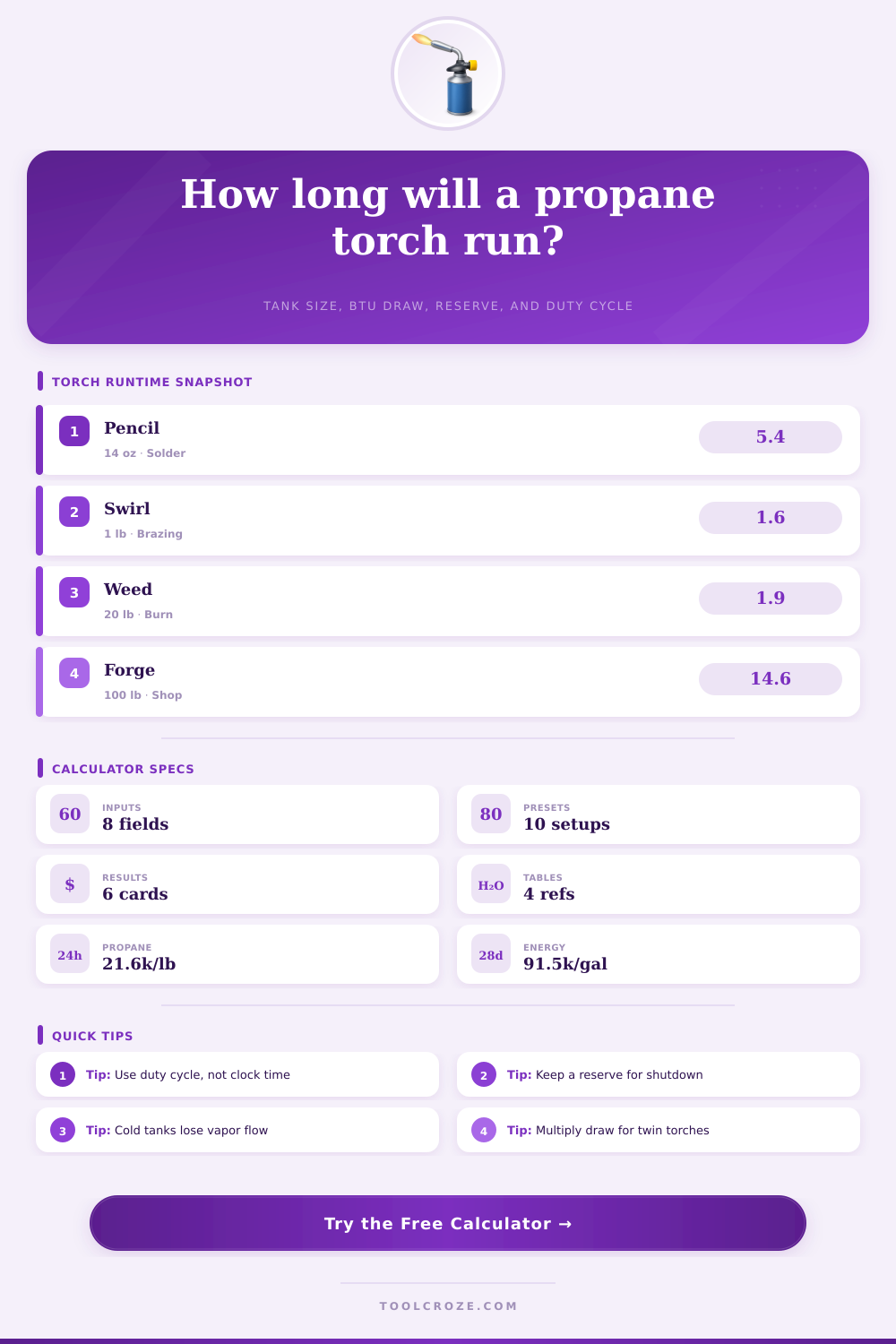
| Pencil soldering torch | 14.1 oz bottle | 3,500 BTU/hr | 65% flame, 70% duty | About 5.4 hr |
| Swirl flame plumbing torch | 16.4 oz bottle | 14,000 BTU/hr | 75% flame, 55% duty | About 1.6 hr |
| Plumbing torch | 20 lb cylinder | 25,000 BTU/hr | 75% flame, 50% duty | About 18.8 hr |
| Weed burner wand | 20 lb cylinder | 400,000 BTU/hr | 85% flame, 40% duty | About 1.4 hr |
| Roofing torch | 30 lb cylinder | 500,000 BTU/hr | 80% flame, 55% duty | About 1.5 hr |
| Forge burner | 100 lb cylinder | 100,000 BTU/hr | 85% flame, 60% duty | About 33.3 hr |
05 Propane Energy Reference
06 Tank Size Table
| Tank or cylinder | Fuel amount | Approx energy | Best fit |
|---|---|---|---|
| 14.1 oz disposable | 0.88 lb | 19,000 BTU | Small soldering and heat shrink work |
| 16.4 oz camping bottle | 1.03 lb | 22,200 BTU | Short plumbing or brazing tasks |
| 5 lb cylinder | 5 lb | 108,000 BTU | Portable bench torch work |
| 20 lb cylinder | 20 lb | 432,000 BTU | Weed burners, small roofing jobs, mobile work |
| 40 lb cylinder | 40 lb | 864,000 BTU | Longer high-output torch sessions |
| 100 lb cylinder | 100 lb | 2,160,000 BTU | Forge, shop, thawing, and multi-hour work |
07 Flame And Duty Table
| Work style | Flame setting | Duty cycle | Average draw factor |
|---|---|---|---|
| Intermittent soldering | 45% to 70% | 25% to 50% | 0.11x to 0.35x |
| Pipe sweating or brazing | 65% to 90% | 40% to 70% | 0.26x to 0.63x |
| Weed burning passes | 75% to 100% | 35% to 65% | 0.26x to 0.65x |
| Roofing or membrane work | 70% to 100% | 50% to 85% | 0.35x to 0.85x |
| Forge or heat-treat burner | 70% to 95% | 60% to 95% | 0.42x to 0.90x |
08 Cold Vapor And Pressure Table
| Condition | Planning adjustment | Runtime effect | Practical caution |
|---|---|---|---|
| Above 50 F tank | Full vapor estimate | Runtime mostly fuel-limited | Still check hose, regulator, and cylinder rating |
| 32 F to 50 F tank | About 80% vapor estimate | High-output torches may sag | Larger cylinders help maintain pressure |
| 10 F to 32 F tank | About 60% vapor estimate | Runtime may be interrupted | Manifolded tanks or a bulk tank may be needed |
| Below 10 F tank | About 40% vapor estimate | Draw limit often controls | Do not heat cylinders with an open flame |
| Higher regulator pressure | Square-root flow trim | More draw can shorten runtime | Never exceed torch, hose, or regulator ratings |
09 Practical Runtime Tips
When you use a propane torch, you must be able to determine how much propane fuels is left in the tank. Furthermore, you have to be able to determine whether the propane fuel will last until your job is finish. The amount of propane fuel that is available for use is dependent upon more than the size of the propane tank that is in use.
The amount of propane fuel that is available is also affect by the setting of the flame, the frequency in which the torch is utilized, the temperature of the environment around the propane cylinder, and the pressure of the regulator that controls the flow of propane fuel to the torch. Each of these factors are an input into the calculator, and the calculator provides an estimate of the amount of propane fuel that the torch will use based upon these different inputs. The capacity of the propane tank is one consideration for propane torch users, but it is not the only factor that is consider in the calculation of the length of time that the torch will burn with available propane fuel.
How to Tell How Long a Propane Torch Will Last
A twenty-pound propane cylinder may have the same weight of fuel as a smaller propane cylinder, but the amount of fuel that is actualy useable is less due to the reserve that is set aside for that propane tank, and the way that the propane tank is fill. A reserve is set aside for the propane tanks because propane tanks do not typically empty of all of the propane fuel within them; there must be some reserve within the propane tank so that the flame does not become inconsistently. The amount of propane fuel for the tank is converted from its current size and unit to pounds so that all calculations is consistent with one another.
Another factor to consider is the flame setting that is utilized with the torch and the duty cycle of that torch. The propane torch only reaches its rated BTU output for each hour if the valve is open to its fullest extent, and if the torch is continuously burning with that valve open to its fullest extent. Most torch users do not use the torch in these conditions, however.
A duty cycle input allows the calculator to account for the fact that the torch is only burning during work periods. As a result, a torch that is used for only forty percent of the time will use less propane fuel than a torch that is utilize for one hundred percent of the time; this is one of the reasons that a tank of propane fuel may last for different length of time when used with a torch. The temperature of the environment around the propane tank is another factor for consideration.
Propane must be in the gaseous state in order for it to burn in the propane torch. Due to this requirement of propane to exist in a gaseous state, it is difficult for propane tanks to be exposed to cold temperatures; as a result, they will not be able to supply the same amount of propane vapor as tanks that are at room temperature. The calculator allow for the user to enter the temperature at which the propane tank will be used.
The calculator will provide an output regarding the vapor margins that exist between the propane tanks gaseous output and the vapor that can be supplied by the propane cylinder at the temperature entered. If the vapor margins is low, then the flame will be small, or the propane tank may begin to develop frost on its exterior, despite the amount of propane fuel that is still within the tank. In these situations, another propane tank may be required for the same amount of work.
Another factor that will affect the operation of the propane torch is the pressure of the regulator attached to the propane tank. Due to the nature of propane tanks, a square-root trim is use in calculating the propane fuel consumption. If the propane torch is set to any pressure above the rated pressure of the torch, then the amount of heat output by the torch will increase, along with the consumption of propane fuel.
If the pressure of the torch is set below its rated pressure, the flame will be soft than the BTU rating of the torch. These factors indicate that the pressure of the regulator should be set to the same pressure as the propane torch to ensure accuracy in the calculations and estimate by the propane torch fuel calculator. These factors can be multiplied if using more than one propane torch.
Using two propane torches at the same settings does not halve the length of time that the propane fuel will last; doubling the number of torch flame also doubles the amount of vapor that is demanded from the propane cylinder. Due to this increase in demand for vapor, it is difficult to find disposable propane cylinders that can supply the vapor necessary for two propane torches of the swirl-flame type. Thus, a vapor check is useful for torch users that plan to utilize more than one propane torch.
The reference tables that is provided for different amounts of propane tanks, torch types, and duty cycles are not exact prediction as to how long the torch will last with the propane fuel. However, these tables are useful in that they illustrate the effect that different variables will have upon the length of time that the propane torch will run with the available fuel. For instance, the information within these tables can illustrate the difference in function between a pencil torch and a roofing torch, each of which may be contained within different sized propane tank.
External variables can affect the performance of the torch. For instance, propane torchs may be used in environments with high amounts of wind. The wind may lead to the need to increase the flame setting of the propane torch beyond that which is set for the flame.
Other factors to consider include the length of the hose that is use to distribute propane to the torch, and how the age of the propane tanks and the quality with which it was filled may impact the amount of liquid propane that can be supplied to the torch. All of these external variables indicate that the fuel calculator will only provide estimate for torch users. To get an estimate of how long the propane torch will actualy last, the torch should be used for a cycle to measure the length of time that it burns, and the setting at which the torch flame is maintained.
By entering the length of time that the torch should burn, along with the setting of the flame into the calculator, an estimate will be provided regarding how long the torch will last. This estimate is one that can be used to determine whether the amount of propane fuel that is contained within the current propane tank is the correct amount of propane fuel for the job that is to be perform.