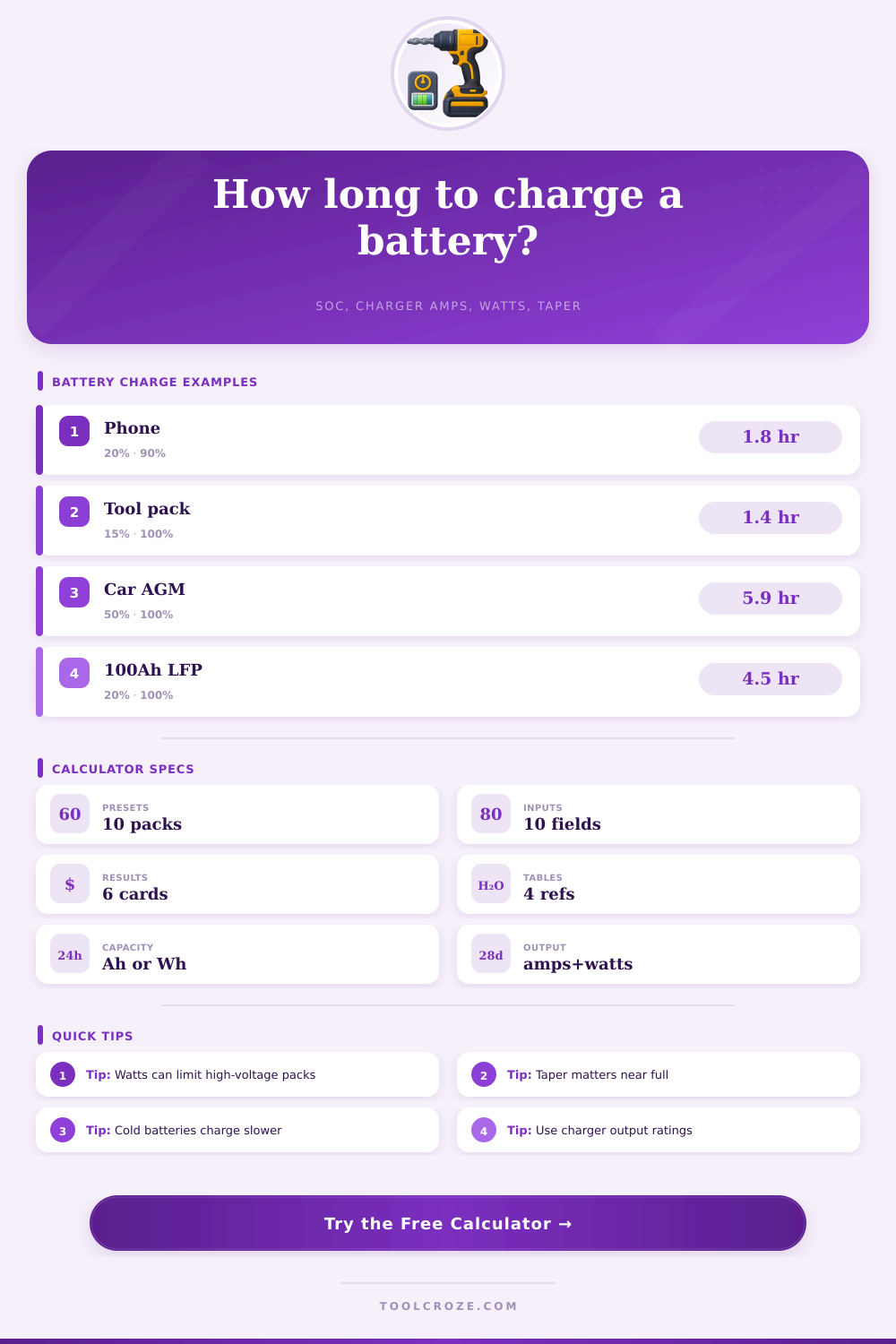
Battery Charge Time Calculator
Estimate bulk charging time, taper time, charger watt limits, energy added, wall energy, and temperature-adjusted charge rate for real batteries and chargers.
🔋 Real Battery and Charger Presets
Load a common battery setup, then fine-tune capacity, SOC window, charger amps, watts, efficiency, taper behavior, and ambient temperature.
⚙ Charge Inputs
📊 Results
Calculation Breakdown
🔌 Battery and Charger Grid
📘 Chemistry Reference
| Chemistry | Common nominal voltage | Typical charge efficiency | Practical taper note |
|---|---|---|---|
| Lithium-ion | 3.6 to 3.7 V per cell | 90% to 96% | Often tapers above about 80% SOC |
| LiFePO4 | 3.2 V per cell | 92% to 98% | Can hold current longer, then tapers near full |
| Lead-acid / AGM | 2.1 V per cell | 75% to 90% | Absorption stage can dominate the last 20% |
| NiMH | 1.2 V per cell | 65% to 80% | Heat and termination method affect final time |
📈 Charger Output Reference
| Charger type | Typical amps | Typical watts | Best fit |
|---|---|---|---|
| USB phone charger | 1 to 3 A | 10 to 30 W | Phones, small tablets, compact packs |
| USB-C laptop charger | 3 to 5 A | 45 to 100 W | Laptops and high-power portable devices |
| Automotive smart charger | 4 to 15 A | 60 to 220 W | 12 V lead-acid and AGM batteries |
| Solar charge controller | 10 to 60 A | 150 to 1200 W | RV, marine, off-grid battery banks |
🌡 Temperature Derating Table
| Battery temperature | Model factor | Charge behavior | Planning note |
|---|---|---|---|
| 50 to 95°F | 100% | Normal charge acceptance | Use rated charger output |
| 32 to 49°F | 82% | Slower charge acceptance | Allow more time for lithium packs |
| 14 to 31°F | 55% | Strong cold derate | Confirm battery allows charging |
| 96 to 104°F | 90% | Warm-pack throttling likely | Ventilate the battery area |
⏱ Taper Phase Guide
| Taper setting | Starts near | Average taper current | Use when |
|---|---|---|---|
| No taper | 100% SOC | 100% of bulk | Rough constant-current estimate only |
| Light taper | 90% SOC | 65% of bulk | LiFePO4 or chargers that hold current high |
| Standard taper | 80% SOC | 45% of bulk | Common lithium-ion charge planning |
| Aggressive taper | 70% SOC | 30% of bulk | Lead-acid absorption or conservative charging |
💡 Tips and Safety
The time it take to charge a battery depends on several specific factor. For instance, the energy capacity of the battery will impact the charging time. The speed of the battery charger will also impact the charging time.
The current state of the battery will also impact the charging time. For example, the battery will charge more quick if the environment is warm, as opposed to when the environment is cold. Each of these factors will impact the charging time of the battery.
Factors That Affect Battery Charging Time
The factor of the battery capacity is one of the main determinant of the charging time. The battery capacity determines how much total energy the battery can hold. If the battery can hold more energy, then the battery will require more time to charge it to the necessary level.
The second of the main factors is the voltage of the battery. If two batteries has the same amperage, but one battery has a higher voltage than the other, then the battery with the higher voltage has more power. A calculator can help with the math for those who dont wish to calculate the wattage of they battery themselves.
The third of the main factors is the state of charge of the battery. The state of charge describe how much energy is currently in the battery. If the battery has a high state of charge, it will take more time to charge it to 100% than a battery with a low state of charge.
In most batteries, the charging time for the last stage of the battery will be longer than the other stages. This is due to the reduction of the charging current that occurs as the battery nears 100% charge. This is referred to as tapering.
In lead-acid batteries, tapering is drastic; other battery chemistries display different rate of tapering. You can adjust the tapering parameter in this tool to account for each chemical composition of the batteries. The charger specifications and the charging temperature will also impact the charging time.
The current and power rating of the battery charger will impact the rate at which the battery will charge. A charger with a low current or power rating will charge the battery more slow. The battery chemistry accepts charge at different rate at different temperatures.
In cold environments, the battery may find it more difficult to accept the current from the charger. Batteries also reduce the charging current if the battery is becoming too hot so as to not damage it. These factors will be accounted for in the tool.
Efficiency in the transfer of energy from the charger to the battery will also impact charging time. Energy will be lost as the battery charge (as heat), so the energy supplied to the battery will be less than the energy stored in the battery. Many people plan for battery charging times but also account for potential setbacks in their planning.
For example, they may plan to charge their battery, but then find that some charger may not meet the claims made for those chargers. To account for this, you can add a percentage of reserve time in the planning of battery charging. Battery chemistries may impact how long it takes for a battery to charge.
For instance, the rate at which a laptop will charge using a USB-C charger will be different than the rate at which an RV battery will charge when using a solar charger controller. Each of these batteries has different typical amperages and wattages. The calculation also includes a C-rate.
The C-rate will describe how aggressive you are in charging the battery relative to its capacity. For instance, a one-C rate means that it will take the battery one hour to become fully charged if there were no tapering of the batterys charging current. Most batteries is not designed to handle being charged at this rate each day.
It is important to understand that battery charging speed may not be consistent throughout the charging period. Many individual will sit and watch as the battery begins to charge at a high rate, but they may not account for the fact that the charging rate will slow with the tapering of the battery’s current. The tool accounts for this factor; the bulk charging time and the tapering time are separated so that users can understand this inherent charging behavior.
Such knowledge will allow them to purchase battery charger with higher current capacities to meet their needs. Another of the factors that may impact charging times is the charging temperature of the battery. Batteries that take a while to charge when at room temperature will take much longer to charge if the battery is cold.
This factor is also accounted for in the tool. If you do not adjust this parameter in the battery charging planning process, the battery may take much longer to charge than what was plan. Through regular use of this tool, individuals will have a better understanding of how each of the factor will impact the charging time of the battery.
The voltage and current of the battery are the primary factor that will impact charging time. However, the tapering and charging temperature will also have an impact on charging time. Each of these factors will allow individuals to remove the guesswork from battery charging time planning.