Compressor Pressure Build Time Calculator
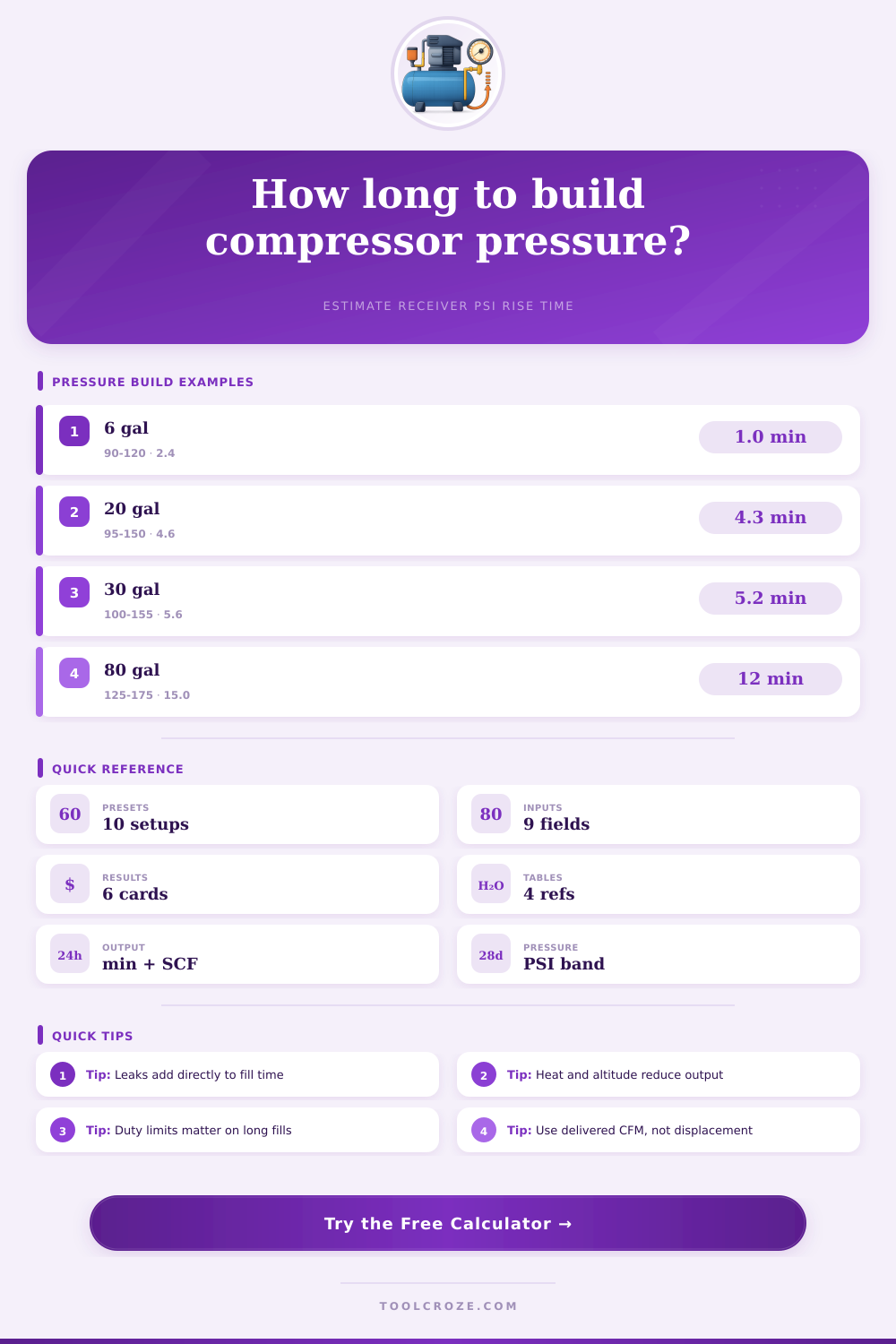
Estimate how many minutes a compressor needs to raise receiver pressure after derating delivered CFM for altitude, intake temperature, pump duty, leaks, motor horsepower, and efficiency.
⚙ Compressor Presets
📈 Pressure Build Inputs
📊 Compressor/Tank Comparison Grid
📕 Pressure Band Reference
| Receiver | Pressure Rise | Approx Air Added | Build Time at 10 Net SCFM |
|---|---|---|---|
| 6 gallon trim compressor | 90 to 120 PSIG | 3.2 SCF | 0.3 min |
| 20 gallon portable tank | 95 to 150 PSIG | 19.8 SCF | 2.0 min |
| 30 gallon belt-drive tank | 100 to 155 PSIG | 29.7 SCF | 3.0 min |
| 60 gallon shop receiver | 110 to 145 PSIG | 37.7 SCF | 3.8 min |
| 80 gallon two-stage receiver | 125 to 175 PSIG | 71.9 SCF | 7.2 min |
⛅ Altitude and Temperature Derate
| Condition | Typical Factor | What Changes | Calculator Effect |
|---|---|---|---|
| Sea level, 68°F intake | About 1.00 | Rated air density | Delivered CFM is nearly unchanged |
| 2,500 feet, 80°F intake | About 0.91 | Thinner and warmer intake air | Build time increases roughly 10% |
| 5,000 feet, 90°F intake | About 0.83 | Altitude and heat stack together | Net build flow drops sharply |
| Hot enclosed garage, 105°F | About 0.94 | Warm intake has less mass | Fill takes longer even at low altitude |
💨 Leak and Duty Reference
| Shop Condition | Leak Allowance | Duty Concern | Pressure Build Impact |
|---|---|---|---|
| Fresh hose, closed couplers | 0.0 to 0.1 SCFM | Low on short fills | Net CFM stays close to rated output |
| Several quick connects | 0.2 to 0.5 SCFM | Moderate for small pumps | Small compressors show noticeable delay |
| Old hose reel or manifold | 0.5 to 1.5 SCFM | High during long recovery | Build time can double on low-CFM units |
| Audible leak under pressure | 1.5+ SCFM | Continuous cycling likely | Tank may never reach cut-out pressure |
⚡ Motor HP and Efficiency Guide
| Compressor Type | Typical Motor | Efficiency Range | Common Delivered CFM Range |
|---|---|---|---|
| Oil-free pancake or hot dog | 0.7 to 1.0 HP | 50% to 60% | 2.0 to 3.0 SCFM at 90 PSI |
| Portable oiled single-stage | 1.5 to 2.0 HP | 58% to 68% | 4.5 to 7.0 SCFM at 90 PSI |
| Shop single-stage vertical | 3.0 to 5.0 HP | 65% to 75% | 10 to 15 SCFM at 90 PSI |
| Two-stage shop compressor | 5.0 to 7.5 HP | 70% to 82% | 15 to 25 SCFM at 175 PSI |
ℹ Practical Pressure Notes
A compressor take in air from an environment and compresses that air into a tank so that it can be used to power various tool. The time that it takes for a compressor to refill a tank with compressed air is dependent upon a variety of different variable. Many individual may think that a compressor will refill a tank at the same rate each time.
However, a variety of different factor will change the rate at which the compressor delivers air into a tank. One of the main factor that will affect the time that it takes for a compressor to refill a tank is the volume of that tank. Tanks with a larger volume will require more air to reach the desired pressure.
What Affects How Fast a Compressor Fills a Tank
Additionally, if the pressure band is particularly widely, the compressor will have to push more air before it will recognize that the tank has reached the desired pressure. The volume of the tank, however, isnt the only factor that will play a role in the amount of air that the compressor can deliver into the tank. For instance, the temperature at which the compressor takes in the air will affect the density of that air.
Warm air is less dense than cold air, thus, the compressor will move less air if the intake air is warm. Additionally, air will also become less dense at higher altitude, meaning the compressor will move less air at high altitudes compared to sea level. The leaks in the tank will also play a role in how much air the compressor can deliver to the tank.
If the tank has a leak, air will escape from the tank. Thus, air will be lost from the system and the compressor will have to work harder to refill the tank. Depending upon the size of the leak, a significant amount of air can be lost over time.
Therefore, if the tank has a leak, the compressor will likely take longer to refill the tank. Additionally, other factor such as the horsepower of the motor and the duty rating of the motor can also play a role in how much air can be pushed into the tank. For instance, manufacturers typicaly manufacture air compressor with a specific duty rating.
Duty ratings indicate how long the air compressor can run before it needs to cool the motor to allow the motor to continue functioning. If the air compressor is performing various task continuously, the motor may reach temperatures that are to high for the motor. Additionally, the motor will impact how much air the motor can compress.
If the demand for air is too high for the available horsepower, the motor may struggle to provide enough air to the tank or the motor may continuous trip. These different variable can be accounted for with a calculator. The calculator will allow individuals to input variables like the temperature, the altitude, and the leaks in the air compressors tank to name a few.
By using this calculator, individuals can better understand how much air the compressor will move. Using these realistic input will provide a better estimation of the air movement rate different than the air compressors nameplate figure for airflow. When purchasing an air compressor, individuals must take into account the type of task that will be performed with the air compressor.
Tasks performed in short burst will require motors with lower duty ratings. Tasks that require the air compressor to continuously push air, like sanding or painting, will require higher airflow rate. Additionally, adding more receiver tank volume will allow tanks to better absorb high demands for air for short periods of time.
However, adding more receiver tank volume also means that the air compressor will take longer to refill the tank. Thus, individuals must consider whether the additional volume will be worth the longer refill time for the tank. Finally, by understanding the factors that impact the air compressors ability to deliver air into the tank, individuals will be able to better plan their task accordingly.