Tire Air Volume Calculator
Estimate tire cavity volume, the free air held at pressure, and the standard air needed to move from starting PSI to target PSI for cars, pickups, trailers, RVs, and off-road tires.
📌Real tire size presets
Choose a common tire size, then adjust the exact width, aspect ratio, rim, pressure, temperature, and quantity for your vehicle or service bay.
⚙Tire and pressure inputs
Enter a tire size and pressure range to calculate the air volume.
🗂Tire/spec comparison grid
📊Common tire air volume reference
| Tire size | Typical use | Estimated outside diameter | Approx cavity volume |
|---|---|---|---|
| 195/65R15 | Compact car | 25.0 in / 635 mm | 6.6 gal / 25 L |
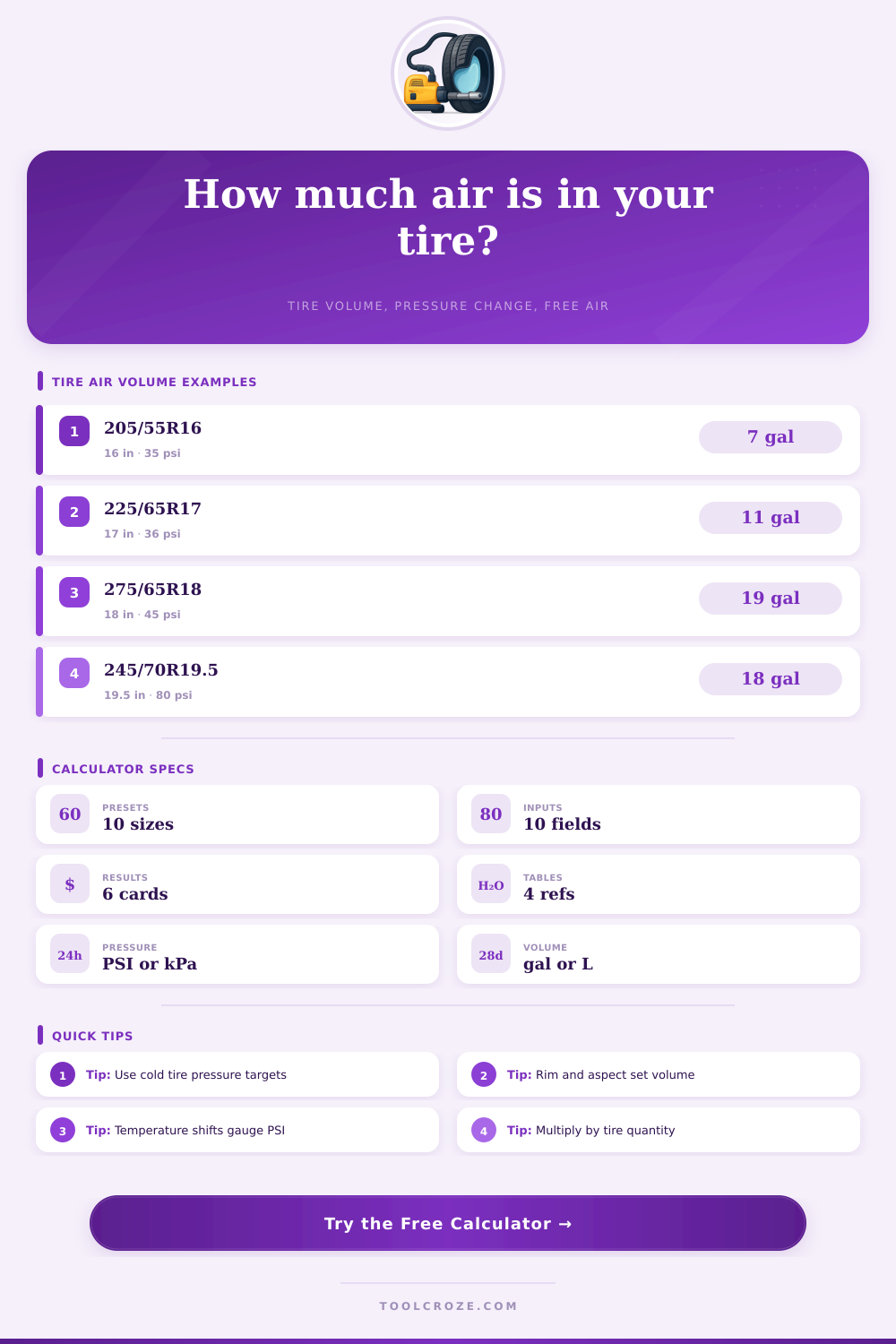
| 205/55R16 | Sedan | 24.9 in / 632 mm | 7.2 gal / 27 L |
| 225/65R17 | Crossover | 28.5 in / 724 mm | 11.2 gal / 42 L |
| 265/70R17 | Pickup | 31.6 in / 803 mm | 19.2 gal / 73 L |
| 275/65R18 | Light truck | 32.1 in / 815 mm | 19.4 gal / 73 L |
| 245/70R19.5 | RV or commercial | 33.0 in / 839 mm | 18.2 gal / 69 L |
🌡Pressure and temperature table
| Condition | What changes | Rule of thumb | Calculator treatment |
|---|---|---|---|
| Cold morning | Gauge pressure reads lower | About 1 psi per 10°F for many tires | Uses absolute pressure and air temperature |
| Warm shop | Gauge pressure reads higher | Do not chase hot tire pressure down | Reports pressure drift separately |
| High target PSI | More standard air held | 80 psi holds about twice 35 psi air | Uses PSI gauge plus atmospheric pressure |
| Bleed down | Air is removed, not added | Negative pressure delta means bleed volume | Labels add or bleed automatically |
📐Size formula guide
| Input | Formula step | Example 205/55R16 | Why it matters |
|---|---|---|---|
| Section width | mm / 25.4 = inches | 205 mm = 8.07 in | Sets cross-section width |
| Aspect ratio | width x aspect % | 8.07 x 0.55 = 4.44 in | Sets sidewall height |
| Outside diameter | rim + 2 sidewalls | 16 + 8.88 = 24.88 in | Checks tire size reasonableness |
| Cavity volume | width x sidewall x shape x center circumference | about 7 gal | Converts tire size to air space |
📋Pressure band examples
| Scenario | Start to target | Typical tire quantity | Planning note |
|---|---|---|---|
| Daily driver top-off | 28 to 35 psi | 4 tires | Small pressure delta, volume still adds up across a set. |
| Pickup after towing setup | 35 to 50 psi | 4 tires | Large LT tire volume and pressure both increase air demand. |
| RV front axle | 65 to 80 psi | 2 tires | High absolute pressure makes held air much higher than cavity volume. |
| Off-road airing up | 15 to 35 psi | 4 tires | Big casing volume dominates the refill amount. |
✅Tire air volume tips
Tire pressures is the amount of compress air that exists within a tire. However, the measurement of tire pressure depend on several different factor. The gauge that is used for measure tire pressure measures the pressure of the compress air that is within the tire.
However, the volume of that compress air can change based off the dimension of the tire and the target pressure within that tire. While it may seem as if tire pressure only has one measurement, the measurement of tire pressure are actualy the calculation of factors like tire width, sidewall height, the size of the rim, and the volume of the tire cavity. The dimensions of the tire cavity influence the amount of air that is required to fill that cavity to the target pressure of the tire.
How Tire Size, Pressure, and Temperature Change the Air Inside a Tire
The dimensions of the tire cavity determine the size of that cavity and how much air is required to fill it. Factors like the section width of the tire, the aspect ratio of the tire, the diameter of the rim, the shape factor of the tire cavity, and the target pressure all plays important roles in the measurement of the air within the tire. For instance, the section width and aspect ratio of a tire can help determining the height of the sidewall of the tire.
That height will play a role in the size of the tire cavity. Additionally, the diameter of the rim will determine the circumference of the tire that gets filled with air. However, the shape factor will account for the fact that not all tire have the same shape of tire cavity.
For example, the tire of a light truck may have a more different amount of usable air then the tire of a passenger car. The target pressure measurement of the air within the tire will change the total volume of air within that tire. For instance, the cavity of the tire will hold more cubic feet of air at 80 psi than it will at 35 psi.
This relationship between target pressure and volume is partly due to the fact that the target psi represent a higher level of compression of the air within that tire cavity. The temperature within the tire will also play a role in the amount of air within that tire. When the temperature within the tire rises, the air within that tire will expand.
Conversely, when the temperature within the tire falls, the air within that tire will contract. For instance, the tire may contain a certain amount of air in the morning when the temperature is relatively cool. However, during the afternoon, when the temperature has risen, the tire may have a higher air pressure within it.
In addition to the effects of temperature on air within the tire, it may be assumed that the amount of air within a tire is constant after the tire has been filled with air. However, the amount of air within a tire can change due to temperature change or slow leak of that air. It is important to account for these variables because the volume of air that is required to fill a tire is related to both the size of the cavity of the tire and the target pressure of that tire.
For instance, a trailer tire or the tire on an RV will require a larger volume of air then a compact car tire because the trailer tire will have both a larger cavity within the tire and a higher target air pressure within that tire. Therefore, the total volume of air that would of have to be pumped into each tire if there were many tire on a given vehicle. Due to the relationship between the size of the tire and the amount of air that it can contain, the size of the air compressor that is used to fill those tires is also important.
For instance, a crossover vehicle tire may contain less air than the tire of a light truck. Thus, a small air compressor may be able to efficiently fill the tires of a crossover SUV but not the tires of a light truck. Understanding these variables regarding air volume allow for the individual to properly determine whether or not the individual is using an air compressor that has enough air volume to reach the target air pressure within the tires of the vehicle.
Thus, the calculator outlined above will allow individuals to understand how each of these factors impact the volume of air that is contained within a tire.