Polyester Resin Catalyst Calculator
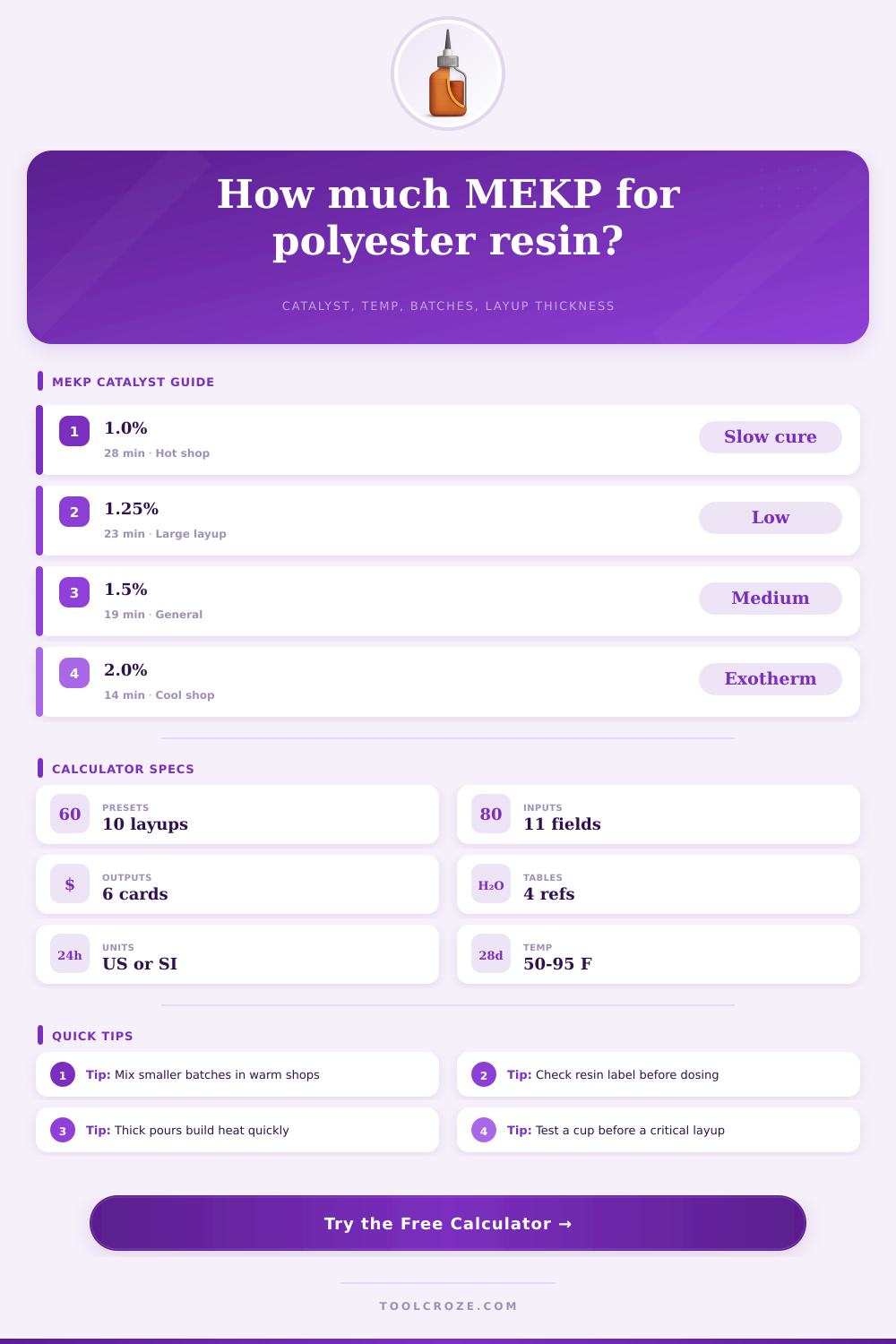
Estimate MEKP catalyst, promoted-resin allowance, batch splits, waste, laminate heat risk, and working-time window for polyester fiberglass layups.
▣Fiberglass layup presets
Choose a practical shop scenario, then tune resin amount, catalyst percentage, temperature, gel target, thickness, and batches to match your resin label.
⚙Catalyst inputs
▦Resin profile summary
▤Reference tables
| MEKP by weight | Typical use | Gel tendency at 70 F | Shop caution |
|---|---|---|---|
| 0.75% to 1.00% | Hot shop, large surface, slow wet-out | Slowest practical band | May cure poorly if resin label requires more |
| 1.00% to 1.25% | Large laminate panels and mold skin coats | Moderate-slow gel | Good ventilation and test batch still required |
| 1.25% to 1.75% | General fiberglass layup and small repairs | Balanced working time | Do not extend open time by under-catalyzing |
| 1.75% to 2.00% | Cool shops or small thin patches | Faster gel | Watch exotherm in cups and thick corners |
| Over 2.00% | Only when the resin maker permits it | Very fast gel | Higher heat, shrink, cracking, and print-through risk |
| Shop temperature | Gel time effect | Batch planning | Layup note |
|---|---|---|---|
| 50 to 59 F | Much slower | Use small test cup before work | Cold resin can remain tacky or weak |
| 60 to 69 F | Slightly slower | Normal batch size if label allows | Warm resin containers indoors if needed |
| 70 to 79 F | Baseline range | Good default for most estimates | Wet out cloth before the clock gets tight |
| 80 to 89 F | Faster gel | Split batches and stage tools first | Cups can heat rapidly after mixing |
| 90 F and up | Very fast gel | Use very small batches | Delay work or cool materials if possible |
| Laminate thickness | Heat risk | Batch advice | Common example |
|---|---|---|---|
| Under 0.06 in | Low | Normal small repair batch | One to two layers of cloth |
| 0.06 to 0.12 in | Moderate | Watch temperature and cup mass | Three layers of 6 oz cloth |
| 0.12 to 0.25 in | Elevated | Split layers or allow heat to fall between passes | Mat and roving patch |
| 0.25 to 0.50 in | High | Use staged laminations | Transom or tank lid reinforcement |
| Over 0.50 in | Severe | Engineer the cure schedule | Thick cast or concentrated corner |
| Catalyst/temp/laminate grid | Cool thin | Room temp medium | Hot thick |
|---|---|---|---|
| 1.0% MEKP | Long wait | Slow but useful | Safer heat, slow cure |
| 1.25% MEKP | Steady gel | Balanced large batch | Use small batches |
| 1.5% MEKP | Normal patch | General default | Heat watch zone |
| 1.75% MEKP | Fast repair | Quick gel | High exotherm risk |
| 2.0% MEKP | Cool-shop only | Small patch only | Avoid unless approved |
ℹShop tips
Calculating the amount of MEKP catalyst that you need for your polyester resins is a necessary part of the polyester resin process. The amount of MEKP catalyst that you use will determine the speed at which the chemical reaction take place, as well as the amount of heat that builds up within the polyester resin. If you use too little MEKP catalyst, your polyester resin will remain soft and stickily for extended periods of time.
However, if you use too much MEKP catalyst, your polyester resin will generate heat at rapid rate, shortening your working period with the polyester resin. The temperature of the shop in which you are using the polyester resin is another important factor in the setting of the MEKP catalyst. A shop that maintain temperatures of 85 degrees will allow the polyester resin to move through its liquid phase at faster rates then a shop that maintains temperatures of 65 degrees.
How to Calculate MEKP Catalyst for Polyester Resin
The temperature should be entered into the calculator, as the calculator utilize the temperature of the shop to recalculate the gel window for the polyester resin. This allow the person using the polyester resin to determine if the polyester resin will remain workable once it is placed upon the glass. Thickness and the mass of the polyester resin that is to be cured is another important factor.
Thin skin of polyester resin will shed heat at faster rates than batches of polyester resin of thick compositions. Thus, a thin skin of polyester resin will not generate as much heat within the polyester resin as a thick layer of polyester resin. The thickness and mass of the polyester resin are included in the calculation of the heat risk from the polyester resin; these variable will impact the polyester resin more than the amount of MEKP catalyst if the polyester resin is deeper than a quarter inch in thickness.
The allowance for waste of polyester resin is another necessary field within the calculator. It is possible that more polyester resin will be required than the calculations indicates. An allowance for waste account for the amount of polyester resin that will remain on the trays, rollers, and other equipment used in the application of polyester resin.
The allowance for waste is included to ensure that the amount of catalyzed polyester resin is not under estimated. The field for the promoter is another important field within the calculator. Some polyester resin batches contains cobalt, or other chemicals that act as promoter for the curing of the polyester resin.
If the polyester resin contains promoters, using additional amounts of promoter will shorten the time in which the polyester resin will remain in its liquid state. Thus, the calculator adjust for the amount of promoter that is already contained in the polyester resin. The batch count feature allow for the polyester resin batches to be divided into smaller batch.
This is useful in that the amount of heat that each batch generate will be less. Thus, by dividing the polyester resin into smaller batches, there will always be fresh polyester resin available to use in the layup process. This field allow for the amount of MEKP catalyst to be measured only once, then poured into each batch of polyester resin that is prepared.
The reference tables include common scenarios for polyester resin applications. The tables indicate how changes in the temperature will change the rate at which the polyester resin set. Additionally, the tables indicate how increases in the thickness of the polyester resin will increase the risk of the polyester resin overheating.
These tables are a means of providing an individual with an understanding of whether or not the calculations are reasonable for there specific project. As with any mathematical calculation, the conditions in which the polyester resin is being utilized will vary from the ideal conditions that were used to calculate the amount of MEKP catalyst needed. Factors like humidity, the age of the polyester resin, the amount of pigment that is contained within the polyester resin, and the brand of the polyester resin may change the setting time of the polyester resin.
Prior to the beginning of any layup process, a test cup of polyester resin should of be performed to ensure that these variables will not impact the project in a manner that cannot be managed. In a way, the MEKP catalyst calculator is a means of allowing an individual to understand the relationship of each of the variables. Each of the variables impact the others.
Thus, through understanding each of these variables, and their relationships to one another, an individual will have a better understanding of polyester resin and be able to make informed decision regarding its use.