River Table Epoxy Calculator
Estimate mixed epoxy for live-edge rivers, void fill, seal coats, overpour, layer thickness limits, resin weight, and resin-to-hardener split before you start mixing.
Pick a common live-edge layout, then fine-tune the measured river width and depth. Presets are practical starting points, not limits.
River Table Epoxy Results
Use these cards to sanity-check the calculator inputs against typical river-table shop assumptions.
These tables keep the estimate auditable: epoxy type, wood behavior, layer planning, and common river-table dimensions.
| Epoxy Type | Typical Layer | Best Use | Planning Note |
|---|---|---|---|
| Deep pour casting epoxy | 1 to 2 in | River channels | Lower exotherm; slower cure window. |
| Tabletop coating epoxy | 1/16 to 1/8 in | Flood coat | Use for surface finish, not bulk volume. |
| Fast set casting epoxy | 1/4 to 1/2 in | Small voids | Needs conservative layer thickness. |
| UV-stable clear casting | 1/2 to 1.5 in | Clear rivers | Good for pale woods and clear pigments. |
| Wood Species | Absorption | Movement Concern | Seal-Coat Factor |
|---|---|---|---|
| Walnut live edge | Medium | Moderate seasonal width change | 1.00x |
| White oak | High open grain | Strong tangential movement | 1.18x |
| Hard maple | Low to medium | Stable when dry and flat | 0.92x |
| Ash or elm | High edge texture | Checks and wild grain matter | 1.15x |
| Redwood burl | Variable soft figure | Soft pockets and punky spots | 1.25x |
| River Depth | Layer Limit | Likely Layers | Shop Check |
|---|---|---|---|
| 0.5 in | 0.5 in | 1 layer | Good for shallow ribbons. |
| 1.0 in | 0.5 in | 2 layers | Common desk and console depth. |
| 1.5 in | 0.5 in | 3 layers | Typical dining slab fill. |
| 2.0 in | 0.75 in | 3 layers | Deep pour epoxy strongly preferred. |
| Table Project | River Size | Void Factor | Typical Mixed Epoxy |
|---|---|---|---|
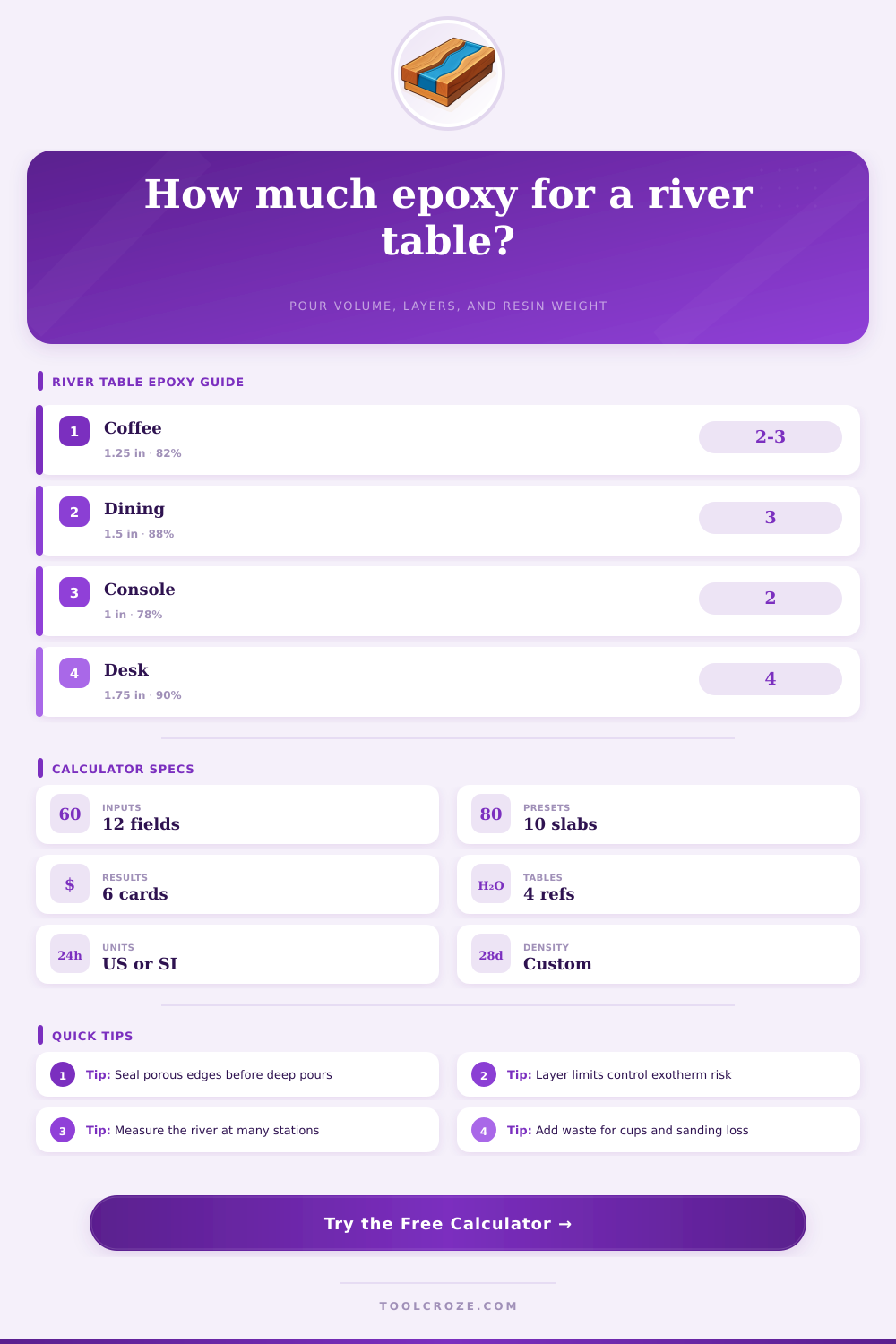
| Coffee table | 72 x 7 x 1.25 in | 80 to 88% | 2.0 to 2.8 gal |
| Dining table | 96 x 8 x 1.5 in | 85 to 95% | 4.0 to 5.3 gal |
| Console table | 60 x 4.5 x 1 in | 70 to 85% | 1.0 to 1.5 gal |
| Conference top | 120 x 10 x 1.75 in | 85 to 100% | 8.0 to 10.5 gal |
When you prepare to build a river table with epoxy resin, you must account for the volume of epoxy resin that the project will require. The eye of a river table maker often fail to fully judge the volume of the gap between the two wood slabs. The eye also fails to see how deep or how wide the gap between the wood slabs are.
Thus, if you are not careful with the way that you judge the volume of the gap, you may either not have enough epoxy resin to complete the project, or you may purchase too much epoxy resin for your project. In order to calculate the volume that is required for the project, you must use a calculator. To calculate the volume of epoxy resin required for the project, the calculator requires that you enter several factor relating to the project.
How much epoxy resin you need for a river table
The river table maker must enter the length and the width of the gap between the wood slabs. In addition to the length and width of the gap, you must also enter the void factor for the gap into the calculator. The void factor accounts for the irregularities in the wood slabs.
In addition to the void factor, the depth of the gap must be entered into the calculator. The depth of the gap will help to determine how many layer of epoxy resin will be required to fill the gap. In addition to the depth of the gap, an overpour allowance and a seal coat count must also be entered into the calculator.
An overpour allowance must be entered to account for the fact that the epoxy resin will be flattened during the pouring process. Additionally, the wood slabs will absorb some of the epoxy resin during the sealing process. Finally, a percentage of the epoxy resin that will be wasted during the mixing and pouring process must also be entered into the calculator.
The calculator will provide the maker with several pieces of information regarding the project and the amount of epoxy resin that will be required to complete it. The calculator will provide the total amount of mixed epoxy resin that will be required for the project, and this number will be more accurate then the theoretical estimate that you may have of the size of the river that will be formed by the poured epoxy resin. The calculator will also provide the weight of that total volume of epoxy resin, as it is important for the maker to know how much weight of epoxy resin will need to be moved.
Another output of the calculator will be the layer count for the epoxy resin project. This will allow the maker to understand if the project can be completed in one session, or if it will be necessary to split the project into several days to allow for proper temperature control of the epoxy resin. Finally, the calculator will provide the resin to hardener split, as the accurate ratio of epoxy resin to hardener will prevent errors in the addition of those two chemical.
In addition to the information that the calculator will provide the maker, it is also important to respect the layer thickness limit of the epoxy resin that will be used in the creation of the river table. If the thickness of the layers of epoxy resin that are to be poured into the gap between the two wood slabs is too thick relative to the capabilities of the epoxy resin, then the epoxy resin may overheat during the pouring process. Overheating the epoxy resin may lead to the cracking of the wood slabs, or the discoloration of those wood slabs.
Therefore, it is important to know the layer thickness limit of the epoxy resin prior to beginning the pouring process. This will allow the maker to either change the type of epoxy resin that is to be used in the project, or to adjust the number of layers of epoxy resin that will be poured into the gap between the two wood slabs. Additionally, it is important to refer to the tables provided in the calculator to determine how the different wood species will react to the application of epoxy resin.
For instance, oak will require more seal coats than maple will, and deep pour epoxy resin will allow for thicker layers of epoxy resin than that which can be poured onto tabletops made with epoxy resin of the tabletop pouring category. The information that is provided in the epoxy resin calculator will allow the maker of the river table to make better decisions regarding the pouring of the epoxy resin into the gap between the two wood slabs. For instance, if the calculation reveals that three layers of epoxy resin will be required rather than two, it will be necessary to adjust the pouring schedule for the epoxy resin to ensure appropriate temperature control.
It will also be necessary to measure the width of the gap at various place along the wood slabs, as the width of the gap at its widest point may not be the same as the average width of the gap. If the maker adjusts the void factor for the wood slabs, the amount of epoxy resin that will be required will be calculated again for accuracy. For instance, changing the void factor from 82 percent to 94 percent will save the maker both money and effort in pouring additional epoxy resin than is required for the project.
After the epoxy resin calculator provides an amount of epoxy resin that will be required for the project, that amount will need to be adjusted for the waste of epoxy resin that will happen during the process of mixing the epoxy resin and pouring it into the gap between the two wood slabs. Based off the cost of the epoxy resin and the value of the wood slabs that are to be filled with epoxy resin, the maker must decide whether the project is still worth the cost. Some wood slabs will be worth the additional cost of the epoxy resin.
Other wood slabs, however, may be better utilize as two separate river tables. The epoxy resin calculator allows the maker to decide in advance whether the project is worth the cost of epoxy resin prior to beginning the process of pouring the epoxy resin into the gap between the two wood slabs. You should of checked your calculations twice to avoid a misstak.
It is actualy more difficult then most people thinks. The resin will disapear fastly if you dont watch it. Make sure you recieve your supplies on time too.
The moddern techniques requires alot of patience. Its better to be safe than sorry when working with luxurius furnitures.