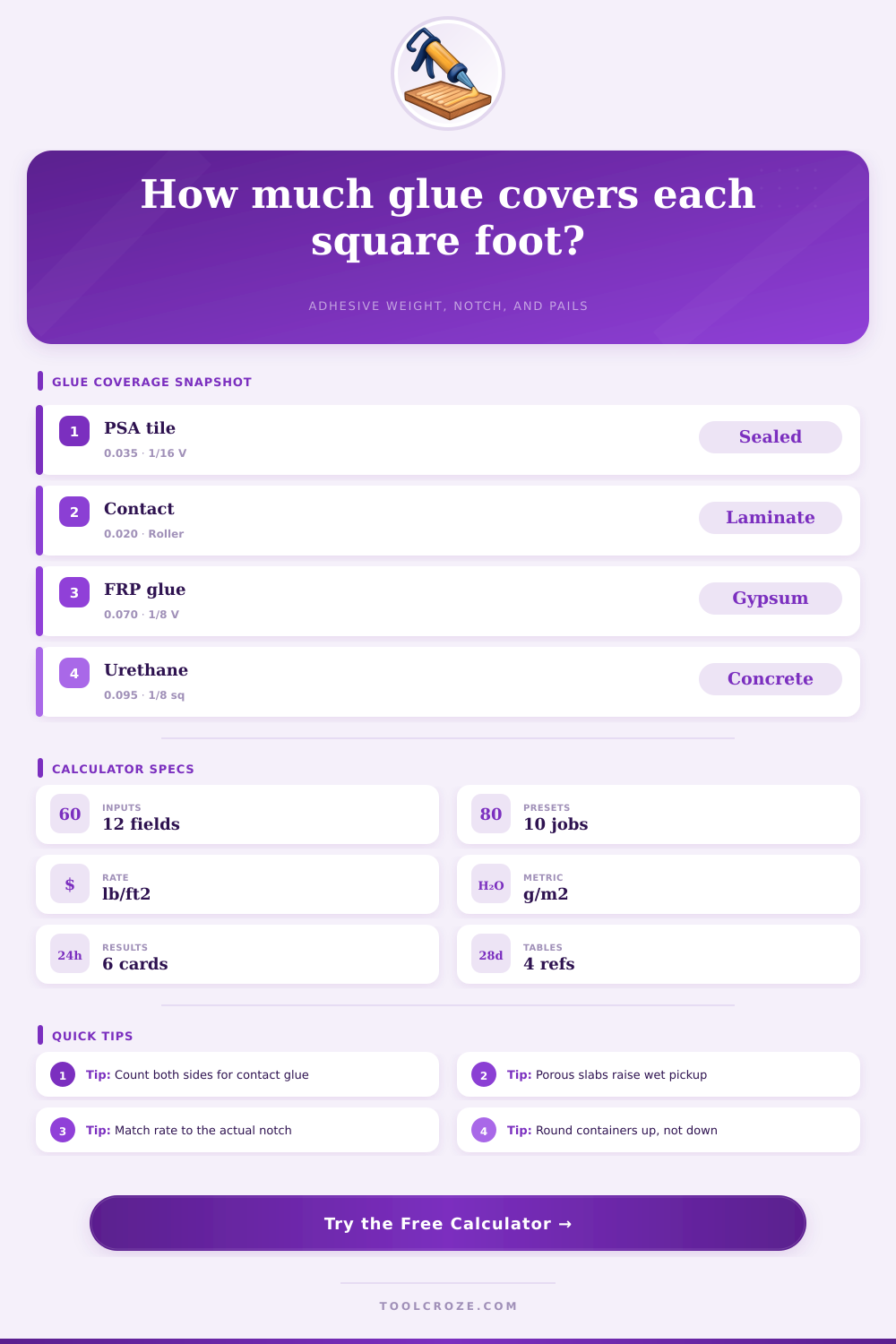
Glue Coverage Per Square Foot Calculator
Estimate wet adhesive weight, dry solids, lb per square foot, g per square meter, trowel/notch demand, coated sides, waste, and container yield for shop and jobsite glue applications.
Load a starting point for common adhesive spreads. Then adjust the actual product rate, trowel, substrate, and container size to match the label.
| Adhesive type | Typical wet rate | Solids range | Common application |
|---|---|---|---|
| Pressure sensitive flooring adhesive | 0.025 to 0.045 lb/ft² | 45% to 65% | Vinyl tile, plank, sheet goods |
| Carpet tile tackifier | 0.018 to 0.035 lb/ft² | 35% to 55% | Release-bond carpet tile |
| Contact cement, each coated side | 0.015 to 0.030 lb/ft² | 20% to 35% | Laminate, rubber, trim |
| FRP or wall panel adhesive | 0.055 to 0.085 lb/ft² | 55% to 75% | Fiberglass panels, wall board |
| Urethane flooring adhesive | 0.070 to 0.120 lb/ft² | 85% to 100% | Rubber, resilient, wood products |
| Tile mastic or premix adhesive | 0.080 to 0.150 lb/ft² | 65% to 80% | Small tile, backsplash, panels |
| Spray trim adhesive | 0.006 to 0.018 lb/ft² | 15% to 35% | Fabric, foam, temporary bonding |
| Epoxy bond coat | 0.060 to 0.110 lb/ft² | 95% to 100% | Metal, concrete, repair overlays |
| Applicator | Calculator factor | Approximate film behavior | Best fit |
|---|---|---|---|
| Smooth roller or flat coat | 0.60x | Thin continuous film | Tackifier, primer-like adhesive |
| Fine spray coat | 0.85x | Light open film | Fabric, foam, trim work |
| 1/32 in V-notch | 0.95x | Fine ridges | Thin resilient goods |
| 1/16 in V-notch | 1.10x | Moderate ridges | Vinyl, carpet tile, light panels |
| 1/16 in square notch | 1.25x | More adhesive left standing | Panel and sheet adhesives |
| 1/8 in V-notch | 1.55x | Heavy ridged bed | Wall panels, resilient flooring |
| 1/8 in square notch | 1.85x | High wet pickup | Urethane and rough backings |
| 3/16 in V-notch | 2.35x | Very heavy bed | Uneven or textured backings |
| 1/4 in square notch | 3.05x | Maximum bed in this calculator | Heavy mastic and setting beds |
| Substrate condition | Factor | Why it changes coverage | Practical check |
|---|---|---|---|
| Nonporous metal, plastic, laminate | 0.92x | Little absorption | Watch for squeeze-out or slip |
| Sealed concrete or primed surface | 0.98x | Near label conditions | Use label spread as the baseline |
| Gypsum board, FRP back, smooth panel | 1.05x | Slight face texture | Keep full transfer at corners |
| Plywood or OSB | 1.12x | Wood grain and joints drink adhesive | Vacuum dust before spreading |
| Porous concrete or cement board | 1.22x | Open surface pulls moisture or resin | Prime if product data allows it |
| Fabric, foam, or open backing | 1.32x | Open fibers trap adhesive | Test a small sample first |
| Container reference | Approximate net weight | Use in calculator | Notes |
|---|---|---|---|
| 1 gallon pail | 8.5 to 10 lb | Enter 9 lb if no net weight is listed | Density varies by adhesive chemistry |
| 2 gallon pail | 17 to 20 lb | Enter 18 lb as a planning placeholder | Common for small flooring jobs |
| 3.5 gallon pail | 30 to 35 lb | Enter the label net weight | Frequent resilient flooring size |
| 4 gallon pail | 34 to 40 lb | Works for many panel adhesives | Use label yield for final staging |
| 5 gallon pail | 43 to 50 lb | Good for large-area estimates | Heavy materials may exceed 50 lb |
| 10 kg pail | 22 lb | Metric mode: enter 10 kg | Useful for imported adhesives |
| 20 kg pail | 44.1 lb | Metric mode: enter 20 kg | Common commercial pack size |
When you are planning to use adhesives, you must consider the amounts of adhesive you will need for your project. A person may look at the square footages of a label to determine how much adhesive they will need to purchase. However, the amount of adhesive that will actualy be applying to the work surface will be different than the amounts of adhesive that is listed on the product label.
For these reasons, people either encounter shortage of the adhesive products or they experience overruns of those adhesive products. The amount of adhesive that is used in a particular job is influenced by the adhesive product that is used, the tool used to apply the adhesive to the work surface, and the surfaces that the adhesive is applied to. For instance, the type of adhesive that is used for vinyl tile products are different from the type of adhesive that is used on rubber floors.
How Much Adhesive Do You Need?
Furthermore, the size of the notch in a trowel will impact the amounts of adhesive that is applied to a work surface. Adhesive tends to soak into the pore of a porous work surface, so adhesive will be in greater amount required for a porous work surface than for a sealed work surface. Finally, if the work that is to be performed involves placing objects onto two sides of a work surface, then twice as much adhesive will be required to adhere to those two surfaces as will be required if only one side is to be coating with the adhesive.
In addition to the factors related to the adhesive and the work surfaces, factors related to the adhesive itself can impact the amount of adhesive that should be purchased for a project. The wet weight of the adhesive is the weight of the adhesive when the adhesive is first applied. Efficiency of the workers may cause some of the adhesive to remain in the bucket or on the rollers.
Some of the adhesive may be wasted in applying it to the work surfaces; that waste is accounted for in a waste allowance for the adhesive. The solids percentage of the adhesive is the percentage of the weight of the adhesive that will remain after the water or solvent used in the adhesive evaporate. The calculator will calculate the total amount of wet weight of the adhesive that will be needed for a project, as is the number of full containers of adhesive of the size specified should be prepare for the project.
The type of substrate upon which the adhesive is to be applied is another factor that can influence the amount of adhesive that is used. The amount of adhesive that adheres to a plywood floor with open grain is different from the amount of adhesive that adheres to a sealed concrete floors. However, many crews may apply the same amount of adhesive to both type of flooring.
If there is not enough adhesive placed on the porous flooring, the corners and the joints will not become adhered to the flooring. The calculator allows for a crew to select the type of backing for the work surface to which the adhesive will be applied, and the amount of adhesive that will be required will be adjusted according to that substrate. Furthermore, reference tables shows the amount of adhesive that is used with different types of adhesives, which allows for a crew to determine if the amount of adhesive that is being spread is normal for that type of adhesive product.
The open time for the adhesive is another factor that must be consider. The open time is the length of time during which the adhesive will remain workable before it skins over. If the work area is warm, the open time for the adhesive may be shorter.
Thus, if the crew works at a slower pace than the open time for the adhesive allow, then a second installer will be required to spread the adhesive, or an adhesive with a longer open time may have to be select. The calculator will calculate the amount of square feet of work that can be performed by one installer per minute, which will allow a crew to determine if their work pace will require more than one installer. Many people make mistake in the amount of adhesive that they should purchase.
Adhesive labels show yields under specific conditions in the laboratory, but the conditions on a job site may not be the same. The number of containers of adhesive should always be rounded up to the next full container so that there is no opportunity to run out of adhesive prior to the completion of the project. The calculator will show the yield of adhesive per container and the comparison of that yield to the yield on the product label.
The purpose of the adhesive calculator is to ensure that there will be an adequate supply of adhesive to complete the project before the job is finished. Thus, once a crew understands how the notch size, substrate type, and number of sides of the work surface impacts the amount of adhesive that will adhere to that substrate, the crew can make a decision about how much adhesive to order for the project.