Wood Glue Coverage Calculator
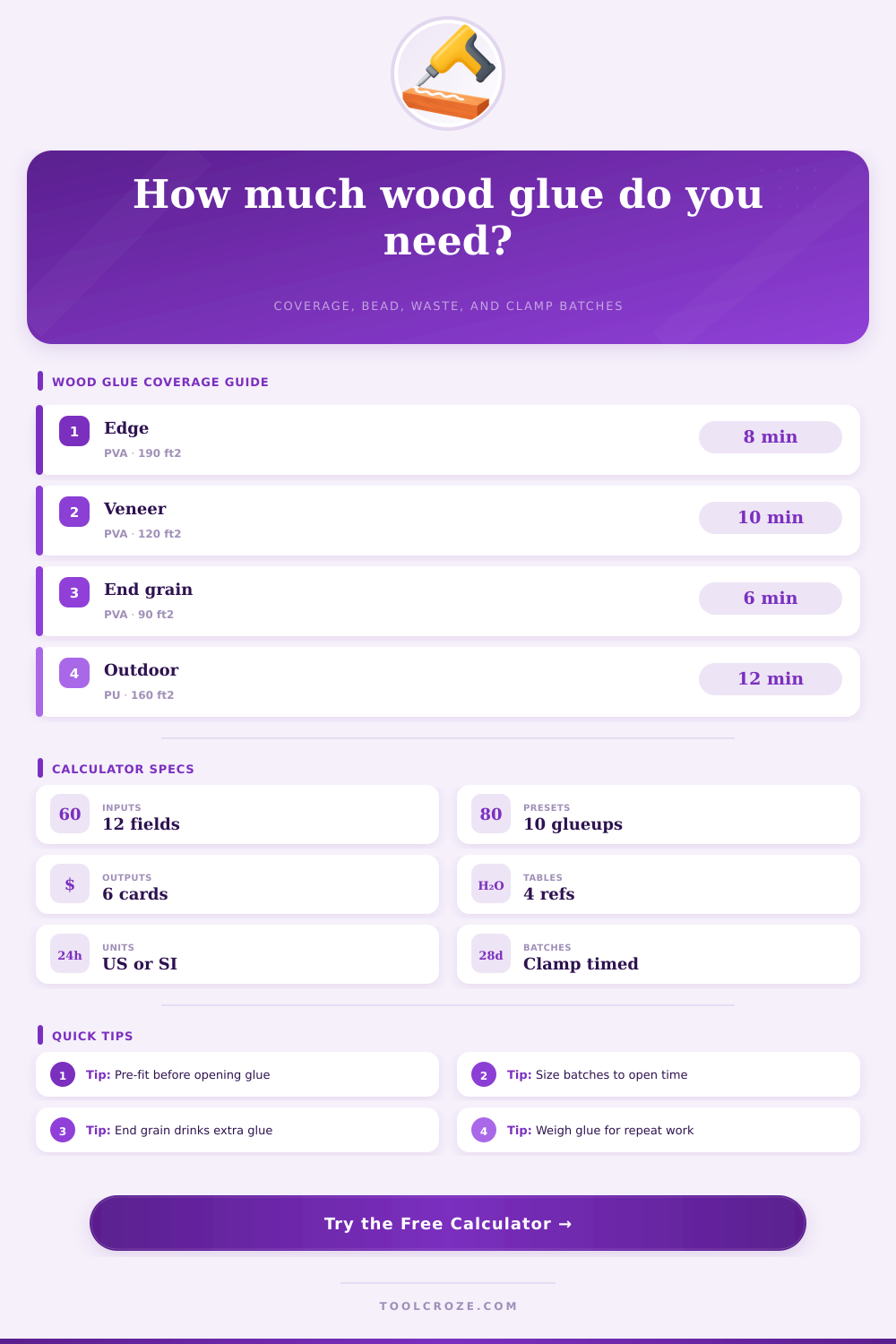
Estimate glue volume from joint area, glue type, spread rate, wood porosity, open time, bead size, waste allowance, and clamp batch size.
🛠 Woodworking Glue-Up Presets
Pick a real shop scenario, then adjust the glue, porosity, open time, bead diameter, and clamping pace for your project.
📐 Glue Coverage Inputs
Calculation Breakdown
⚙ Glue, Wood, And Spec Comparison Grid
📊 Glue Type Reference
| Glue type | Typical spread | Open time | Best use |
|---|
🪵 Wood Porosity And Joint Factors
| Surface | Coverage factor | Typical glue-up | Practical note |
|---|
📏 Bead And Film Reference
| Applicator | Bead size | Approx coverage | Use case |
|---|
🗜 Clamp Batch Planning Reference
| Glue-up | Batch target | Clamp pressure cue | Timing cue |
|---|
💡 Shop Tips
Applying an correct amount of glue to a project is necessary because the amounts of glue that is applied to the joint will determine if that joint remains together or if that joint fails. If there is too little glue applied to the joint, the glue will starve because the wood will absorb the glue before it sets. If there is too much glue applied to the joint, there will be extra time required to clean up the glue that squeeze out of the joint.
The amount of glue that will be required for a project can depend upon the types of wood to be glued, the type of joint to be made, the open time of the glue, and the working pace of the woodworker. Wood can present challenge in that different species of wood absorb glue differently. Some species of wood will allow the wood’s cellular structure to absorb the glue, while other species of wood will cause the glue to remain at the glue line where the two pieces of wood meets.
How to Work Out the Right Amount of Wood Glue
The porosity of the wood can therefore be a determining factor in the amount of glue that should be applied to the joint. Additionally, wood will absorb glue when it is applied, and the glue will skin over when it is no longer being applied to the wood. Thus, the time that remains before the glue skin over can factor into the equation of how much glue to use; whether one heavy coat is better than two lighter coats, for instance, can be considered.
The calculator accounts for each of these factors to determine the volume of glue that will be necessary for the project. One factor that can impact the amount of time that glue remains usable is the open time of the glue. Open time can change with the environment.
For instance, if the glue has a twelve-minute open time when the environment is cool, that open time could be less if the environment is warmer. These time factor will be input into the glue calculator, as the usable open time can depend upon the temperature of the wood that will be glued and the size of the portions of wood to be glued. Additionally, the usable open time will also depend upon whether the woodworker applies the glue to one face of the wood or to two face of the wood.
Another factor that will influence the amount of glue needed for a project is the size of the batch. For example, if a given batch of glue is spread over a large area, the glue may skin over before the clamp is placed upon the joint. The calculator will ask the woodworker how much area can be spread, assembled, and clamped within a single cycle in order to calculate the batch size of glue required to complete the project.
The batch size will help to determine how many separate application of glue will be required for the project, as well as to ensure that the clamp can keep up with the pace at which the woodworker works. For example, if the open time of the glue is twelve minutes, and if it takes the woodworker fifteen minutes to complete a batch of glue work, another factor to consider will be whether a slower setting of glue should be used or whether the work will need to be broken into separate step. Another factor that will influence the amount of glue that is needed for a project is the allowance for waste.
Glue will be lost when the woodworker spreads glue with a roller, glue will be lost through drips of glue that land on the workbench, and glue will be lost to the end grain of the wood. Thus, an allowance for glue waste should be made. However, considering that the percentage of glue that will be lost is a more accurate factor than the amount of glue that will be lost, the calculator will use the percentage instead of the amount.
Additionally, if no allowance for waste is made, the woodworker may find themselves out of glue before the project is complete. Bead size is another factor to consider when glue is applied from a bottle. If narrow bead of glue are applied to the project, it is possible to cover more distance along the piece of wood than if heavy beads of glue of the same total volume are applied.
However, using narrow beads introduces more opportunity for error in the placement of the wood pieces. An alternative to narrow beads is to use heavy beads of glue which allow for more time to make adjustments before the woodworker clamps the wood pieces, but which require more cleanup afterwards. The diameter of the glue beads will be converted into the length of the glue beads that the woodworker will be able to spread with their total volume of glue.
This factor will help to reveal whether it is more practical to use glue from a bottle or from a roller or trowel. The reference tables included at the end of the calculator will provide context for the factors that is entered into the calculator. For instance, the reference tables will illustrate how the different types of glue have different open times at different spread rate.
Additionally, the tables can help to reveal how the porosity of the wood can change the coverage factor of the glue applied. These reference tables will prove helpful for woodworkers who are selecting between two different types of glue or who are changing the type of wood that is to be glued. Overall, the glue calculator should be used as a planning tool to prepare the woodworker for the glue-up.
For instance, knowing the total volume of glue that will be required and the number of batch of glue that the woodworker can produce within their open time will allow them to prepare the clamps, cauls, and other wooden parts of the project. By preparing these items prior to opening the bottle of glue, the woodworker will ensure that the glued joint will remain tight once the clamps are removed.