Floor Jack Capacity Calculator
Estimate the jack rating needed for a real vehicle lift by combining curb weight, load distribution, axle share, safety margin, lift height, saddle reach, slope, and side-load allowance.
Choose a realistic starting point, then adjust the numbers to match the vehicle placard, lift point, and jack label in front of you.
Full Breakdown
| Vehicle Type | Typical Curb Weight | Front Share | One-End Jack Load |
|---|---|---|---|
| Light roadster or compact hatch | 2,300–3,000 lb | 50–58% | 1,200–1,800 lb |
| Midsize sedan or wagon | 3,300–4,100 lb | 55–62% | 1,800–2,600 lb |
| Crossover or body-on-frame SUV | 4,200–5,900 lb | 52–60% | 2,200–3,600 lb |
| Half-ton pickup with cargo | 5,000–6,800 lb | 45–56% | 2,500–4,200 lb |
| Heavy-duty pickup or van | 7,000–10,000 lb | 45–58% | 3,500–6,200 lb |
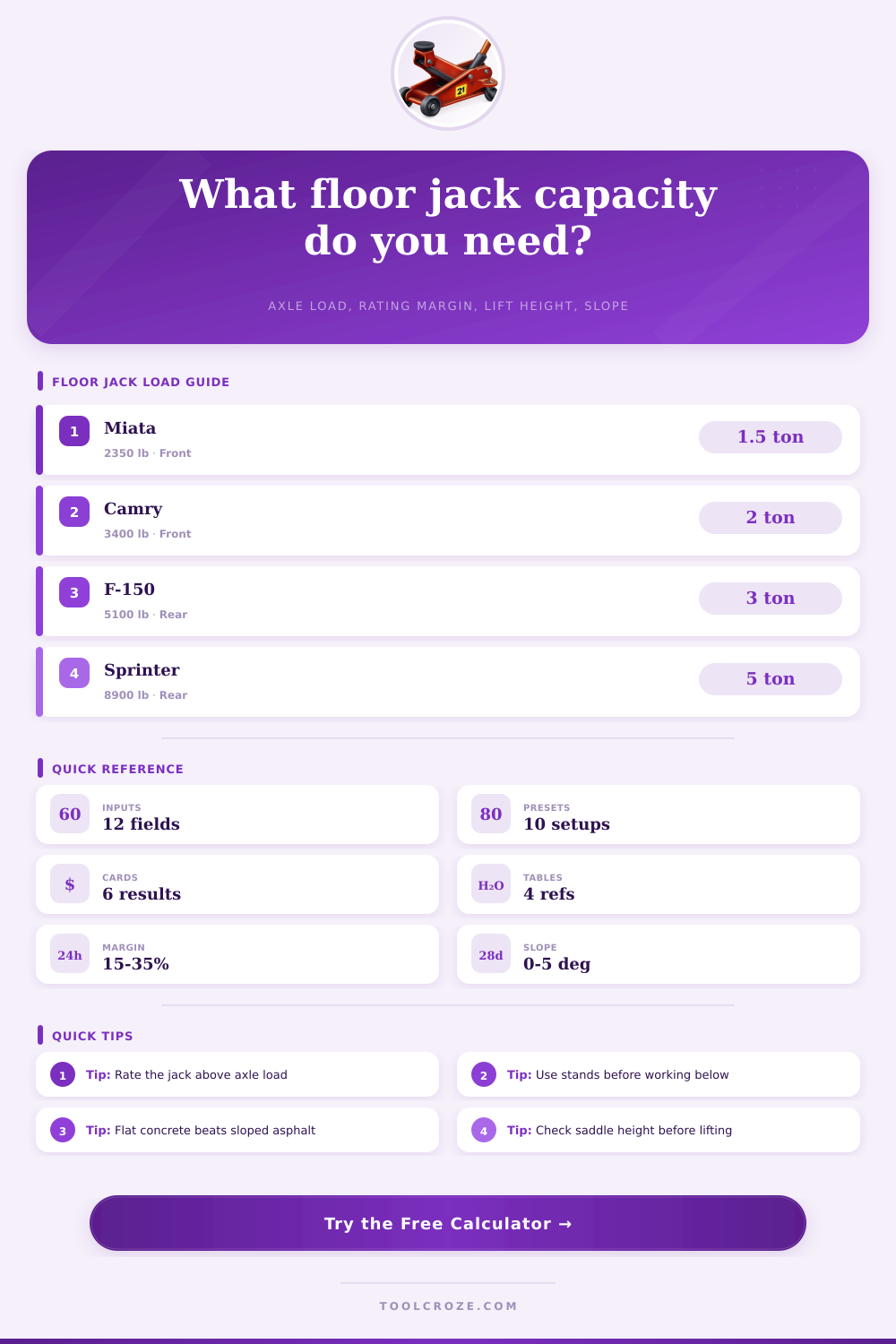
| Jack Rating | Nominal Capacity | Best Fit | Watch Point |
|---|---|---|---|
| 1.5 ton | 3,000 lb | Low compact cars, one corner | Limited height and margin |
| 2 ton | 4,000 lb | Sedans and small crossovers | Check front axle load |
| 3 ton | 6,000 lb | SUVs and half-ton trucks | May need taller saddle reach |
| 4 ton | 8,000 lb | Loaded vans and large SUVs | Confirm low-entry clearance |
| 5–6 ton | 10,000–12,000 lb | Heavy pickups and dual-rear vans | Use matching rated stands |
| Support Method | Load Path | Stability | Calculator Note |
|---|---|---|---|
| Jack stands at frame or axle points | Rated mechanical stands | High on level floor | Preferred before working below |
| Wood cribbing under tire or frame | Stacked vertical blocks | High when square and wide | Use solid, flat lumber only |
| Wheel-on ramps | Tires remain supported | High with chocks | Good for underbody access |
| Hydraulic jack only | Hydraulic seals and casters | Low for underbody work | Accept only for brief wheel removal |
| Condition | Allowance | Why It Matters | Practical Check |
|---|---|---|---|
| Flat concrete | 0–5% | Casters roll freely as the arc changes | Jack tracks straight during pump strokes |
| Textured or slightly sloped floor | 5–15% | Side force rises as the load shifts | Vehicle remains centered on saddle |
| Offset frame contact | 10–25% | Saddle reach can twist the jack arm | Pad sits flat, not on an edge |
| Outdoor asphalt or gravel | 25%+ | Wheels can sink or bind under load | Use a rated plate or move indoors |
When choosing a floor jack, you have to choose a floor jack that will support the weight that sits on a single axles. Additionally, you must also consider the weight of the vehicle that is to be lifted at a single point. Many people doesnt account for the weight of the vehicle that is to be lifted.
Additionally, many people do not account for the extra weight of the vehicle when it is raised to the floor jack. Finally, because the weight of the vehicle can shift when the floor jack is raising the vehicle, it is essential that the floor jack has a margin of safety to account for this shifting of the weight. To calculate the safe capacity for a floor jack, it is necessary to input the curb weight of the vehicle, the weight of any extra cargo that is in the vehicle, the front weight distribution of the vehicle, and the lift share of the lift.
How to Choose a Safe Floor Jack
Additionally, you also must account for the slope of the floor and the reach of the saddle of the floor jack. The rated tonnage for the floor jack do not account for the fact that the floor is rarely perfectly flat. Any side force created due to the floor being off centered and/or sloped is deducted from the tonnage to account for this potential extra force.
Additionally, height reserve is also essential to consider prior to lifting the vehicle with the floor jack. Height reserve is the lifting height that is left over after the tire of the vehicle clear the ground. The floor jack is only meant to lift the vehicle to an extent, and the remaining jacks that are used to support the vehicle must have a point of contact with the ground.
Thus, the calculator also accounts for required lift height and the maximum saddle height that the floor jack can reach. Many times, the floor jack may appear to be tall enough for lifting the vehicle, but it may not be tall enough when accounting for the floor jack adapter pad or the slope of the floor. The floor jack is only to be used to raise the vehicle on which the work will be performed.
Additionally, you should not use the floor jack to support the vehicle. Once the floor jack raises the vehicle, stands that are rated to support the weight of the vehicle must support it. Jack stands are one such means of supporting the vehicle.
Additionally, cribbing can also be used as an alternative means of supporting a vehicle on its frame. It is also essential to never leave a vehicle on a floor jack while work is being performed under the vehicle. The reference tables include the typical curb weights for different classes of vehicles, as well as the one end loads for those vehicles.
These tables are an essential means of allowing people to confirm that the vehicle that is to be lifted does not have a weight that will require additional headroom from the floor jack. For instance, the reference tables show that a midsize sedan can have a front axle weight that is over 2,000 pounds when only the front end of the vehicle is lifted. Additionally, the weight of a half-ton truck with tools in the truck bed can be even more.
Thus, this information allows people to determine if the floor jack that they will use has enough headroom to lift the vehicle to the height that is required. The slope of the floor on which the vehicle will be lifted is one of the most important factors to consider prior to lifting the vehicle. Even a small slope on a driveway can create a side force with the floor jack.
Additionally, the higher that the vehicle is raised, the greater of a side force is created. Thus, the floor jack tonnage is deducted for the slope of the floor that is to be used to raise the vehicle. The deduction of this capacity allows for a better understanding of the safe capacity of the floor jack.
If the deduction of capacity for a slope is too great, then the vehicle must be moved to a flatter surface. Finally, the results of the calculation will indicate whether or not the floor jack that you will purchase is able to safely lift the vehicle. If the capacity that is required to lift the vehicle is less than the adjusted rating of the floor jack, and if the height reserve allows for proper support of the vehicle on jack stands, then the floorjack is within the parameters that should be purchased.
However, if the capacity that is required is close to the adjusted rating for the floor jack, or if there is not enough height reserve for proper support of the vehicle on jack stands, then it will be necessary to purchase a floor jack with a higher rating, remove some of the weight of the cargo of the vehicle, or move the vehicle to a flatter work surface. Thus, buying a floor jack with a large enough reserve is essential for avoiding problems when lifting the vehicle.