Winch Capacity Calculator
Estimate required line pull, rated winch size, rope margin, snatch block benefit, and loaded layer derating for vehicle recovery, ramp pulling, dragging, and controlled hoisting checks.
① Choose a real winching scenario
Each preset loads a realistic mix of weight, slope, resistance, stuck factor, rigging, rope rating, and safety margin. Adjust any field for your exact recovery or lift.
② Enter load, terrain, rigging, and rating details
③ Capacity result cards and full breakdown
Calculated load pull
0 lb
terrain, slope, and stuck factorTarget rated capacity
0 lb
after selected safety factorAvailable winch pull
0 lb
layer and rigging adjustedSingle rope line load
0 lb
load per loaded winch lineRope MBS margin
0.0x
Capacity verdict
Check
winch, rope, and safety target④ Recovery factor quick grid
3-8%
Hard tire rolling resistance on pavement, slab, or packed shop floor
12-25%
Grass, gravel, shallow sand, loose trail surface, or trailer bunk friction
1.5-2.5x
Breakaway stuck factor for tires buried in mud, wet clay, snow, or sand
55-85%
Typical available pull on upper drum layers before rigging advantage
⑤ Winch, rope, and application reference tables
Recovery and pulling preset assumptions
| Scenario | Typical loaded weight | Terrain input | Stuck factor | Rigging note |
|---|---|---|---|---|
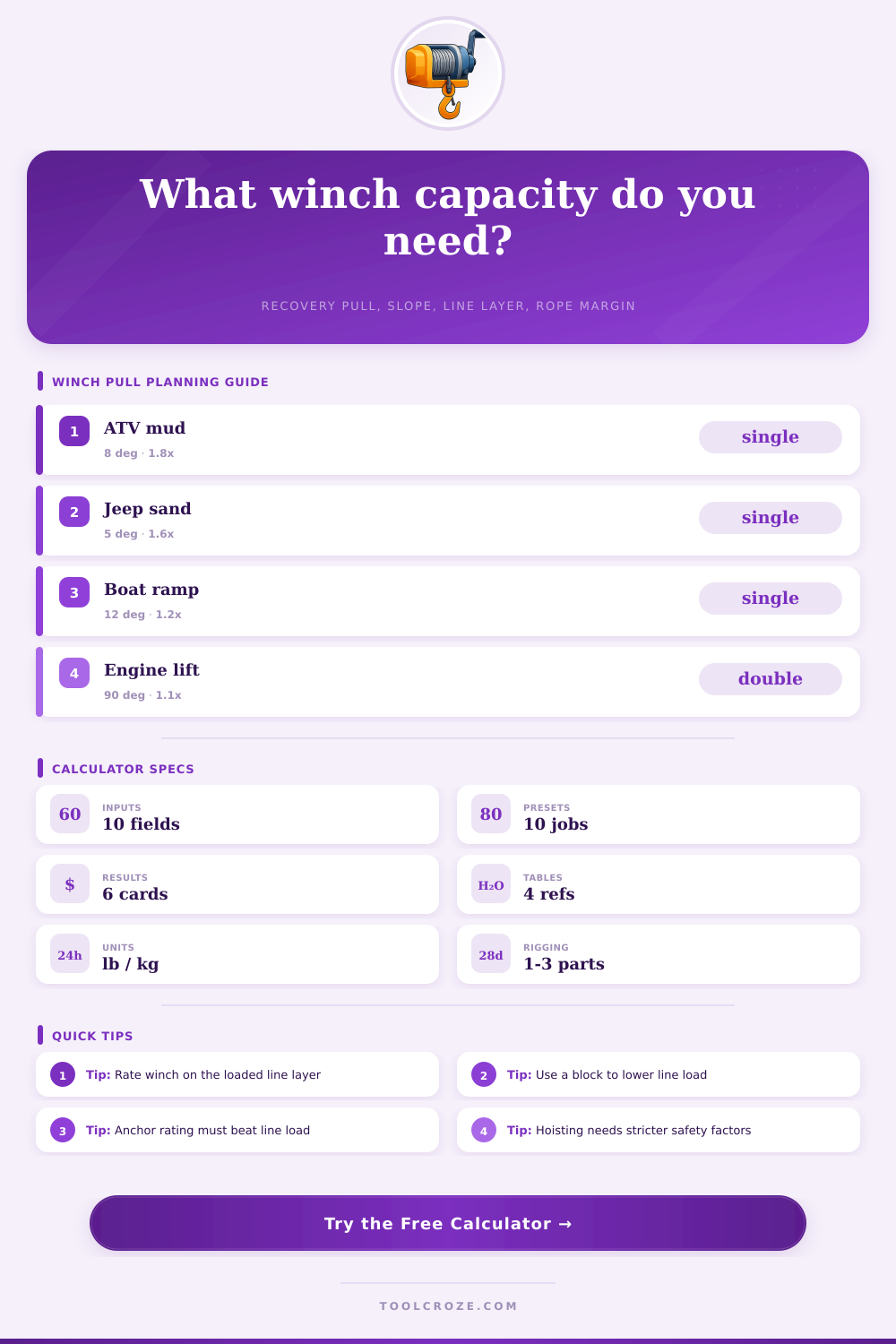
| ATV axle-deep mud | 700 to 1,000 lb | 22% rolling, 8 degrees | 1.8x | Small winch, short pulls, use a tree saver and damper. |
| UTV wet pasture incline | 1,500 to 2,200 lb | 18% rolling, 10 degrees | 1.4x | Double line if traction is poor or the anchor angle is awkward. |
| Jeep buried in beach sand | 4,800 to 5,800 lb | 24% rolling, 5 degrees | 1.6x | Shovel and boards can lower the stuck factor before winching. |
| Overland truck clay rut | 6,500 to 8,500 lb | 30% rolling, 7 degrees | 2.0x | Expect heavy line load; keep bystanders outside the recoil path. |
| Boat trailer ramp pull | 2,500 to 6,000 lb | 10% rolling, 10 to 15 degrees | 1.1x to 1.3x | Check bow eye, strap, bunk friction, and trailer geometry. |
| Engine hoist double-line | 400 to 1,000 lb | 0% rolling, 90 degrees | 1.05x to 1.2x | Use lifting-rated hardware and a much higher safety factor. |
Rolling, sliding, and slope planning values
| Surface or load condition | Resistance range | Slope effect | Use when |
|---|---|---|---|
| Pneumatic tires on pavement | 3% to 6% | Weight x sine of slope | Rolling vehicle, good tires, firm surface, little breakaway load. |
| Trailer up wet ramp | 8% to 15% | Ramp angle often dominates | Boat, utility trailer, dolly, or cart being pulled upward. |
| Gravel, grass, or shallow rut | 12% to 22% | Add slope to rolling term | Tires still roll but ground gives way or drags against the tire. |
| Sand, snow, sticky clay | 20% to 45% | Slope plus high breakaway | Vehicle plows material or tires are partially buried. |
| Skidding log or dragged equipment | 35% to 70% | Slope and sliding friction combine | Load does not roll or has digging edges on soil or gravel. |
| Vertical hoist check | 0% to 5% | Nearly full load weight | Load is suspended; rigging must be lifting-rated. |
Winch layer derating and rigging effect
| Line on drum | Typical pull available | What it means | Planning action |
|---|---|---|---|
| Layer 1 | 100% of rating | Closest to drum, strongest mechanical advantage. | Spool out enough rope to work from the first or second layer when practical. |
| Layer 2 | About 85% | Common working layer after a short line pull. | Useful for moderate recovery if anchor distance is limited. |
| Layer 3 | About 75% | Pull drops as drum radius increases. | Consider a snatch block if calculated pull is close to rating. |
| Layer 4 | About 65% | Upper wraps can surprise users with lower pull. | Reduce wraps, improve traction, or double-line before loading heavily. |
| Layer 5 | About 55% | Short pulls on a full drum are least efficient. | Avoid relying on full nameplate pull from this layer. |
Winch, rope, and application comparison grid
| Application | Common winch class | Rope or cable check | Safety factor target | Practical capacity note |
|---|---|---|---|---|
| ATV or small UTV recovery | 2,500 to 4,500 lb | MBS commonly 2x to 4x winch rating | 1.25x to 1.5x | Anchor quality and fairlead angle often decide the real margin. |
| Full-size vehicle recovery | 9,000 to 12,500 lb | Inspect synthetic rope for heat, abrasion, and flattened sections | 1.5x to 2x | Upper layers and stuck suction can erase nameplate capacity quickly. |
| Heavy overland or work truck | 12,000 to 18,000 lb | Use compatible shackles, rings, hooks, and extensions | 2x to 3x | Double-line rigging may be normal rather than exceptional. |
| Boat, trailer, or ramp loading | 1,500 to 8,000 lb | Compare strap, rope, bow eye, and hook ratings | 1.5x to 2x | Wet bunks, ramp angle, and poor alignment raise load sharply. |
| Skidding logs or dragging equipment | 8,000 to 15,000 lb | Abrasion protection is as important as raw MBS | 2x to 3x | Sliding resistance can exceed rolling recovery values. |
| Hoisting-style lift check | Only lifting-rated equipment | Use WLL-rated lifting components, not recovery-only parts | 5x or per rule | Many vehicle recovery winches are not approved for overhead lifting. |
⑥ Practical rigging notes
A winch calculator help a person determine the amount of force that a winch can provide and the amount of force that a load require. A winch calculator is helpful because winches does not always provide the force necessary to move a vehicle by the winch’s full rated force, and the force that is required from a load isnt just the weight of the vehicle that must be moved. Many factor can influence the force that a winch must exert to succesfully move a load, such as the slope of the ground, the rolling resistance of the ground, and the stuck factor of the vehicle.
These factors can all influence the amount of force required from a winch to successfully move a vehicle. Consequently, a winch calculator can help a person determine the force that a winch must exert to succesfully move a load. The slope of the ground that a vehicle is on is one of the factor to consider with a winch calculator.
How to Use a Winch Calculator
If the ground on which a vehicle is sitting is sloped, the winch will have to exert additional force to overcome the force of gravity. The steeper the slope of the ground, the more force that the winch must exert to move the vehicle. The rolling resistance of the ground is another of the factors to consider with a winch calculator.
Rolling resistance is a force that resist the movement of the tires of a vehicle; the rolling resistance will be high if the ground is soft clay or mud, for instance, but will be low on pavement. Thus, rolling resistance is a factor that will change the amount of force that the winch must exert. Finally, the stuck factor of the vehicle is another of the factors to consider.
The stuck factor accounts for the suction or friction that helps to hold a vehicle in place before it start to move. This factor must be accounted for in the calculations that a winch calculator can perform. The line layer is another factor to consider.
Winches are typically rated for the force that they can provide on the first layer of the line, but it is common for the line to be on the third or fourth layer of the line. As the number of layers in the line increase, the radius of the winch drum increases, which decreases the force that the winch can exert. Winch calculators account for line layer automatically, so the person doesnt have to be calculate by the person.
Snatch blocks can be used to increase the mechanical advantage in relation to the winch and the number of lines that pull on the load. The use of snatch blocks, however, will also introduce friction into the system. Thus, winch calculators that include the line layers will allow a person to determine the effect of mechanical advantage on the system without forming incorrect assumptions about the winch rating of the winch.
Rope margin and the safety factor are two more considerations in the winch calculator. The rope margin and safety factor determine if the rope will break during the movement of the load. The manufacturer can determine the minimum strength of a synthetic line, and a winch calculator compares the force that is calculated with this minimum strength.
The ratio is provided to the user, and this indicate to the user if the rope is strong enough to handle the load. In addition to the rope margin, the safety factor can also be considered. For instance, a safety factor can provide an extra level of protection from the load that may be exerted on the rope.
For hoisting applications, a higher safety factor is introduced because of the rules and risks of those applications. Consequently, a winch calculator can account for these variables so that the user can select the proper safety factor for those applications. The real world conditions may differ than those calculated by the winch calculator.
For instance, the anchor point for a load may shift when the rope becomes tight to the vehicle, the synthetic line may lose its strength if it becomes too hot from being rapid pulled by the winch, and the vehicle may be on an angle to the ground that introduce additional factors that may act upon the winch mount. Thus, there are variables in the real world that must be accounted for, although the winch calculator can reduce the uncertainty that a person may feel about the calculations of the load. If the winch calculator indicates that the force that the winch must exert will be too great to move the vehicle under existing conditions, then other options can be considered, such as digging out the tires of the vehicle or using a second vehicle to change these numbers.
A person should of use a winch calculator as a habit before beginning to recover a vehicle. A person should run the winch calculator before the line depart the winch drum. If a person improves the traction of the vehicle, for instance, the stuck factor can be adjusted in the winch calculator.
A winch calculator should be used as a signal to a person to prepare for the recovery of the vehicle, but should not be considered to be a guarantee of the success of those recovery efforts. When the available pull meet the safety factor and the rope margin is above two, the recovery setup is ready to use.