Filler Hardener Ratio Calculator
Calculate cream hardener by gram weight or bead length, then adjust for ambient temperature, filler type, repair size, spread thickness, pot life, and staged batches.
◎Repair Presets
Choose a realistic filler dosing setup, then fine tune the batch size, bead diameter, or temperature.
⚙Dosing Inputs
Full Breakdown
▣Live Material Grid
⇄Hardener / Filler / Temp Comparison
ℹPractical Dosing Notes
▦Temperature Dose Reference
| Shop temperature | Light skim dose | Normal filler dose | Fast repair dose | Expected pot life |
|---|---|---|---|---|
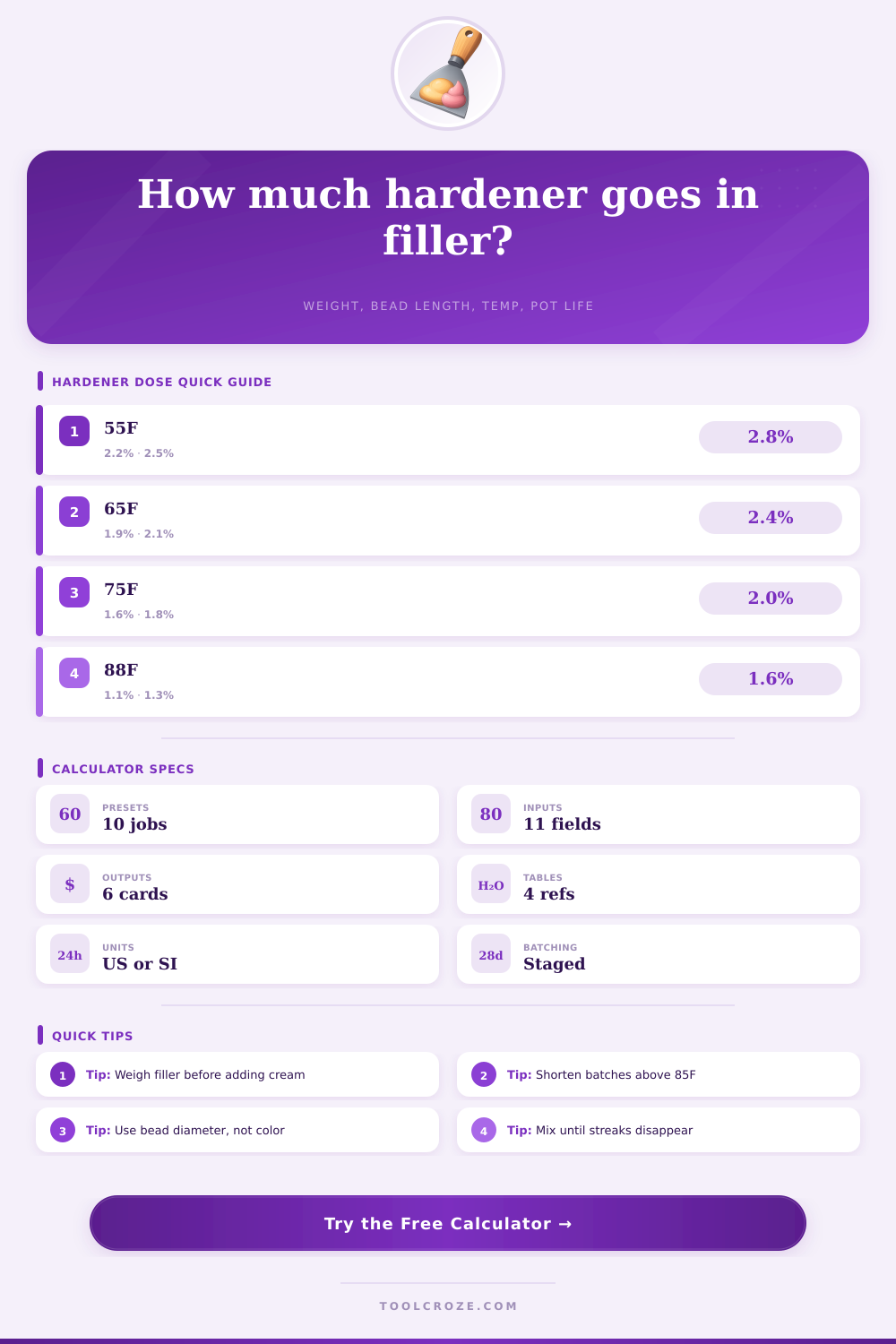
| 50-58°F / 10-14°C | 2.2% | 2.5% | 2.8% | 7-10 min |
| 59-68°F / 15-20°C | 1.9% | 2.1% | 2.4% | 5-8 min |
| 69-78°F / 21-26°C | 1.6% | 1.8% | 2.0% | 4-6 min |
| 79-88°F / 27-31°C | 1.3% | 1.5% | 1.7% | 3-5 min |
| 89-100°F / 32-38°C | 1.0% | 1.2% | 1.4% | 2-4 min |
▤Filler Type Reference
| Filler type | Typical density | Useful dose band | Best spread thickness | Batch behavior |
|---|---|---|---|---|
| Lightweight polyester filler | 1.05 g/cm³ | 1.5-2.2% | 1-3 mm | Balanced sanding |
| Premium stain-resistant filler | 1.12 g/cm³ | 1.4-2.0% | 1-3 mm | Watch over-catalyst stain |
| Polyester finishing glaze | 1.18 g/cm³ | 1.2-1.8% | 0.3-1.5 mm | Shorter open time |
| Fiberglass strand filler | 1.28 g/cm³ | 1.8-2.5% | 2-6 mm | Builds heat in thick spots |
| Metal-reinforced filler | 1.55 g/cm³ | 1.5-2.2% | 1-4 mm | Heavier board mass |
| Marine polyester fairing | 0.92 g/cm³ | 1.5-2.0% | 1-5 mm | Often staged wider |
| Polyester wood filler | 1.15 g/cm³ | 1.8-2.8% | 2-8 mm | Porous edges slow spread |
| Knife-grade polyester putty | 1.25 g/cm³ | 1.4-2.0% | 0.5-3 mm | Sets quickly in small cups |
◌Hardener Bead Conversion Table
| Bead diameter | Approx grams per cm | Approx grams per inch | 10 g hardener needs | Best use |
|---|---|---|---|---|
| 2 mm fine bead | 0.040 g | 0.102 g | About 250 cm | Tiny glaze dabs |
| 3 mm narrow bead | 0.090 g | 0.230 g | About 111 cm | Small repairs |
| 4 mm common bead | 0.161 g | 0.408 g | About 62 cm | Fine control dosing |
| 6 mm broad bead | 0.362 g | 0.919 g | About 28 cm | Larger board mixes |
| 8 mm heavy bead | 0.643 g | 1.63 g | About 16 cm | Quick estimating only |
▥Repair Size and Batch Staging Table
| Repair situation | Typical filler mass | Suggested staging | Spread thickness target | Dosing caution |
|---|---|---|---|---|
| Door ding glaze | 20-45 g | One tiny board | 0.5-1 mm | Use less catalyst in heat |
| Quarter skim | 120-250 g | Two boards if warm | 1-2 mm | Avoid dry edges |
| Fiberglass patch | 80-180 g | One or two boards | 3-5 mm | Heat rises in bulk |
| Hail dent set | 60-160 g | Separate spot mixes | 0.8-1.5 mm | Time each cluster |
| Deep low spot | 180-400 g | Multiple thin coats | 2-4 mm each | Do not over-harden |
Getting the hardener ratios correct in body filler involves ensuring that the ratio of body filler to hardener will allow the body filler to properly set. Using too little hardener will cause the body filler to remain soft and not properley harden. Using too much hardener will cause the body filler to cure more quickly, which can cause the body filler to contain heat that may crack or stain the vehicle surface.
The two components must be balanced with each other in order for the body filler to perform proper. Temperature is one of the variable to consider with body filler. A shop that is seventy degrees may allow the body filler to remain workable for a longer period of time then a shop that is eighty-five degrees.
How to Mix Body Filler and Hardener
Because higher temperatures cause body filler to cure at a faster rate, mechanics will have to use more hardener in shops with higher temperatures. A calculator can help mechanics to enter the temperature of the shop where the body work will be performed, and then will provide information regarding how the dose of hardener should be changed with the change in temperature of the shop. The type of body filler that is used also will have an effect upon the ratio of hardener that should be used.
For instance, lightweight polyester body filler behaves differently than body filler that contains fiberglass strands, or from marine specific body filler. Body fillers that are more denser require more of the product to cover an area of the vehicle that needs to be repaired, and dense body fillers may produce more heat during the repairing process. Additionally, dense body fillers hold more mass on the mixing board than lighter body fillers.
Thus, adjustment must be made with the type of body filler to ensure it doesnt set before the mechanic is finished applying the body filler to the vehicle. The size of the repair that will be performed, and how large of batches of body filler are to be prepared also have an effect upon the mixing of the hardener. Small repair can be mixed in batch amounts in a single batch of body filler.
However, with larger repairs, it is necessary to split the body filler into different batch so that the body filler does not cure in one batch before the second batch is completed. Body filler batch calculators allow mechanics to enter the size of the repair that will be performed, and will provide information as to how the body filler should be divide into different batches. By dividing the body filler into batches of a set size, mechanics can avoid running out of time and body filler to perform the repair.
One of the most important measurements is that of bead length. Cream hardener tube will dispense different amounts of hardener if the diameter of the bead of hardener is changed. A thin bead will contain less weight of hardener than a thick bead.
Thus, mechanics should weigh a test bead of hardener of the same diameter as the other body filler that will be used in the repair. By using the same diameter of bead that will be used for mixing the body filler, the batch calculator will provide an accurate measurement for the amount of hardener that should be used. Additionally, the batch calculator will provide several different outputs.
The weight of the hardener that should be used, the length of the bead that should be used, the amount of time that the body filler will remain workable, the number of batches of body filler that should be mixed, and the amount of body filler to be used in each batch of body filler will be provide by the calculator. All of the information provided by the calculator should be read to complete the repair proper. Many individuals make mistakes when using body filler with hardener.
They often treat the percentage of hardener to use as a fixed number. However, the percentage of hardener that is used to mix with the body filler should not be a fixed number. For instance, a two percent ratio of hardener to body filler may work at the body fillers recommended temperature of 70 degrees F, but the same percentage of hardener will cause the body filler to over-catalyze in temperatures above 70 degrees F. Additionally, the same two percent ratio will cause the body filler to under-catalyze if temperatures are lower than 70 degrees F. Furthermore, body filler percentages should also provide for waste of the body filler; some of the body filler will inevitably be left on the spreader and mixing board.
Providing for waste of the body filler will ensure that there is enough body filler to perform the repair. Overall, using the batch and hardener calculator will allow technicians to ensure that all of their repairs are the same with each repair. After technicians become familiar with the way that body filler reacts to different temperatures and to different batch size, the technicians will have more consistency with the work that they produce.
The less time spent sanding repairs and fixing cracks in body filler, the more efficiently the body repair technician can be. Thus, consistency in the ratio of hardener to body filler will ensure that all body repairs hold, and do not fail.