Primer Coverage Calculator
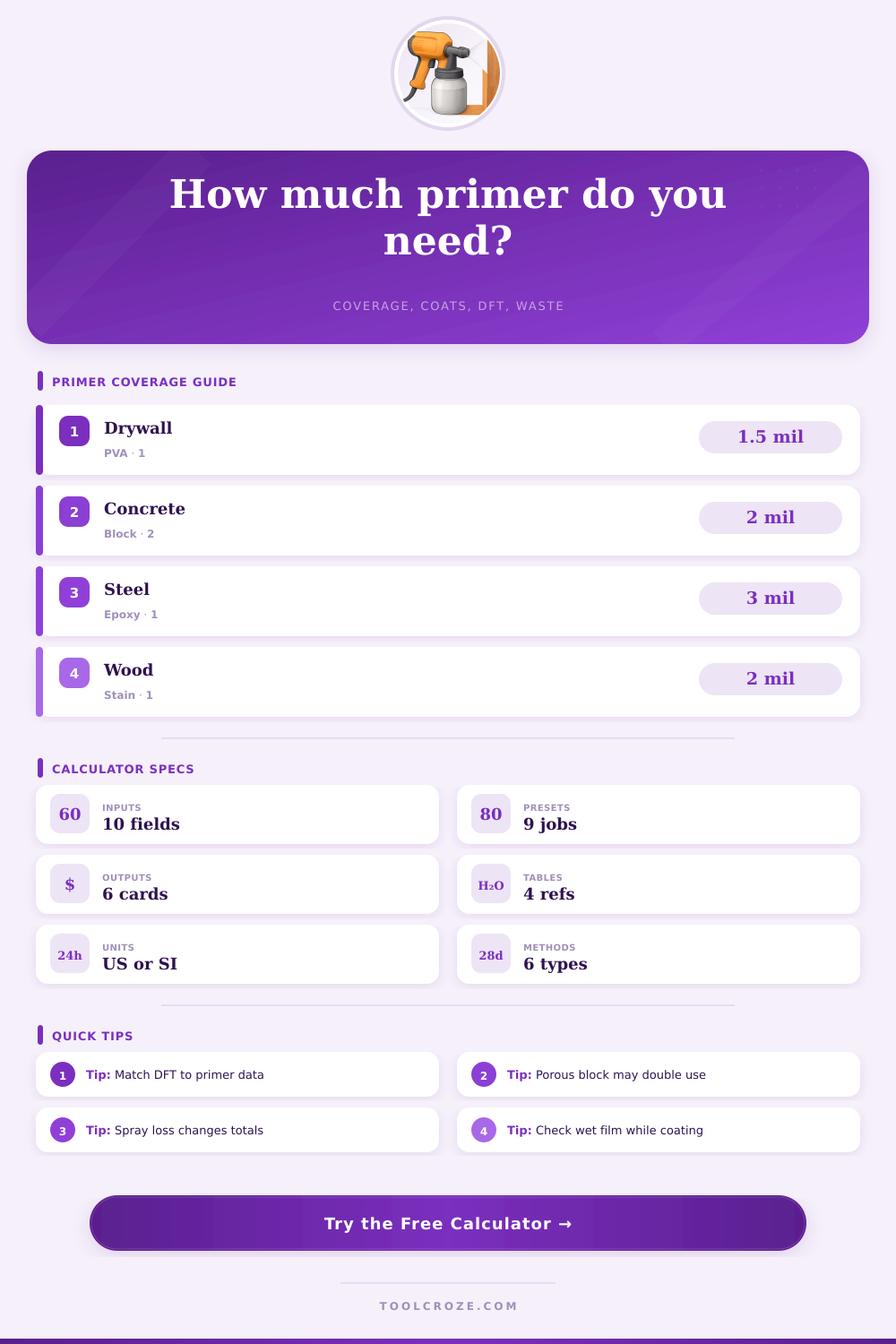
Estimate primer volume from area, coats, porosity, primer solids, target dry film thickness, application transfer efficiency, and planned waste allowance.
▣ Job Presets
Load a real painting scenario, then adjust any field to match the coating data sheet or project specification.
▤ Primer Inputs
Calculation Breakdown
▥ Job Summary Grid
▦ Primer Reference Tables
| Primer Type | Common Substrate | Typical Solids | DFT Per Coat | Coverage Note |
|---|---|---|---|---|
| PVA drywall primer | New gypsum board | 30-38% | 1.0-1.8 mil | Uniform suction over joint compound |
| Acrylic multipurpose | Drywall, plaster, wood | 34-42% | 1.2-2.0 mil | Balanced holdout on mixed surfaces |
| Alkyd wood primer | Trim, doors, raw lumber | 42-55% | 1.5-2.5 mil | Good enamel base and tannin control |
| Shellac stain blocker | Smoke, knots, water marks | 28-36% | 1.0-1.8 mil | Thin film but strong stain isolation |
| High-build epoxy | Steel, concrete, fiberglass | 55-72% | 2.5-5.0 mil | Higher build with lower theoretical spread |
| Block filler | CMU and open masonry | 45-62% | 4.0-8.0 mil | Absorption can dominate total volume |
| Substrate | Porosity Multiplier | Prep Signal | Primer Fit |
|---|---|---|---|
| Smooth galvanized metal | 1.00x | Clean and scuff, no chalk | Etch or bonding primer |
| Paint-grade MDF | 1.10x | Sealed faces, thirsty edges | Acrylic or shellac |
| Bare pine or cedar | 1.16x | End grain and knots visible | Alkyd or shellac spot prime |
| New drywall | 1.08x | Joint compound flashes dull | PVA or acrylic primer |
| Troweled concrete | 1.20x | Water darkens surface quickly | Acrylic masonry primer |
| Split-face block | 1.75x | Open voids and heavy texture | Block filler |
| Application Method | Typical Efficiency | Best Use | Waste Planning |
|---|---|---|---|
| Microfiber roller | 90% | Smooth drywall and ceilings | Low overspray, tray loss remains |
| Brush and roller | 88% | Occupied rooms and touch-ups | Higher edge loading on trim |
| Airless interior spray | 72% | New construction walls | Masking, hose, and overspray loss |
| Airless steel spray | 65% | Frames, tanks, shop coating | Geometry and rebound reduce capture |
| HVLP spray | 78% | Cabinets, doors, detailed parts | Cup residue and fan overlap matter |
| Conventional spray | 55% | Complex assemblies | Highest overspray allowance |
| Spec Check | Formula | Use In Calculator | Field Check |
|---|---|---|---|
| Theoretical coverage | 1604 x solids / DFT | Baseline sq ft per gallon | Compare to data sheet spread rate |
| Wet film thickness | DFT / solids fraction | Target gauge reading while wet | Comb gauge on representative surface |
| Practical coverage | Theoretical x efficiency / factors | Expected field spread per coat | Track area covered per container |
| Total volume | Area x coats / practical coverage | Primer to stage including waste | Do not exceed pot life for mixed systems |
▧ Primer / Substrate / Spec Grid
▨ Practical Coverage Notes
Estimating primer require a person to understand that primer coverage change based off the absorption of the primer by the wall’s surface. Primer coverage can be found on an product data sheet for the primer, but the amount of primer that will be used for a given project will depend on the porosity of the surface to be coated, the method at which the primer will be applied, and the amount of primer that may be wasted during the application process. The porosity of a surface will change the amount of primer that are absorbed by the wall, thus influencing the amount of primer that will be required.
Similar to porosity is the factor of film thickness, which is the thickness of the primer after the solvent have evaporated. Primer may have a certain percentage of solids by volume, which relate to the target dry film thickness of the primer. If a primer has thirty-five percent solids by volume, for instance, three times as much primer would have to be applied to achieve one mil of dry film thickness.
How to Work Out How Much Primer You Need
The application method for the primer will create losses in the primer that is applied to the job. If using rollers or brushes, some of the primer will be lost on the edges of the rollers or brushes; if using an airless sprayer, some of the primer will be lost in overspray. The primer calculator account for the efficiency with which primer can be applied to a project, thus including in its estimate the amount of primer that will be lost during primer application.
Some additional allowance for primer waste can be include in the calculation for touch-ups and missed corners. The complexity of the surface to be treated will influence the amount of primer required to properly coat the project. Complex geometries of a structure will require more primer than a simpler, flat structure.
The complexity of the project can be accounted for in the primer calculator by using a multiplier to account for the complexity of the structure to be treated. Primer reference tables can help to verify the amount of primer that will be needed for a project. The reference tables can help to confirm that the specific primer that is to be used is the same than that which is represented in the primer calculator; the tables include the solids by volume and the target dry film thickness of various types of primers.
If the brand of primer that is to be purchased has a different solids by volume than the default settings of the calculator, youll have to adjust the solids by volume in the calculator to reflect the brand of primer that will be used. Each of the variables for the primer calculation can be verified prior to ordering the primer. Porosity can be tested with water drops on the structure, transfer efficiency can be tested by applying primer to drop cloths and walls, and the solids by volume and the target dry film thickness can be direct read from the primer label.
Thus, by verifying each of these variables, the estimate of the amount of primer that will be needed will be a reliable number that can be used to stage the materials required for the project.