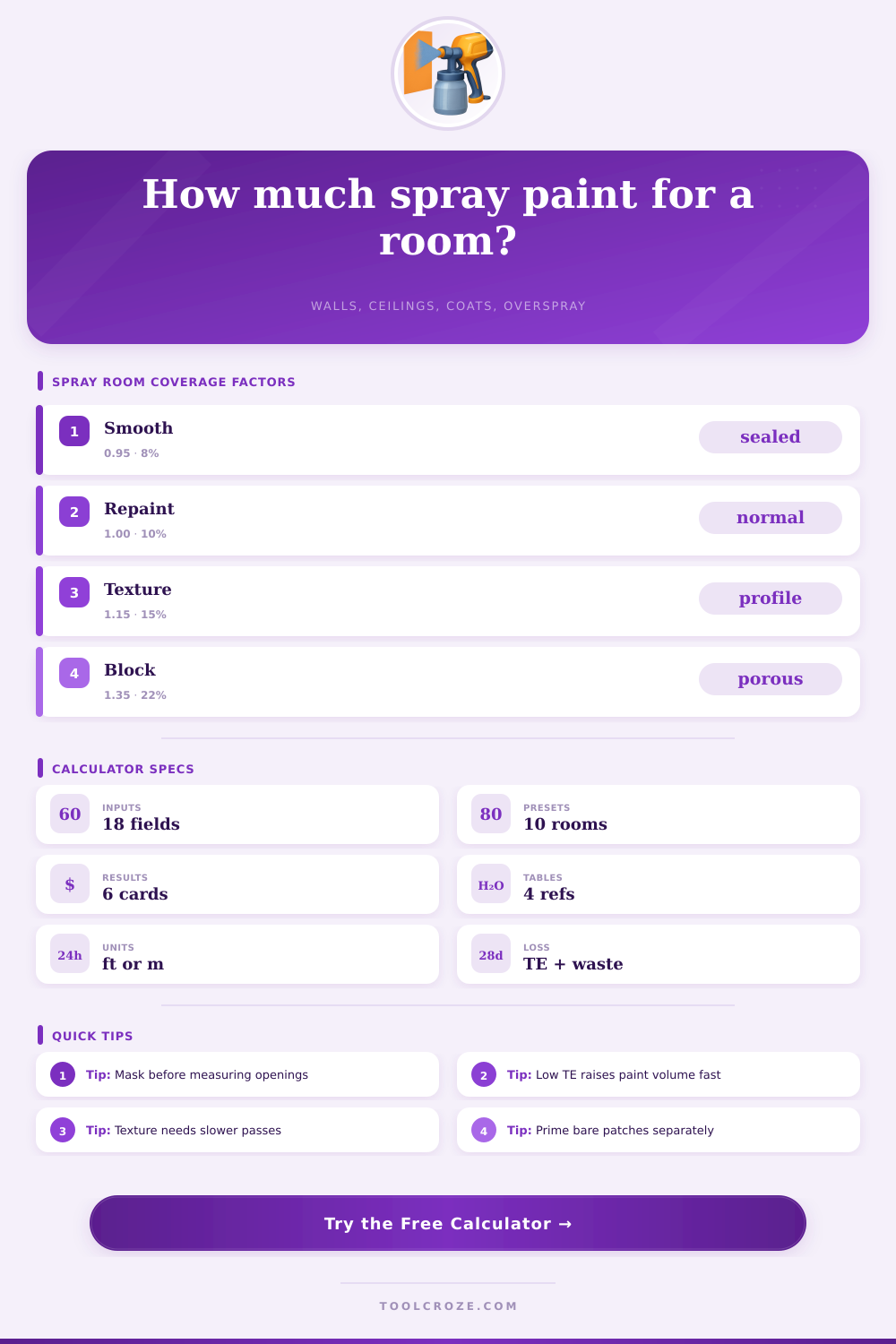
Spray Paint Room Coverage Calculator
Estimate net wall and ceiling area, subtract masked openings, then adjust for coats, surface profile, solids, transfer efficiency, and overspray waste.
▣Room Project Presets
Choose a real room scenario to load practical dimensions and spray settings, then fine-tune the fields below.
▧Room, Exclusions, and Spray Inputs
Full Coverage Breakdown
▦Coating, Surface, and Room Comparison Grid
Interior Latex on Smooth Drywall
Use the label coverage as the baseline, then allow transfer efficiency and waste to drive the extra loaded volume.
Primer on Patched Bedrooms
Primer and repair spots raise the coating factor because thirsty patches can dull the first pass.
Enamel in Trim-Heavy Rooms
Masking exclusions reduce area, but slower passes and lower transfer efficiency can still increase loaded paint.
Textured Basement Walls
Texture increases real surface area and catches overspray in the profile, so the surface factor matters.
Garage Interior Shells
Large simple walls are efficient, but porous surfaces often need more coating than the square footage suggests.
Ceiling Included Projects
Ceilings add a full floor-area rectangle and usually deserve a separate pass count in planning.
▥Reference Tables
Surface Factor Reference
| Surface | Factor | Typical Waste | Use Case |
|---|---|---|---|
| Sealed smooth drywall | 0.95x | 8-10% | Newer finished rooms |
| Repainted smooth wall | 1.00x | 10-12% | Standard bedrooms |
| Orange peel texture | 1.08x | 12-16% | Common interior texture |
| Knockdown texture | 1.18x | 15-20% | Heavy profile walls |
| Bare drywall | 1.25x | 12-18% | Primer-first projects |
| Concrete block | 1.35x | 18-25% | Porous utility rooms |
Spray Transfer Efficiency Guide
| Spray Method | Typical TE | Pattern Control | Room Fit |
|---|---|---|---|
| Aerosol cans | 35-45% | Small fan | Closets, touch-ups |
| Conventional siphon | 35-50% | Moderate | Ventilated workrooms |
| Airless sprayer | 45-60% | Wide fan | Walls and ceilings |
| HVLP turbine | 55-70% | Fine control | Trim-heavy rooms |
| Air-assisted airless | 65-80% | Controlled fan | Finish rooms |
Opening Exclusion Shortcuts
| Opening | Imperial Area | Metric Area | Planning Note |
|---|---|---|---|
| Interior door | 20 sq ft | 1.9 sq m | Common 30-36 in door |
| Large window | 18 sq ft | 1.7 sq m | Subtract glass only |
| Double closet | 40 sq ft | 3.7 sq m | Two-door opening |
| Bathroom mirror | 12 sq ft | 1.1 sq m | Enter as masked area |
| Kitchen backsplash | 22 sq ft | 2.0 sq m | Enter as masked area |
Coating Solids and Coverage
| Coating | Solids | Coverage | Spray Note |
|---|---|---|---|
| Thin stain | 18-25% | 250-350 sq ft/gal | Low build film |
| Lacquer finish | 25-35% | 300-450 sq ft/gal | Fast solvent flash |
| Interior latex | 38-48% | 300-400 sq ft/gal | Common room paint |
| Acrylic primer | 35-45% | 250-350 sq ft/gal | Porous areas vary |
| Waterborne enamel | 42-55% | 350-450 sq ft/gal | Slower finish passes |
△Practical Spray Planning Tips
Calculating the correct volume of paint prior to begin to spray a room is a necesary step in the process because calculating the correct volume of paint will prevent you from run out of paint during the project. Spray paint introduce some differences from rollers and brushes; a portion of the paint that come out of the spray gun does not make its way onto the walls. The calculator allows you to enter the dimensions of the room, the size of the openings that you will mask, and the efficiency of your spray equipment; the calculator will then make the mathematical calculations for you.
After you enter all of the parameters for your room, you can focus on the decisions regarding the amount of paint you will need to purchase. The shape of the room and the texture of the surface to be painted is two factors that will impact the amount of paint that will be required. The shape of the room and the texture of the surface will change the amount of paint that is required to cover the room.
How Much Paint You Need to Spray a Room
For instance, one gallon of paint may be sufficient for a large smooth rectangular room, but it may not be enough for an L-shaped room or a room that contains textured drywall. Additionally, different materials will absorb the paint at a different rate; the paint that spreads onto drywall will not travel as rapid to areas of bare block or bare drywall. Thus, the calculator does not create the surface area for the room, but it does factor in the amount of paint that the material will absorb.
The efficiency of the spray gun is another variable that will impact the amount of paint that you will need to purchase for your project. High volume, low pressure sprayers often will transfer 60% of the paint from the can to the walls, but aerosol cans may only provide 40% of the paint from the can to the walls. Thus, the paint that does not reach the painting area will become overspray; the overspray may land on the floor, on the masking paper, or into the air.
You must account for the paint that leaves the can or spray gun without reaching the walls in the number of gallons of paint that you purchase. The spray gun efficiency factor and the paint waste percentage are separate variables in the paint calculator so that you can view how each of these factors impact the amount of extra paint that you will need to purchase for the job. Another factor that will impact your calculations is the number of openings in the room.
Doorknobs and windows will need to be masked prior to painting, and each masked door or window will decrease the total number of square feet that will need to be painted. If you do not take the time to measure these masked openings prior to purchasing paint, you may either not have enough paint to complete the job, or you may purchase too much paint and end up with paint leftovers. Therefore, taking the time to measure the area of each masked opening will produce a more accurate count of the number of gallons of paint that will be required.
An additional factor that will impact your calculations is the number of coats of paint that will be used. If you are changing the color of the walls from a dark color to a light color, you may find that you will require an extra coat of paint. The calculator allows you to input a multiplier for an extra coat of paint so that you dont have to calculate that number manual.
Additionally, if you plan to spray both the ceiling and the walls with the spray gun, you will need to account for that extra square footage. The reference tables located on the calculator allow you to select the type of paint sprayer that you will be using, as well as the type of paint that will be used on the surfaces. Many people are unaware that the coverage rates for the paint that is sold comes with cans does not account for all of the variables for paint coverage.
The paint coverage rate printed on the paint cans is calculated under ideal conditions for smooth surfaces. Real rooms have corners and textured paint surfaces, and painters must spend time feathering the edges of painted areas to allow the paint to reach the painted area. Thus, real rooms will require more paint than the coverage rate indicated on the paint can.
When the calculations are complete, there are three main pieces of information that the calculator will provide to you. The first will be the square footage of the room that will be sprayed, minus the area of the openings. The second will be the adjusted square footage after you have accounted for the number of coats, the texture of the surfaces, and the solids content of the paint.
The third and final piece of information will be the actual volume of paint that you will need to load into the spray gun. This actual volume is the most important figure produced by the calculator; the actual volume required of paint will prevent you from having to run to the paint store in the middle of your painting job. Finally, the paint calculator will also provide an estimate of the time that it will take to complete the job.
The time estimate will provide you with the length of time that the spray gun will be active at the output rate that you have chosen; this does not include the time it will take to mask the openings, move the furniture, or clean up after the painting job is complete. However, this time estimate will help you to decide whether one gallon of paint will last for one afternoon of painting, or whether you will have to schedule your painting job for two different time periods. Thus, the paint calculator allows you to turn your painting idea into a plan.