Impact Wrench CFM Calculator
Estimate running air demand, average compressor load, hose pressure loss, receiver buffer, and reserve margin for real impact wrench work.
Pick a service pattern, then tune the fields for your exact tool, hose, pressure, and fastener pace.
Impact Wrench Air Requirement
| Drive and Service | Typical Torque Class | Running Air Use | Best Hose | Compressor Match |
|---|---|---|---|---|
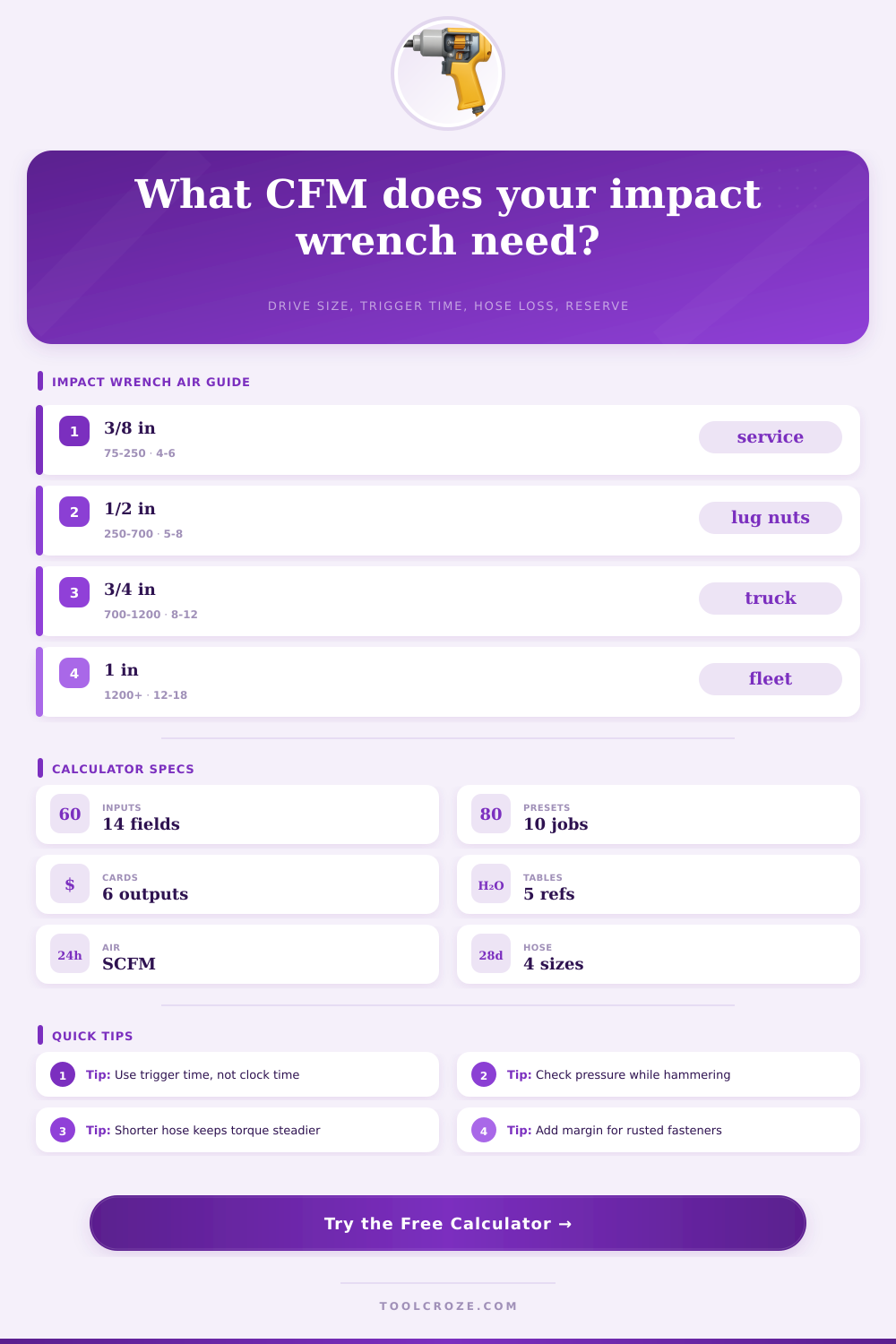
| 3/8 in compact, brake and bracket work | 75 to 250 ft-lb | 4.0 to 6.0 SCFM | 3/8 in ID, short whip | 5 to 7 SCFM delivered |
| 1/2 in mid-torque, mixed service | 250 to 450 ft-lb | 4.5 to 6.5 SCFM | 3/8 in ID, 50 ft max | 6 to 8 SCFM delivered |
| 1/2 in high-torque, lug nuts | 450 to 700 ft-lb | 6.0 to 8.5 SCFM | 3/8 or 1/2 in ID | 8 to 11 SCFM delivered |
| 3/4 in heavy service, farm and truck | 700 to 1200 ft-lb | 8.0 to 12.0 SCFM | 1/2 in ID preferred | 11 to 16 SCFM delivered |
| 1 in fleet impact, repeated truck lugs | 1200 to 1800+ ft-lb | 12.0 to 18.0 SCFM | 1/2 or 5/8 in ID | 16 to 24 SCFM delivered |
| Hose Setup | Best Use | Impact Flow Range | Pressure Drop Risk | Shop Note |
|---|---|---|---|---|
| 1/4 in ID, 25 to 50 ft | Small 3/8 in tools only | Under 5 SCFM | High above 6 SCFM | Can make a strong wrench feel weak |
| 3/8 in ID, 25 to 50 ft | Most 1/2 in service | 5 to 9 SCFM | Moderate | Common minimum for lug work |
| 1/2 in ID, 50 to 100 ft | 3/4 in and high-torque 1/2 in | 8 to 14 SCFM | Low to moderate | Good choice for longer shop runs |
| 5/8 in ID, long drops | 1 in fleet impact work | 12 to 20 SCFM | Low | Useful before a short whip hose |
| Extra couplers, swivels, filters | Any high-flow setup | All ranges | Adds restriction | Use high-flow couplers for big tools |
| Work Pattern | Trigger Seconds | Fasteners per Minute | Air Duty | CFM Planning Method |
|---|---|---|---|---|
| Occasional shop service | 2 to 4 seconds | 1 to 3 | 3% to 20% | Average CFM usually governs |
| Wheel rotation or tire bay | 2 to 5 seconds | 4 to 10 | 13% to 83% | Reserve compressor margin matters |
| Rusted suspension removal | 6 to 18 seconds | 0.5 to 2 | 5% to 60% | Use high service condition factor |
| Fleet lug nut removal | 3 to 8 seconds | 4 to 8 | 20% to 100% | Running CFM can govern sizing |
| Compressor Type | Typical Delivered SCFM | Receiver Size | Impact Wrench Fit | What to Watch |
|---|---|---|---|---|
| Portable trim compressor | 2 to 4 at 90 PSI | 1 to 6 gal | Brief 3/8 in use only | Pressure falls quickly |
| Portable wheelbarrow or twin stack | 4 to 6 at 90 PSI | 4 to 10 gal | Light 1/2 in bursts | Wait time between fasteners |
| Single-stage shop compressor | 8 to 12 at 90 PSI | 20 to 60 gal | Most 1/2 in service | Long hose and coupler loss |
| Two-stage shop compressor | 12 to 18 at 90 PSI | 60 to 80 gal | 3/4 in and tire bay work | Shared air users reduce margin |
| Fleet or industrial air system | 20+ at 90 PSI | 80+ gal | 1 in repeated lug work | Use large drops and high-flow fittings |
| Receiver Size | Useful Pressure Band | Approx Free Air Stored | Best Impact Use | Planning Note |
|---|---|---|---|---|
| 6 gallons | 120 to 90 PSI | About 1.6 SCF | Short 3/8 in bursts | Small buffer, quick recovery needed |
| 20 gallons | 120 to 90 PSI | About 5.4 SCF | Occasional 1/2 in lugs | Works better with slow fastener pace |
| 30 gallons | 120 to 90 PSI | About 8.0 SCF | General 1/2 in shop work | Good reserve for service bursts |
| 60 gallons | 120 to 90 PSI | About 16.0 SCF | High-torque 1/2 in and 3/4 in | Better for repeated lug removal |
| 80 gallons | 120 to 90 PSI | About 21.4 SCF | Fleet and big impact work | Still needs enough pump SCFM |
An impact wrench tool utilizes short bursts of air to hammer the fastener into place. The short bursts of air may require more air than a specifications provided for the tool. An impact wrench require a consistent supply of air to perform efficient.
If the air supply isnt consistent, the impact wrench will lose its torque. The impact wrench will take longer to fasten each of the fastener. Additionally, the compressor motor that charge the impact wrench will run hot due to the inability of the motor to take a break.
How Much Air Does an Impact Wrench Need
The air requirement for the impact wrench isnt just based off the CFM rating of the impact wrench. The air requirement for an impact wrench tool also depend on the length of time that the trigger is held down on the tool. The number of fastener that are fastened in a minute and the air pressure that reach the wrench through the hose will play a role in the requirement of the air for that impact wrench tool.
For instance, a 1/2 inch impact wrench require 6.5 CFM at 90 PSI. However, if the air is working with fastener that are rusted or if the air is working quick to fasten the number of required fastener, there will be a requirement for additional air to perform this task. The service condition setting on the calculator accounts for this additional air.
This setting allows the published CFM of the impact wrench to be altered to reflect the air requirement to fasten the number of fasteners that is required in a minute. The size of the hose that is used to supply the air to the impact wrench tool is an important factor in the air requirement for the tool. Air pressure will decrease as the air travels through the hose.
The longer the hose or the smaller diameter of the hose, the more the air pressure will drop. As a result, the air will feel weak to the impact wrench at the end of the hose. The calculator includes an estimate of the loss in air pressure through the hose to allow the user to determine how long or what size of hose will be required to supply the impact wrench with the necessary air pressure.
Another important factor to consider is the size of the air receiver tank. If many fastener will need to be tightened in a shop, the air receiver tank will need to have a cushion of air above the minimum air pressure require by the impact wrench. This cushion of air will give the wrench the ability to maintain its power while the motor rest.
This buffer of air will allow for the power to remain consistent during the period when the motor is catching up to the air consumption of the wrench. By increasing the size of the air receiver tank, the shop will be able to smooth out the peak in the air consumption of the impact wrench, even with the same size compressor motor. Another factor that must be considered is the duty cycle for the tool.
The duty cycle will determine the amount of air that will be pulled by the impact wrench from the compressor. To calculate the duty cycle, the user will multiply the number of seconds that the trigger is held down for each fastener by the number of fasteners that are to be tighten in a minute. This number will provide the percentage of the time that the impact wrench will be pulling air from the compressor motor system.
The calculator also features a rhythm factor for the duty cycle. The reason for the inclusion of the rhythm factor is to account for the fact that the work that is performed with an impact wrench require the work to stop and start throughout the work period. This additional factor will increase the load that the impact wrench will place on the compressor motor system.
The result of this calculation is the amount of CFM of air that will be required of the compressor motor while the impact wrench is performing its task. Once the running demand and average load of the impact wrench are determine, the reserve margin must be calculated. If the compressor is set to deliver the same amount of air as the average load calculation, the motor may fail while the impact wrench tool is working.
This is due to the fact that the motor may not have any room for variance from the average calculation. To allow for some error and inconsistencies in the air supply to the impact wrench, it is recommended that the compressor be provided with an additional twenty-five or thirty percent of the requirements for air to function. These calculations will allow the machine shop to determine if its current compressor motor is able to supply the amount of air necessary to power the impact wrench.
If the recommended delivered SCFM of the air is higher than the amount of SCFM that is supplied by the shop’s existing compressor, then the current compressor will be shown as too small for the requirements of the impact wrench. By using these numbers, the shop will be able to make a determination of whether or not an increase in the size of the compressor motor is needed. The goal of this entire calculation and recommendation process is to ensure that the air supply for the impact wrench match the work pattern of the tool.
If the air supply matches the work pattern that the impact wrench tool makes, the impact wrench will be able to perform the same level of work on the tenth fastener as it performed on the first. Additionally, by ensuring that air supply matches the work pattern of the impact wrench, the air will be used in an efficient manner. Not only will the impact wrench tool perform consistent, the air compressor motor will have to run less often to deliver the amount of air required by the impact wrench.