Spray Tip Calculator
Estimate tip orifice flow, fan width, pressure correction, viscosity drag, wet and dry film build, overlap effect, and line speed for airless and HVLP-style spray planning.
Choose a real setup to populate the calculator, then adjust the tip, coating, pressure, speed, and target mil thickness.
Formula details will appear here.
Film build details will appear here.
Tip and material fit will appear here.
Mode result will appear here.
Status will appear here.
| Tip code | Fan at 12 in | Orifice | Typical use | Starting pressure |
|---|---|---|---|---|
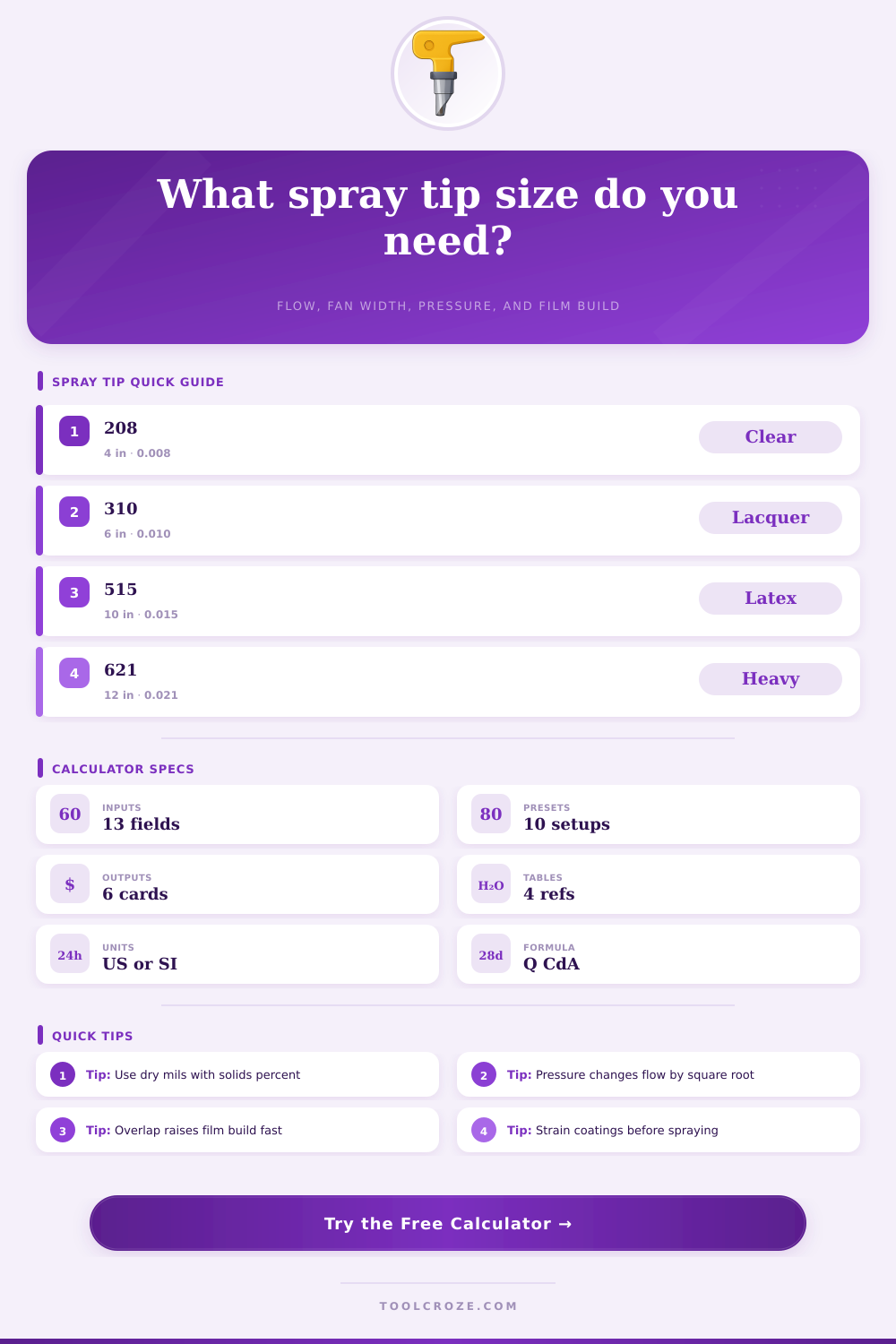
| 208 | 4 in | 0.008 in | Clear, toner, thin lacquer | 800-1400 psi |
| 310 | 6 in | 0.010 in | Cabinet lacquer, fine finish | 1000-1600 psi |
| 411 | 8 in | 0.011 in | Sealer, stain, light enamel | 1000-1800 psi |
| 413 | 8 in | 0.013 in | Deck stain, light paint | 1400-2000 psi |
| 515 | 10 in | 0.015 in | Interior wall latex | 1800-2400 psi |
| 517 | 10 in | 0.017 in | Primer, exterior paint | 2000-2600 psi |
| 519 | 10 in | 0.019 in | Epoxy primer, high solids | 2200-2800 psi |
| 621 | 12 in | 0.021 in | Heavy latex, elastomeric | 2400-3000 psi |
| Material | Typical viscosity | Volume solids | Common orifice | Transfer note |
|---|---|---|---|---|
| Clear lacquer | 20-45 cP | 18-30% | 0.008-0.012 in | Fine atomization matters |
| Stain / sealer | 15-60 cP | 15-35% | 0.011-0.013 in | Watch lap marks |
| Enamel | 60-120 cP | 35-55% | 0.010-0.014 in | Use lower speed for gloss |
| Latex paint | 90-180 cP | 38-48% | 0.015-0.019 in | Filter before spraying |
| Primer | 140-260 cP | 45-65% | 0.017-0.021 in | Confirm pump capacity |
| Elastomeric | 800-2500 cP | 50-70% | 0.021-0.031 in | High pressure and large hose |
| Orifice | Approx GPM at 2000 psi water | Approx GPM at 3000 psi water | Flow class | Pump check |
|---|---|---|---|---|
| 0.008 in | 0.07 | 0.09 | Fine finish | Small pump ok |
| 0.010 in | 0.11 | 0.13 | Light coating | 0.25+ GPM pump |
| 0.013 in | 0.18 | 0.22 | Medium light | 0.35+ GPM pump |
| 0.015 in | 0.24 | 0.29 | Standard paint | 0.45+ GPM pump |
| 0.019 in | 0.38 | 0.47 | High solids | 0.65+ GPM pump |
| 0.031 in | 1.04 | 1.27 | Texture / roof | 1.50+ GPM pump |
| Overlap | Pass advance | Film effect | Use case | Watch point |
|---|---|---|---|---|
| 0% | 100% fan | Lightest film | Striping, test panels | Edge fade visible |
| 25% | 75% fan | 1.33x film | Utility coating | Keep gun square |
| 50% | 50% fan | 2.00x film | Common wall pattern | Runs on slow strokes |
| 65% | 35% fan | 2.86x film | High build coating | Heavy wet edge |
| 75% | 25% fan | 4.00x film | Narrow repair pass | Sags and solvent trap |
Selecting an correct spray tip for your project are essential. Using the wrong spray tip for your project can lead to thin spots in your coating or heavy edge in the coating. Additionally, an incorrect spray tip could also make you waste the materials needed for the project.
Using a spray tip calculator will allow you to estimate the flow and the film build that will happen from the spray gun. This will help you determine your workable speed. One of the factors that will influence the spray tip you choose are the orifice diameter.
Choose the Right Spray Tip and Settings
The orifice diameter will determine the amount of coating that will leave the gun. If the orifice diameter change, the amount of coating leaving the gun will change dramatic. The flow rate of the spray gun follow the square of the orifice diameter.
Another essential factor that will influence your spray tip is the fan width of the tip. The fan width will determine the area that the paint will cover. The orifice diameter and fan width will allow you to determine if you will apply enough material to the project and avoid making extra pass with the spray gun.
Spray tip calculators will show you the gallons per minute and the effective width if you enter the orifice diameter, fan width, pressure, and the viscosity into the calculator. Another factor to consider with the spray gun is the overlap rate. The overlap will impact the thickness of the paint application.
For instance, using a fifty percent overlap will make the thickness of the coating be double than the thickness of one pass of the spray gun. Using a higher percentage of overlap will increase the thickness of the coating even more further. Spray tip calculators will calculate the amount of overlap and the transfer rate to allow you the ability to determine your line speed so that you can achieve the thickness of the dry film that you want.
The third factor to consider is the pressure of the paint. The flow rate decrease with the square root of the pressure. For instance, changing the pressure from two thousand psi to three thousand psi will only increase the flow rate by approximately twenty-two percent.
The spray tip calculator will allow you to test out different spray pressure to make sure that you are not guessing the proper pressure needed for your project. The last two factors that will influence the spray gun are the viscosity and the solids content of the paint. These two factors works in opposing manners.
The viscosity will cause the flow of the paint to decrease through the orifice of the paint gun. However, the solids content will cause the amount of solvent in the paint to decrease. If there is less solvent in the paint, the wet film will produce more dry film.
The spray tip calculator will allow you to enter the viscosity and solids content to change the volume of solids to dry mils result. If you enter the specification of the paint into the spray tip calculator, the machine will calculate the amount of dry mils of paint that will be applied to your project. The line speed of the spray gun is another variable for the project.
If you are moving the spray gun too fast, the thickness of the film will be too thin. If you move the spray gun too fast, the edges of the paint will become visible. Using the spray tip calculator will allow you to determine the line speed that the paint gun should travel at to achieve your target thickness.
You can also use the spray tip calculator to determine the flow rate of the paint if you want to maintain a specific line speed. By using the spray tip calculator, you will have a specific number to use in the field to ensure that the paint are applied correctly. The other factors that could influence the outcome of your painting job are the wind, the temperature of the projects surface, the length of the hose that you will use for the project, and the condition of your paint pump.
All of these factors will influence the outcome of your project. The spray tip calculator will give you a starting point for your project. However, you must use a test panel and a mil gauge to fine-tune your machine settings.
Using a test panel and a mil gauge will allow your estimate from the spray tip calculator to become a reliable plan for your project. The other tables on this page will give you a list of the common tip codes for the spray guns and the materials that work best with these codes. Using these tables will allow you to fine-tune your application rather than start your preparation of the paint gun from zero.
The goal of the spray tip calculator is to produce a consistent film of paint that meet the specification that is stated for the project. Using the spray tip calculator will allow you to ensure that the coating is applied correctly the first time.