Drill Press RPM Calculator
Set a drill press speed from bit diameter, material, bit type, SFM target, pulley limits, feed per revolution, hole depth, coolant factor, and tool maximum RPM.
⚙ Drill Press Presets
Choose a realistic shop setup, then adjust the diameter, material, pulley speeds, feed, and depth for your actual drill press.
📐 Speed And Feed Inputs
📊 Drill Press RPM Results
Calculation Breakdown
📋 Current Bit And Material Grid
📘 Material SFM Reference
| Material | HSS Twist Drill SFM | Cobalt / Carbide SFM | Feed Per Rev Start | Drill Press Note |
|---|---|---|---|---|
| Mild steel 1018 / A36 | 70 to 100 | 90 to 140 | 0.002 to 0.006 in/rev | Use cutting oil and reduce speed for large diameters. |
| Stainless steel 304 / 316 | 30 to 50 | 45 to 80 | 0.0015 to 0.004 in/rev | Keep feed positive to avoid work hardening. |
| Aluminum 6061 / 7075 | 180 to 300 | 250 to 450 | 0.003 to 0.010 in/rev | Clear chips often; aluminum can grab deep flutes. |
| Brass / bronze | 150 to 250 | 220 to 350 | 0.002 to 0.007 in/rev | Use sharp tools and avoid aggressive rake if grabbing. |
| Gray cast iron | 60 to 90 | 90 to 150 | 0.002 to 0.006 in/rev | Often drilled dry; manage abrasive dust carefully. |
| Acrylic / plastic sheet | 70 to 140 | 90 to 180 | 0.002 to 0.008 in/rev | Reduce heat, back the work, and clear chips. |
| Hardwood | 140 to 230 | 180 to 300 | 0.004 to 0.014 in/rev | Brad points and Forstners prefer moderate RPM. |
| Softwood / construction lumber | 180 to 350 | 220 to 450 | 0.006 to 0.018 in/rev | Large spade bits and hole saws need lower speed. |
🔩 Bit Type And Material Compatibility Grid
| Bit Type | Best Materials | Speed Factor | Typical Diameter Range | Watch Point |
|---|---|---|---|---|
| HSS twist drill | Steel, aluminum, brass, plastic | 1.00x | 1/16 to 1/2 in | Use oil in steel and back off if chips discolor. |
| Cobalt twist drill | Stainless and tougher steels | 1.12x | 1/16 to 1/2 in | Works best with steady feed and low heat. |
| Carbide drill | Abrasive cast iron, composites, production metal | 1.25x | 1/8 to 3/8 in | Needs low runout and very rigid fixturing. |
| Brad point | Hardwood, softwood, plywood | 1.10x | 1/8 to 1 in | Great location; slow down near large diameters. |
| Forstner bit | Wood and sheet goods | 0.48x | 1/4 to 2 in | High torque and heat; clear chips frequently. |
| Spade bit | Softwood and rough holes | 0.62x | 3/8 to 1-1/2 in | Needs firm workholding and controlled feed. |
| Step bit | Sheet metal and plastic | 0.78x | 1/8 to 1-3/8 in | Use the active step diameter, not the shank. |
| Hole saw | Wood, plastic, thin metal | 0.35x | 3/4 to 4 in | Large rim diameter makes RPM drop sharply. |
⚒ Diameter To RPM Examples
| Bit Diameter | 60 SFM | 100 SFM | 180 SFM | 250 SFM |
|---|---|---|---|---|
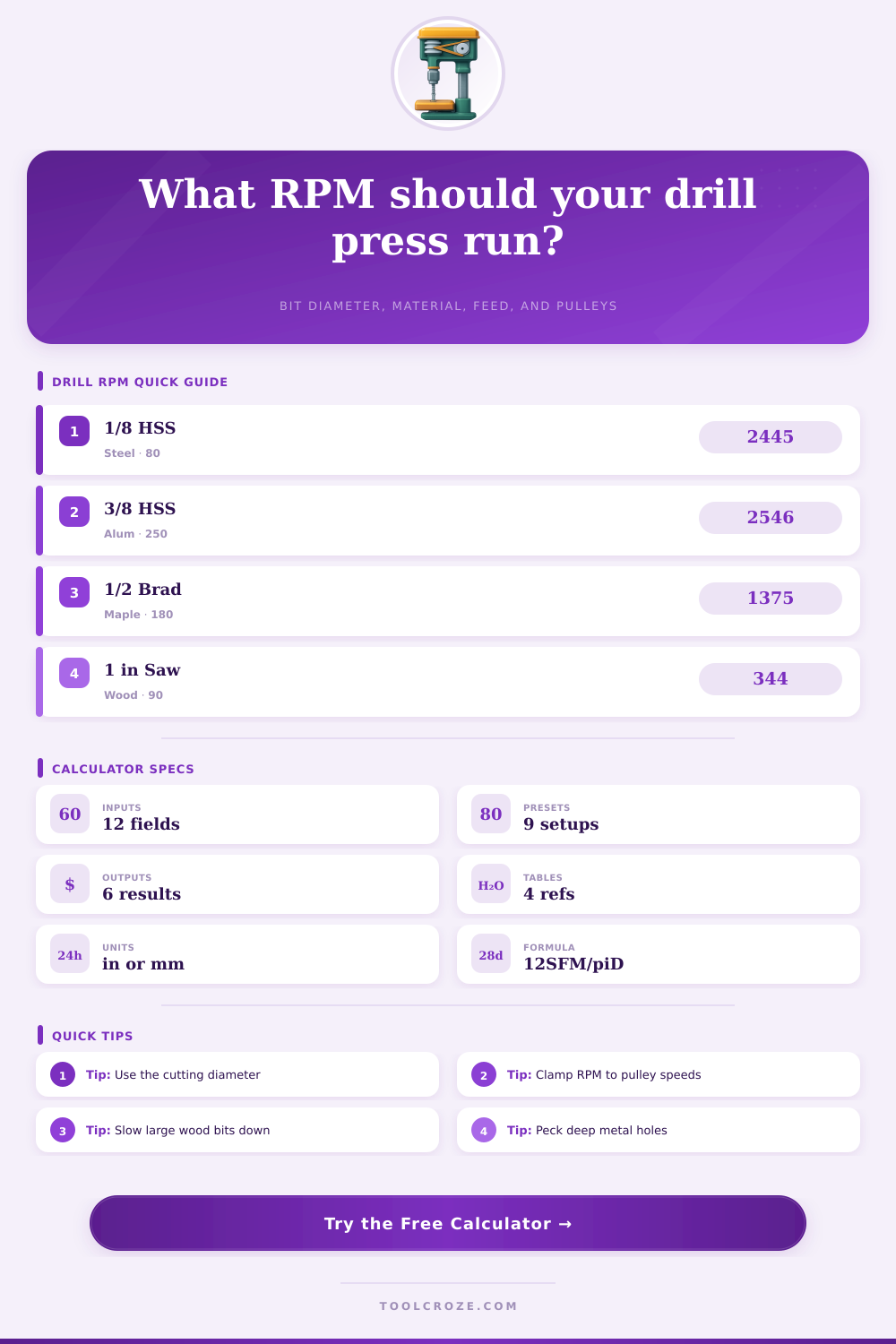
| 1/8 in | 1833 RPM | 3056 RPM | 5500 RPM | 7639 RPM |
| 1/4 in | 917 RPM | 1528 RPM | 2750 RPM | 3820 RPM |
| 3/8 in | 611 RPM | 1019 RPM | 1833 RPM | 2546 RPM |
| 1/2 in | 458 RPM | 764 RPM | 1375 RPM | 1910 RPM |
| 1 in | 229 RPM | 382 RPM | 688 RPM | 955 RPM |
| 2 in | 115 RPM | 191 RPM | 344 RPM | 477 RPM |
📝 Common Drill Press Pulley Setups
| Drill Press Style | Typical Speed Range | Common Pulley Speeds | Best Fit |
|---|---|---|---|
| Benchtop 5-speed | 620 to 3100 RPM | 620, 1100, 1720, 2340, 3100 | Small metal drills and woodworking bits. |
| 12-speed floor press | 250 to 3050 RPM | 250, 340, 390, 510, 650, 990, 1550, 3050 | Better for large bits and hole saws. |
| Variable speed press | 200 to 3600 RPM | Any setpoint inside the belt range | Match formula RPM closely, then verify torque. |
| Metalworking press | 120 to 2500 RPM | 120, 180, 250, 400, 650, 900, 1400, 2500 | Low speeds for steel, stainless, and hole saws. |
| Wood shop press | 500 to 3600 RPM | 500, 850, 1250, 1750, 2500, 3600 | Brad point, twist, spade, and Forstner bits. |
💡 Practical Drill Press Tips
Setting the correct drill press speeds is a necesary task in any workshop. The speed at which you operate your drill press will have an impact on the quality of the hole that is cut and the life of your drill bit. If the speed is too fast for the material that you are cutting, the drill bit can overheat, the material can work harden, and the drill bit can walk across the workpiece.
If the speed is too slow for the material that you are cutting, the drill bit may rub against the material instead of cut it, the drill bit may stall while attempting to cut the material, and heat issues can occur in the drill bit and workpiece. Another factor to consider is the diameter of the drill bit that you use. The surface speed of the cutting edge of the drill bit is what cuts the workpiece.
How to Set Drill Press Speed
Therefore, a small twist drill bit will travel a shorter distance with each revolution then a large hole saw blade. Because the distance that the cutting edge of each drill bit travels with each revolution is not the same, the same drill press speeds will result in different outcomes at the cutting edge of the small drill bit than at the cutting edge of a large hole saw. Finally, the type of material that you are drilling can impact drill bit speed.
Steel, aluminum, hardwood and acrylic has different tolerances to friction. Finally, different types of drill bits have different tolerances to torque than others. These factors impact the recommended surface feet per minute (SFM) for the drill bit.
The drill press speed calculator include the mathematical calculations for drill press speed once you enter the variables for the diameter of the drill bit, the type of material that is being drilled, and the type of drill bit that is to be used. In addition, the calculator can help you to set limits for the pulleys that will ensure that the calculated speed for your project remains within the capabilities of your drill press. The calculator considers the use of coolant, feed per revolution, and the condition of your workshop.
For instance, a rigid work setup with a sharp drill bit will behave differently than a long drill bit in a flexible vise or a hand-fed cutting job on thin stock. The calculator will show the formula that you use to calculate the RPM of your drill press, the nearest available speed setting for the pulleys on your drill press, the surface speed of your drill bit at that calculated pulley speed, the feed rate for your drill bit, and the total time that will be required to complete your project and the number of times that you will need to clear the chips that are cut from the workpiece. Another important factor to consider is the feed rate of the drill press.
A feed rate that is too light with the drill bit can cause the drill bit to polish the workpiece instead of cutting it. A feed rate that is too aggressive for certain materials can cause plastic or thin sheet metal to grab the drill bit or to crack. Therefore, by combining the RPM of the drill press with the feed rate that you enter into the calculator, the calculator will determine the inch or the millimeters of travel per minute of the drill press.
Additionally, the depth and the pecking depth for the workpiece will help to determine the total length of time that the project will take to complete and how many times that you should clear the chips from the workpiece. Reference tables is provided on the calculator to show the typical range of surface feet per minute for different materials and drill bits. These reference tables are not strict rules, but provide a starting point for your project if you are not certain of the proper surface feet per minute for your material.
Additionally, the examples that relate the drill bit diameter to the RPM that should be used for that diameter will allow you to understand the relationship between these two variable. Finally, the table that describes the different available pulley setups on different drill presses will help you to understand that the RPM variables that are calculated are only examples of the available speeds for your drill press; you should typically select the closest available pulley speed for your project. Another factor that you should learn is the appropriate direction to adjust the drill press speed according to the material that you are drilling.
For instance, when drilling in stainless steel or acrylic, you should typically use a slightly slower pulley speed so as to avoid the development of heat and work hardened material in the drill bit and workpiece. For aluminum, you can typically use a higher pulley speed for cutting with a sharp twist drill bit, as aluminum chips easily. For large diameter drill bits or hole saw bits, you will typically need to use a lower pulley speed for drilling to avoid the rapid increase in the rim speed for the drill bit.
For deep holes, peck depth becomes an important consideration, since chips will accumulate in the deep hole and create heat at a faster rate than the coolant can remove the heat from the workpiece. The calculated numbers will provide you with a starting point for your drill press speed and feed rate variables. However, you will have to actualy drill into your workpiece and adjust the feed rate and the drill press speed until you find the proper setting for that specific project.
Once you have established the proper setting of the drill press speed and feed rate for a specific material and bit size, you can use that established formula for any other workpieces of the same size and same material. By using these established combinations of drill press speed and feed rate for specific materials and drill bits, you can ensure that your drill press will produce the same result on any given workpiece.