Silage Clamp Calculator
Size a silage clamp from forage tonnage, dry matter, density, length, width, height, face removal, compaction, and planned storage days.
1Farm Presets
Load a realistic crop and farm scale, then edit dimensions or density to match your actual clamp and forage analysis.
2Clamp Inputs
3Results
4Material / Spec Grid
5Reference Tables
| Forage | Fresh density | DM target | Clamp note |
|---|---|---|---|
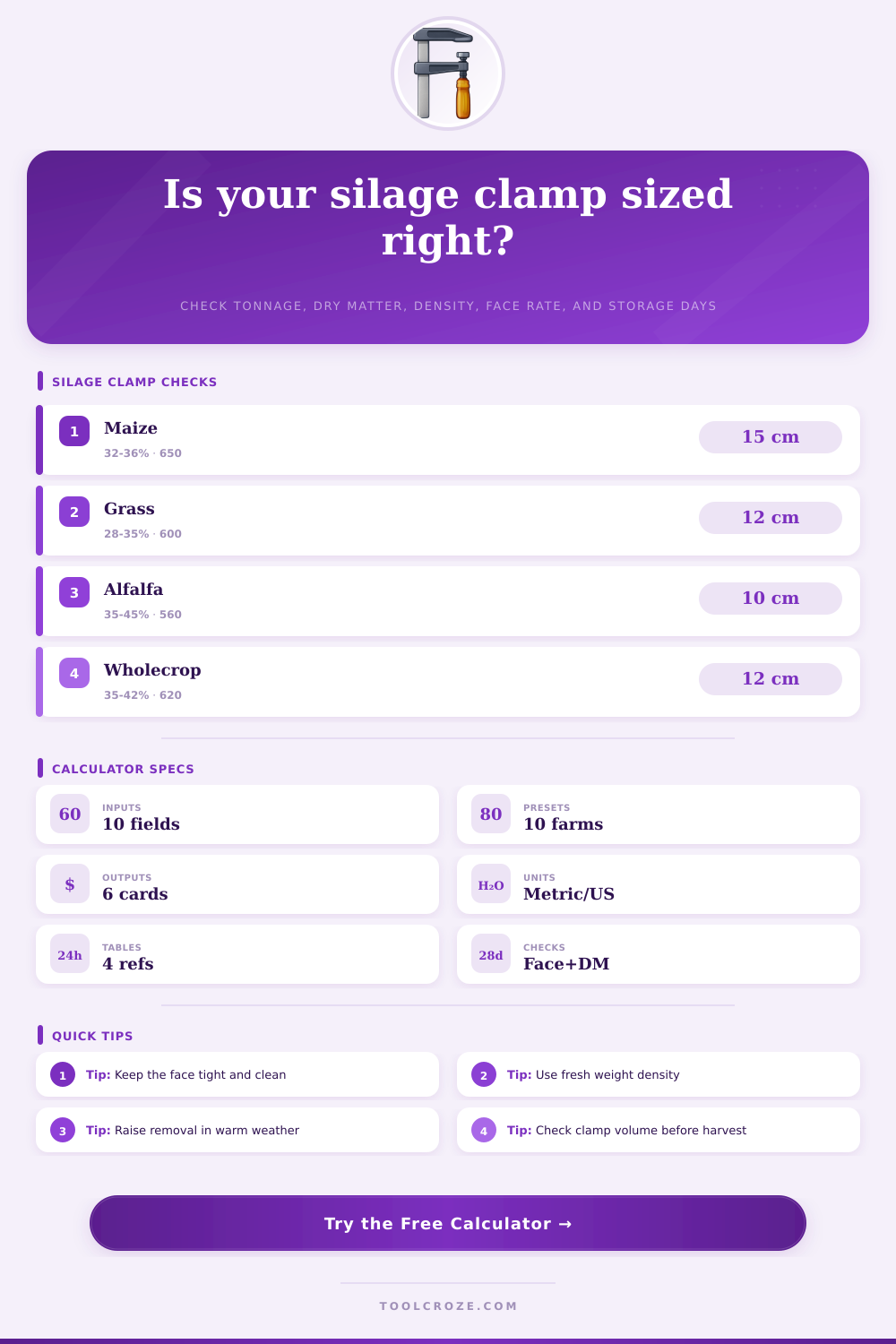
| Maize / corn | 600-720 kg/m3 | 32-36% | High energy, dense pack |
| Grass silage | 520-650 kg/m3 | 28-35% | Wilt drives density |
| Alfalfa haylage | 480-600 kg/m3 | 35-45% | Needs tight exclusion |
| Wholecrop cereal | 560-660 kg/m3 | 35-42% | Chop length matters |
| Condition | Metric target | US target | Risk if slower |
|---|---|---|---|
| Cool winter | 10 cm/day | 4 in/day | Moderate |
| Mild season | 12-15 cm/day | 5-6 in/day | Heating |
| Warm weather | 20 cm/day | 8 in/day | High spoilage |
| Loose face | 20+ cm/day | 8+ in/day | Very high |
| Check | Formula | Use | Watch |
|---|---|---|---|
| Volume | L x W x H | Space | Settled height |
| Capacity | Volume x density | Fresh tonnes | Compaction |
| DM stored | Fresh x DM | Feed value | Storage loss |
| Face days | Length / removal | Feed-out | Weather |
| Farm use | Typical crop | Face area | Planning note |
|---|---|---|---|
| Small dairy | Grass | 20-28 m2 | Keep face narrow |
| Large dairy | Maize | 35-55 m2 | High daily removal |
| Beef unit | Mixed | 18-35 m2 | Longer winter use |
| Contract fill | Maize | 45+ m2 | Pack in thin layers |
6Tips
A silage clamp is a storage structure used to hold forage for animal feed. The silage clamp will work as a slow-release feed factory for the farm that owns the silage clamp. The capacity of a silage clamp will depend on the amount of material that are placed into the silage clamp and how fast that material is removed from the silage clamp.
Several decision has to be made regarding the dimensions of the silage clamp and the rate at which the silage clamp will be depleted before the harvest begins. If you wait until winter to assess the silage clamp, you may find that there is not enough feed for the spring turnout of the farms animal. The first measurement that must be made is the amount of forage that will be stored in the silage clamp.
How to work out silage clamp size and feed rate
The tonnage of the forage will determine the size of the silage clamp that is required. Tonnage is not the complete measurement for the silage clamp because the dry matter percentage of the forage will affect the volume of the silage clamp. If you enter the dry matter percentage into the calculator, the calculator will determine the total amount of dry matter that will be stored in the silage clamp after you enter the percentage of the feed that are lost during storage.
This stored dry matter will be lost to fermentation, effluent, and waste that will exit the silage clamp when the silage clamp is removed from the storage area. Another critical measurement is the density of the silage clamp. Density can be difficult to measure if you only measure the top layer of the silage clamp.
A compaction score will allow for the density to be reduced if the roller that compacted the silage clamp do not reach the corners of the silage clamp. After these settings are entered into the calculator, the calculator will display the capacity of the silage clamp to determine if the silage clamp is large enough to store the forage that will be grown on the farm. If the silage clamp is too small for the amount of forage that will be grown on the farm, there will need to be an adjustment to the settled height of the silage clamp or a different silage clamp will need to be used for the final several weeks of feeding the farms animals.
The rate at which the face of the silage clamp will be depleted is another measurement that can be made with the silage clamp. You can calculate the daily feed delivery rate by multiplying the area of the face of the silage clamp by the depth of the silage clamp that will be removed daily. This rate can be compared with the daily feed requirement of the animals on the farm to determine if the feed will be removed at a sufficient rate from the silage clamp.
If the rate is too slow, the silage clamp may become prone to heat and mould on the face of the silage clamp. However, if the rate is too fast, the silage clamp may become too narrow and tall to roll effective. Silage clamps that are removed at a faster rate in warm weather will allow the oxygen to penetrate the silage clamp at a deeper level than in colder weather.
The density of the silage clamp is another critical measurement that can be made. If the contractor rolls the silage clamp with a heavy roller while incorporating thin layers of forage, the contractor can increase the density of the forage. Higher densities allow for the silage clamp to have a smaller footprint or contain more tonne of silage.
Although rolling to increase the density takes more fuel and time, the calculator will show the results of such an undertaking. The storage loss that will occur in the silage clamp can affect the total amount of feed. If the storage loss is 8%, that is the starting point for silage clamps.
However, if the silage clamp is torn or the sides of the silage clamp are not seal during storage, the storage loss will be higher. Small changes to the percentage of storage loss will change the total amount of feed by several tonnes of feed. Therefore, you will have to enter the storage loss into the silage clamp calculator as a separate input.
The usable volume of the silage clamp will take into account the ramp, rounded shoulders in the silage clamp, and the settled height of the silage clamp. The settled height of the silage clamp will be entered into the silage clamp calculator, as the volume will account for how much the silage clamp will settle into the ground. A tape measure and a moisture meter will be used to ensure that the dimensions that are entered into the silage clamp calculator are accurate.
Using the calculator, the daily feed-out value will determine the amount of labor that will be required on the farm to remove the silage clamp feed. If six tonnes of silage is removed daily from the silage clamp, there will be a quick tractor run or a second cut of silage after lunch. If the size of the herd increase, the silage clamp will have to be wider or there will need to be another silage clamp bay for the farm.
The geometric analysis that can be entered into the silage clamp calculator will display these requirements before any construction is made to the silage clamp. A silage clamp that is sized exactly to the amount of forage that will be grown on the farm leaves no margin for error. If the harvested silage is wet, the silage clamp may not be large enough to contain the additional silage that may be harvested.
Although an oversized silage clamp will provide extra space for silage, the extra area will expose more silage to oxygen. The fit status will allow the farmer to decide if the silage clamp will be sized for extra volume to account for wet harvests or to save the labor that would of been required to construct a silage clamp that can hold the extra silage. Depending on the tonnage, density, and the face removal rate, a silage clamp will succeed if the amount of work that are performed on the silage clamp matches the work that is performed on the farm.