Bushing Press Fit Calculator
Estimate bushing OD interference, housing bore fit, wall-thickness sensitivity, contact pressure, bore closure, installation temperature, and press force.
📌 Bushing Presets
⚙ Calculator Inputs
🧱 Material and Fit Grid
📐 Fit Planning Grid
📊 Reference Tables
| Fit intensity | Interference per 100 mm OD | Typical pressure | Common bushing use |
|---|---|---|---|
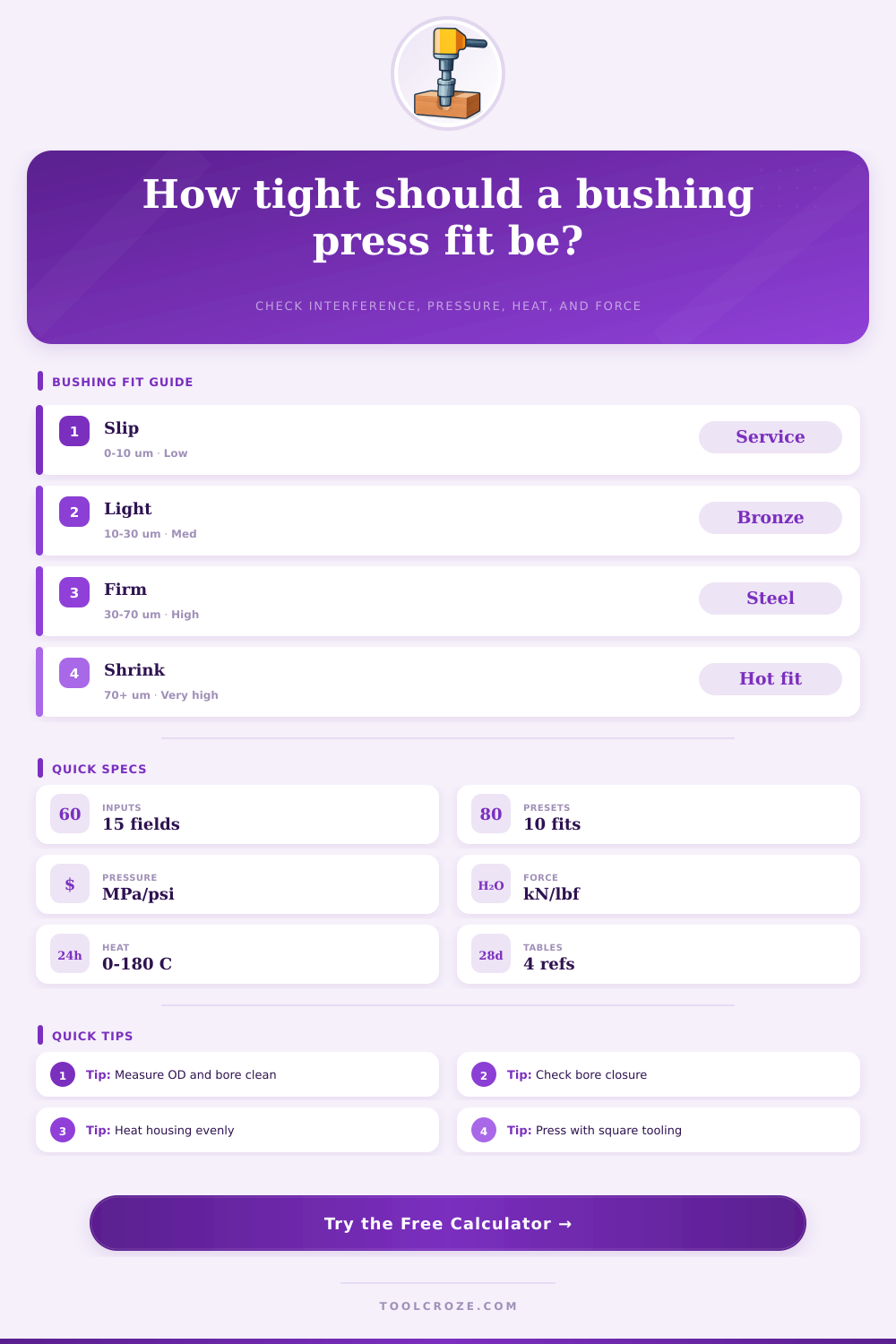
| Slip / serviceable | 0 to 40 um | 0 to 30 MPa | Removable sleeves, light-duty location fits, trial assemblies. |
| Light press | 40 to 120 um | 20 to 80 MPa | Porous bronze and small plain bearings in rigid housings. |
| Firm press | 120 to 250 um | 70 to 170 MPa | Solid bronze, steel backed, and higher retention bushing seats. |
| Heavy / shrink | 250+ um | 150+ MPa | Large sleeves, high load housings, and heat-assisted installation. |
| Bushing material | Modulus | Poisson ratio | Press fit note |
|---|---|---|---|
| Bearing bronze | 100 to 120 GPa | 0.33 to 0.35 | General sleeve baseline; check finished ID after pressing. |
| Sintered bronze | 70 to 95 GPa | 0.30 to 0.34 | Porous structure dislikes excessive force and damaged lead chamfers. |
| Steel backed composite | 150 to 210 GPa | 0.29 to 0.33 | Higher stiffness; liner damage matters more than sleeve stress alone. |
| PTFE composite | 8 to 25 GPa | 0.35 to 0.42 | Low stiffness; use maker fit limits and avoid local crushing. |
| Cast iron bushing | 95 to 130 GPa | 0.25 to 0.29 | Rigid but brittle compared with bronze; avoid shock pressing. |
| Housing material | Modulus | Expansion | Installation note |
|---|---|---|---|
| Steel | 200 to 210 GPa | 11 to 13 um/m-C | Predictable baseline for press and thermal estimates. |
| Cast iron | 100 to 170 GPa | 10 to 12 um/m-C | Lower stiffness can reduce pressure but edge cracking needs attention. |
| Aluminum | 68 to 72 GPa | 22 to 24 um/m-C | Heats open quickly but hot retention may relax more than steel. |
| Stainless steel | 190 to 200 GPa | 16 to 17 um/m-C | Watch galling, clean chamfers, and friction assumptions. |
| Engineering polymer | 2 to 5 GPa | 60+ um/m-C | Use manufacturer limits; creep and temperature dominate fit retention. |
| Setup check | Preferred range | Why it matters | Before pressing |
|---|---|---|---|
| Lead chamfer | 0.5 to 1.5 mm | Reduces shaving and peak start force. | Deburr both housing and bushing OD edges. |
| Surface finish | 0.4 to 1.6 Ra um | Rough bores raise friction and scatter force results. | Clean, inspect, lightly oil if allowed. |
| Driver contact | Full bushing face | Prevents cocking and liner damage. | Driver is square, flat, and smaller than housing shoulder. |
| ID allowance | Measure after fit | Pressing can close a plain bearing bore. | Plan ream, burnish, or hone stock if required. |
💡 Tips
This calculator uses simplified elastic thick-cylinder estimates for planning. Final fits should be checked against the bushing maker, housing drawing, material condition, operating temperature, lubrication, finish, and inspection data.
A bushing press fit is an mechanical connection between a bushing and a housing bore. The quality of the fit rely upon the amount of interference between the two components. Insufficient interference can cause the bushing to walk or spin within the housing bore.
Excessive interference can lead to the crushing of the housing bore or even the cracking of the housing. Thus, it is essential to understand the interference value of the component before using an arbor press or induction heater to install the bushing. Interference are the starting point of all calculations related to the press fit of a bushing.
How Press-Fit Bushings Work and How to Install Them
Interference occurs between the outside diameter of the bushing and the inside diameter of the housing bore. When you press the bushing into the housing bore, the bushing compress and the housing bore expands until the two components reach equilibrium. A calculator can determine the equilibrium of the system if the dimensions of the components and the wall thickness of the bushing are provided.
The interference of two components will create different levels of contact pressure within the housing if the housing is made of steel versus aluminum. Aluminum has a lower modulus than steel so the aluminum housing will expand more then the steel housing when the same interference is applied to both components. The materials of the components impact the outcome of the press fit.
A thin walled PTFE-lined bushing will close its inside diameter more than a thick bronze sleeve when the interference is the same. The wall thickness of the bushing must be considered when calculating the press fit. If the technician will ream or burnish the bushing after it is installed into the housing, the closure estimate of the system must be determined.
Otherwise, the bushing may seize within the housing bore. Another installation technique is to heat the housing component to expand the bore. The expansion of the housing bore can be calculated if the rise in temperature is known.
This calculation will help determine whether the bushing can be installed with an arbor press or whether you can install it by hand. Aluminum housings will provide more clearance per degree of temperature rise than steel housings. However, the aluminum housing will relax more as the aluminum housing return to room temperature.
The press force of the installed bushing can be estimated with a calculator. The press force is calculated from the contact pressure between the bushing and housing, the coefficient of friction between the two components, the contact area, and a safety factor. The friction coefficient can change with the surface finish of the housing bore and the condition of the lead chamfer.
A rough housing bore or damaged lead chamfer will require more press force than if the bore and lead are smooth. The safety factor can be used to provide a more accurately estimation of press force. The bore-closure estimates and hot-clearance estimates interact with each other.
For instance, a bushing that requires a significant amount of heat to reduce the required press force may also require a significant amount of press force to close the bore of the bushing once the housing returns to room temperature. A bushing that features light interference with a polymer housing may also allow the housing to relax over time. A tool that helps to display these interactions allows the designer to adjust the wall thickness or change the materials of the components prior to installing the bushing.
Many people make mistake when installing a press fit bushing if they dont use the correct measurements. Many people use the nominal dimensions of the components from the catalog rather than the actual dimensions of the parts. People also can ignore the temperature of the components during measurement.
A bushing that measures well at room temperature may create too much interference once the shop temperature increase. A housing component with a thin wall behind the bore will flex when a press force is applied to the bushing. Thus, a thin housing wall behind the bore will lower the contact pressure between the bushing and housing which might crack the housing.
A table of interference and pressure values can help the designer understand the relationship between the two. These tables show the maximum interference between the components and the pressure created at that interference. They also show which bushing types are capable of withstanding firm press fits without damaging the liner.
The tables also show the difference between PTFE-lined bushes and bronze bushes. These tables can also act as reality check for the designer to ensure that the interference between the components is not too great which might crack the housing. Another consideration in the installation of a bushing is the life cycle of the component.
For instance, bushings that will be removed from the machine for inspection may have lighter interference with the housing component so that they are not subjected to high press force. High-load bushings may require more press force to initially install and may require a heat cycle so that the metal components expands which allows for the installation of the bushing. A calculation tool can allow the designer to consider these variable.
However, once the designer has the numbers to indicate the interference and press force, the designer must physically perform the press fit so that the bore is free of dirt and the driver tool remains square to the housing bore.