O-Ring Tolerance Calculator
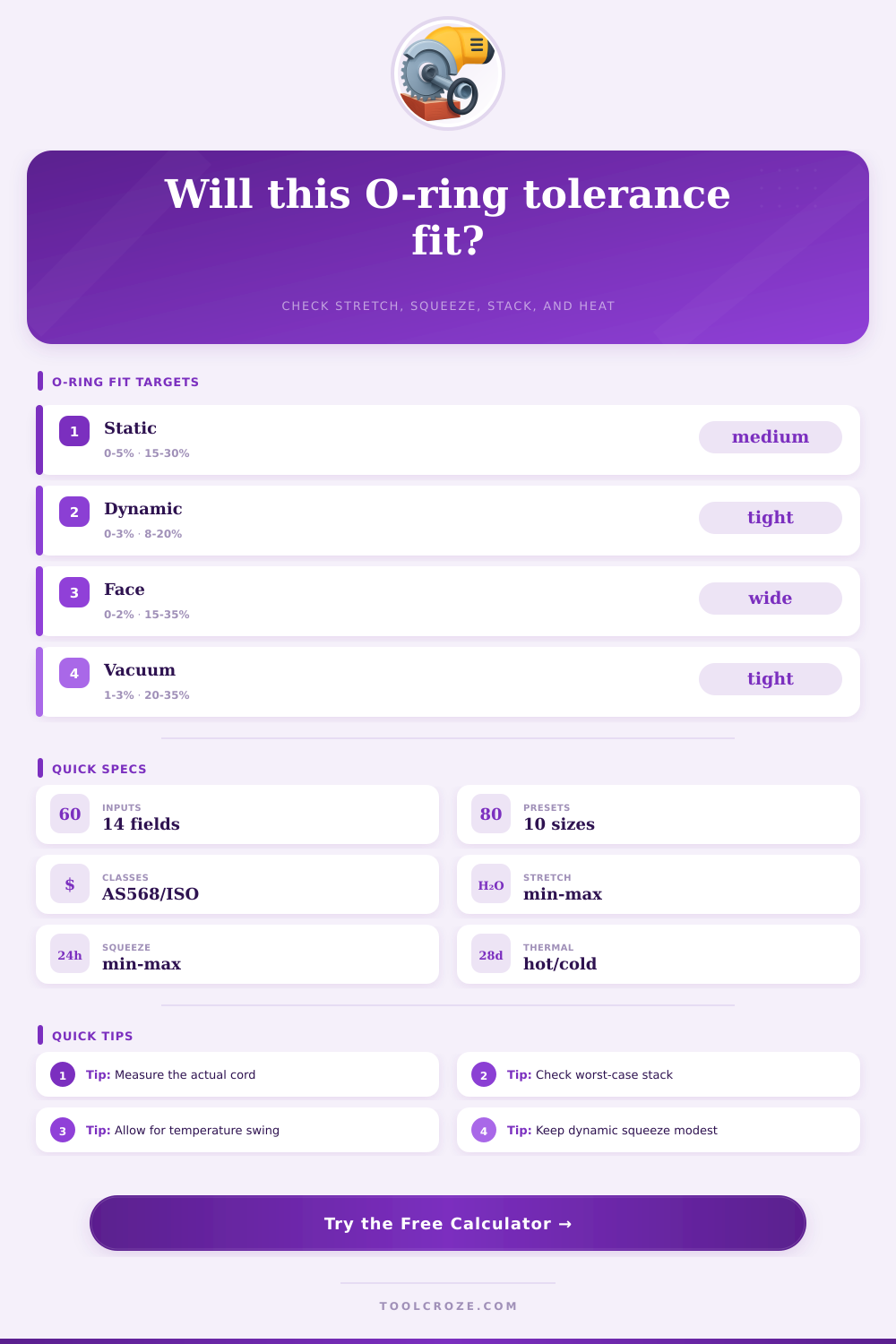
Check nominal ID, cross-section, AS568 or ISO tolerance class, gland stack, installed stretch, squeeze range, and thermal expansion in one worst-case fit pass.
1 Size Presets
Choose a common seal scenario, then adjust the tolerances to match your drawing, inspection data, or supplier sheet.
2 Calculator Inputs
O-Ring Tolerance Results
Breakdown
3 Current Stack Snapshot
4 Tolerance and Specification Grid
| Spec class | ID tolerance behavior | CS tolerance behavior | Best use |
|---|---|---|---|
| AS568 molded standard | Size-based, moderate | Moderate molded cord tolerance | General static and low duty seals |
| AS568 precision | Tighter selected tolerance | Tighter selected tolerance | Close gland stacks and inspected parts |
| ISO 3601 class A | Precision molded range | Precision molded range | Hydraulic and high consistency designs |
| ISO 3601 class B | General molded range | General molded range | Industrial static seals |
| ISO 3601 class C | Wider commercial range | Wider commercial range | Noncritical covers and dust seals |
| Application | Typical stretch target | Typical squeeze target | Design caution |
|---|---|---|---|
| Static radial | 0% to 5% | 15% to 30% | Avoid negative stretch on loose stacks |
| Dynamic radial | 0% to 3% | 8% to 20% | High squeeze raises friction and heat |
| Axial face seal | 0% to 2% | 15% to 35% | Check groove fill and closure force |
| Vacuum face seal | 1% to 3% | 20% to 35% | Surface finish and compression set matter |
| Preset | Nominal ID | Cross-section | Typical tolerance focus |
|---|---|---|---|
| AS568-010 | 0.239 in | 0.070 in | Small ID stretch sensitivity |
| AS568-112 | 0.487 in | 0.103 in | Rod seal squeeze control |
| AS568-214 | 0.984 in | 0.139 in | Balanced static radial fit |
| AS568-325 | 1.475 in | 0.210 in | Large CS compression spread |
| ISO 20 x 2.5 | 20 mm | 2.5 mm | Metric drawing tolerance stack |
| Material or part | Typical expansion | Thermal effect | Stack note |
|---|---|---|---|
| NBR rubber | About 180 ppm/C | Grows much faster than metals | Hot stretch often drops |
| FKM rubber | About 160 ppm/C | Moderate elastomer growth | Good high temperature check |
| Silicone rubber | About 250 ppm/C | Large thermal growth | Watch hot squeeze and fill |
| Aluminum gland | About 23 ppm/C | More metal growth than steel | Hot bore opens faster |
| Steel gland | About 12 ppm/C | Low metal growth | Cold stacks may tighten |
5 Practical Tips
O-ring seals relies on small differences in dimensions between the components of a system that are not always readily visible on the drawing of the component. An O-ring seal may appear to be correct according to the drawing of the component, yet the seal may still allow for leaks at one end of the tolerance bands of the component or may bind within the component at the other end of the tolerance band for that component’s dimensions. You must all consider the interaction between the gland, the stretch of the O-ring seal, the squeeze of the O-ring seal, and the change in each of those components according to changes in temperature before any metal is cut or any batch of O-ring seals are ordered.
The O-ring seal calculator requires specific inputs from the designer of the component that include the O-ring seal. The nominal inside diameter of the component and the nominal cross-section of the O-ring seal define the size of the O-ring seal. The fields for the tolerance of the O-ring seal and the tolerance for the gland diameter and groove depth allows for the designer to enter information about the sizes of those components and there tolerances.
How to Check O-Ring Stretch and Squeeze
The calculator can then use these sizes and the information about their tolerances to calculate the range of stretch and squeeze that can be formed by the O-ring seal. If the stretch of the O-ring seal is too little, the O-ring seal will be too loose within the groove of the component. If the stretch is too great, the O-ring seal may thin out and damage during installation.
If the squeeze of the O-ring seal is too little, the O-ring seal will not provide the seal required to prevent leaks at the component. If the squeeze is too great, the O-ring seal will overheat due to the friction between the O-ring seal and the component, and the O-ring seal may take a permanent set due to such heat. The stretch and squeeze for an O-ring seal should be chosen according to the type of applications for the O-ring seal; static, dynamic, face, or vacuum applications.
Finally, the last of the factors to consider for the design of a component with an O-ring seal is the effect of temperature. Because elastomers expand more than metals, the O-ring seal will often expand within its grooves in response to changes in the temperature at which the component will operate. The thermal coefficient of the elastomer can be entered in the calculator to determine the amount of “thermal stretch” that will occur due to changes in the operational temperature of the component.
If the swing between the reference temperature and the operating temperature is large, you may have to check the compression set data for the elastomer, or you may have to change compounds. The reference tables provide typical tolerances for the elastomer compounds that is specified for seals. The reference tables indicate the target for the stretch and squeeze of the elastomer.
The reference tables are not rules for the seal designer, but the tables can allow the designer to see if the numbers from the calculator are within the normal parameters for the elastomer compounds. If the result of the calculator is CHECK or REWORK, the breakdown of that result will allow the designer to figure out which tolerance need to be adjusted. No assembly will ever match the dimensions provided for the seals in the print.
Thus, the seal designer should not trust the middle of the tolerance bands. Therefore, the calculator forces the designer to consider each end of the tolerance bands for each dimension. A seal that works at the nominal dimension will not function as a seal within the tolerance bands.
One common mistake with the squeeze of an elastomer is to consider it to be less important than the tolerance for the inside diameter of the seal. The squeeze of the elastomer is calculated from the diameter of the cross-section of the elastomer and the depth of the groove in which it is seated; thus, changing the cross-section will have a large effect on the squeeze percentage. Another mistake with elastomer seals is to forget that the thermal growth of the elastomer and the component into which it is being seated will not be the same.
O-rings will expand at a faster rate than the gland into which they are seated. Thus, under hot conditions, the squeeze will increase. Under cold conditions, the squeeze will decrease.
Thus, if the seal is to be used in an environment that experiences both hot and cold temperatures, it is important to know if the gland will still meet the squeeze specifications within both ends of the temperature range of the elastomer. Read the safety note at the bottom of the tool twice. The dimensional fit of the seal is only one of the considerations for creating a well-functioning seal.
Other considerations will include the compatibility of the elastomer compound with the fluid within the system, the pressure limits of the elastomer, the extrusion gap of the component into which it is being installed, and the surface finish of that component. The squeeze calculator is used to ensure that these other variables is considered prior to creating the seal. The calculator is used to avoid problems that can be discovered in operation of the seal.
If the results are within the targets for both the stretch and squeeze of the elastomer, and if the thermal drift within the system is small, the seal design is ready to move to the next design step. If one of the limits is outside of the target for the squeeze or stretch of the elastomer, the breakdown will indicate which tolerance need to be adjusted. Performing the calculations on paper prior to creating the elastomer and groove parts will help to avoid redesigning the seal after the parts have been manufactured.