Wire Rope Tension Calculator
Estimate tension in a suspended wire rope from load, span, sag, rope angle, load-carrying parts, dynamic factor, friction or sheave loss, rope size, and safety factor.
⚙Real wire rope tension presets
Pick a common suspended-load setup, then replace the load, span, sag, angle, and rope data with your measured field values.
📐Calculator inputs
Wire rope tension result
Calculation breakdown
🔗Rope, tension, and spec grid
📊Angle and sag reference
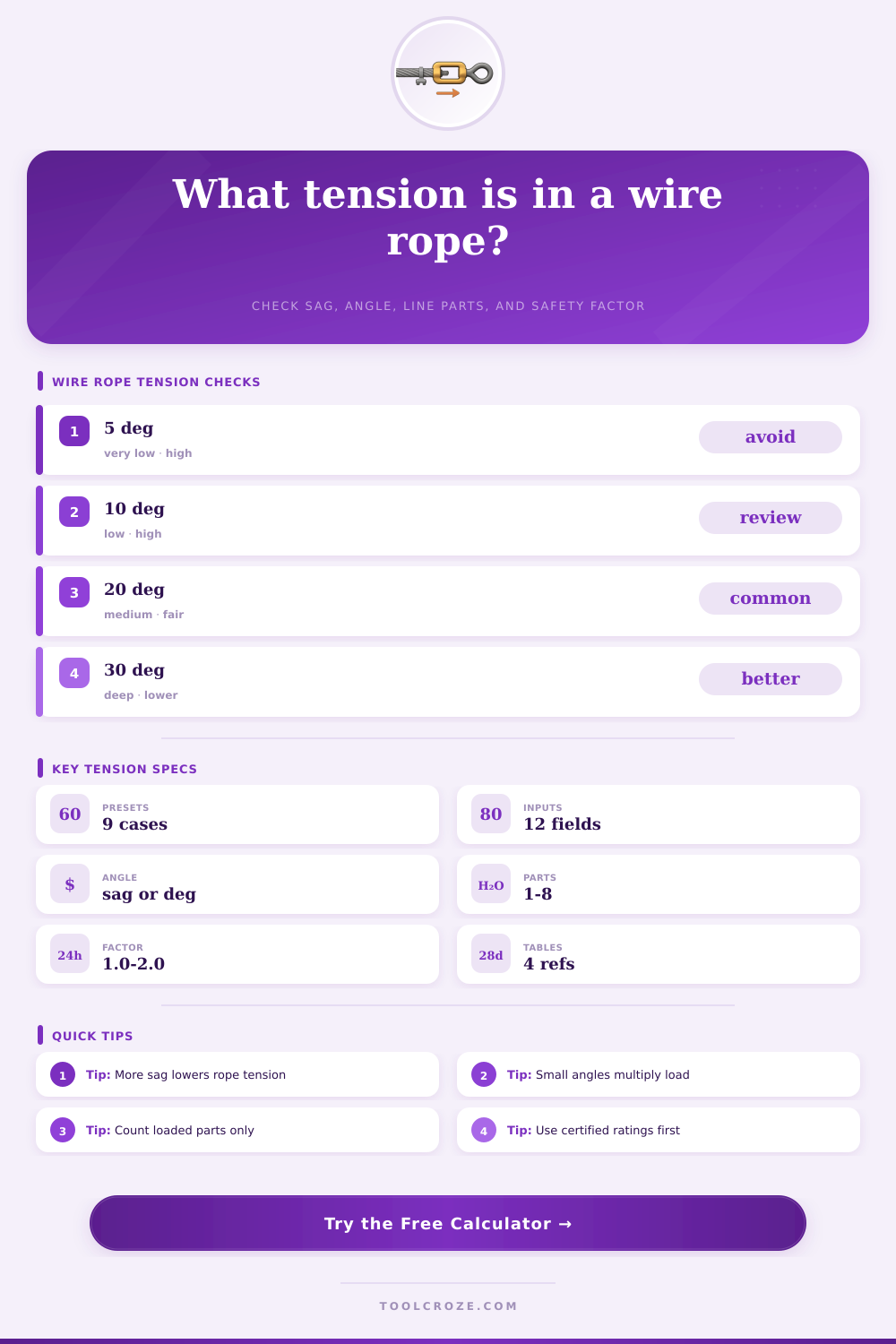
| Rope angle from horizontal | Approx sag as span percent | Tension multiplier per side | Planning meaning |
|---|---|---|---|
| 5° | 4.4% of span | 5.74 x load per side share | Very high tension, usually poor geometry |
| 10° | 8.8% of span | 2.88 x load per side share | High tension, review anchors and rope rating |
| 15° | 13.4% of span | 1.93 x load per side share | Moderate but still anchor-heavy |
| 20° | 18.2% of span | 1.46 x load per side share | Common planning range for non-rigid spans |
| 30° | 28.9% of span | 1.00 x load per side share | Lower tension, more vertical clearance needed |
⚖Dynamic factor reference
| Dynamic factor | Typical condition | Calculator effect | Use note |
|---|---|---|---|
| 1.00 | Static hanging load only | No extra load added | Use only when movement is controlled and known |
| 1.10 | Smooth handling or light adjustment | Adds 10% to suspended load | Good for careful positioning checks |
| 1.25 | Normal planning allowance | Adds 25% to suspended load | Default for common field uncertainty |
| 1.50 | Start, stop, wind, bounce, or sway | Adds 50% to suspended load | Use when motion or weather can load the rope |
| 2.00 | Severe shock planning | Doubles suspended load | Does not make shock loading acceptable for lifts |
🔀Friction and sheave loss reference
| Loss entered | Efficiency used | Common source | Planning note |
|---|---|---|---|
| 0% to 3% | 97% to 100% | Direct straight rope, no moving sheave | Best case; still check end fittings and anchors |
| 4% to 8% | 92% to 96% | Good sheave, fair alignment | Common allowance for simple reeving |
| 9% to 15% | 85% to 91% | Multiple sheaves or moderate friction | Inspect sheaves, fleet angle, and bearing condition |
| 16% to 25% | 75% to 84% | Tight bends, poor alignment, dirty bearings | High loss and high wear; review the layout |
| Over 25% | Under 75% | Severe friction or poor geometry | Do not treat the estimate as a usable design rating |
🛡Wire rope strength and safety reference
| Rope or factor | Typical planning value | Calculator use | Important limit |
|---|---|---|---|
| 7x19 galvanized cable | Flexible, lower MBS estimate | Useful for light control and support checks | Use certified cable rating for final decisions |
| 6x19 or 6x36 IWRC | General wire rope strength class | Default construction for tension planning | Finished assemblies may rate lower than rope |
| 19x7 rotation-resistant rope | Hoist-specific construction | Moderate MBS estimate with handling caution | Needs correct end terminations and reeving |
| 5:1 safety factor | Common wire rope sling design factor | Default required MBS multiplier | Codes, equipment manuals, and lift plans may require more |
| Damaged or uncertified rope | No usable planning capacity | Condition factor can be set to zero | Remove from service instead of calculating around damage |
💡Wire rope tension tips
Wire rope tension is an important factor to consider in many projects due to the fact that the tension of the wire rope determines the force that will travels through the rope. Many project use wire rope, such as in the create of stage banners, service drops for utility companies, temporary gantries, and guy lines for the masts of various structures. The tension of the wire rope can be determined by the relationship between the downward load that is placed upon the rope and the sideways pull upon the rope.
The angle between the load and the rope will determine the tension of the wire rope, as small changes in the angle can create great changes in the tension of that rope. If the angle between the load and the rope is very small, then the tension that is placed upon the wire rope will be very highly. The calculator allows for the determination of the tension of the wire rope by entering the load that the wire rope must support, the span of the wire rope, and the sag of the wire rope.
How to Calculate Wire Rope Tension
In addition to these factor, additional factors must also be included in the calculation. The dynamic allowance account for the effect of both wind upon the wire rope as well as the starting and stopping of the load that the wire rope is to be transported by. Friction loss