Standing Rigging Calculator
Estimate wire or rod standing rigging tension, working load margin, elastic stretch, and turnbuckle take-up for shrouds, forestays, backstays, and structural stays.
1 Standing rigging presets
2 Rigging inputs
Rigging calculation results
Formula breakdown
3 Current material spec grid
4 Wire, rod, and material reference
| Material or profile | Elastic modulus | Typical use | Notes for calculator |
|---|---|---|---|
| 1x19 316 stainless wire | 193 GPa / 28,000 ksi | Cruising shrouds and stays | Common marine baseline; use published MBL for terminal set. |
| 1x19 304 stainless wire | 193 GPa / 28,000 ksi | Freshwater or light service | Similar stretch to 316, but corrosion environment matters. |
| Compact strand 316 wire | 195 GPa / 28,300 ksi | Backstays and higher strength wire | Often smaller stretch for a given catalog strength. |
| Nitronic 50 stainless rod | 200 GPa / 29,000 ksi | Race rigs and rod standing rigging | Low stretch; terminal condition is critical. |
| Galvanized 1x19 wire | 200 GPa / 29,000 ksi | Traditional or structural stays | Check coatings, corrosion, and bend radius carefully. |
| Duplex stainless rod | 200 GPa / 29,000 ksi | Custom high-load stays | Use engineer or supplier data for exact strength. |
| Diameter | Area | 1x19 316 breaking load | Typical boat range |
|---|---|---|---|
| 3 mm / 1/8 in | 7.1 mm2 | 1,500-1,800 lbf | Dinghy, small dayboat, lifeline-sized stays |
| 4 mm / 5/32 in | 12.6 mm2 | 2,600-3,000 lbf | Daysailer, small keelboat, light forestay |
| 5 mm / 3/16 in | 19.6 mm2 | 4,000-4,700 lbf | Coastal cruiser shrouds and stays |
| 6 mm / 1/4 in | 28.3 mm2 | 7,000-8,500 lbf | Mid-size cruiser, lowers, forestay |
| 8 mm / 5/16 in | 50.3 mm2 | 12,000-14,500 lbf | Offshore cruiser, racer, heavy backstay |
| 10 mm / 3/8 in | 78.5 mm2 | 18,000-22,000 lbf | Large cruiser, multihull, structural stay |
| Member | Common pretension | Watch point | Practical tuning cue |
|---|---|---|---|
| Cap shroud / V1 | 12-20% of breaking strength | Chainplate and spreader compression | Keep leeward cap just firm when sailing upwind. |
| Lower shroud | 8-15% of breaking strength | Mast column bend and panel pumping | Balance port and starboard while sighting mast track. |
| Forestay | 10-18% of breaking strength | Headstay sag and furler limits | Confirm furler bearing travel after any adjustment. |
| Backstay | 5-18% of breaking strength | Masthead load and split-stay geometry | Check max tension under adjuster purchase. |
| Structural tie stay | Engineer-specified | Dead load, live load, and connection design | Use stamped calculations for occupied structures. |
| Turnbuckle size | Approx thread pitch | Movement per full turn | Adjustment reminder |
|---|---|---|---|
| 1/4-28 UNF | 0.036 in per thread | 0.071 in with two ends | Small boats and light stays. |
| 5/16-24 UNF | 0.042 in per thread | 0.083 in with two ends | Common small cruiser turnbuckle. |
| 3/8-24 UNF | 0.042 in per thread | 0.083 in with two ends | Check clevis pin and jaw rating. |
| 1/2-20 UNF | 0.050 in per thread | 0.100 in with two ends | Leave adequate thread engagement. |
| M8 x 1.25 | 1.25 mm per thread | 2.5 mm with two ends | Metric rigs use pitch in mm per turn. |
| M12 x 1.75 | 1.75 mm per thread | 3.5 mm with two ends | Match thread form before calculating turns. |
5 Rigging tips and safety note
Standing rigging are the component of a boat that holds the mast in place. The standing rigging must remain under constant tension to ensure that the mast remains in a straight colum. The standing rigging creates a column for the mast through the use of compressive loads.
However, if the tension of the standing rigging isnt correct, the standing rigging may sag or allow the mast to no longer remain in a straight column. A person may notice that the forestay or the shroud components of the standing rigging are sagging, indicating that the standing rigging is not performing its function for the boat. Because the standing rigging components perform this function for the boat, it is necessary for the crew to have an understanding of its function.
Standing Rigging: What It Does and How to Adjust It
To calculate the necessary components of the standing rigging for a boat, the person using the calculator must provide four different components. These components is the diameter of the stay, the length of the stay, the published breaking strength of the stay, and the expected service load of the stay. The diameter and length of the stay will create the area of the component, as well as allow for the calculation of how much the standing rigging will stretch under load.
The published breaking strength of the component will allow the person to understand the maximum strength of that component, while the service load of that stand rigging will allow the understanding of how much force will act upon the standing rigging during its expected use. If the person alters any of these component, the safety factor and the elastic movement of the standing rigging will change, as well. Pretension is the amount of tension that will be applied to the standing rigging prior to the boat is exposed to any external loads.
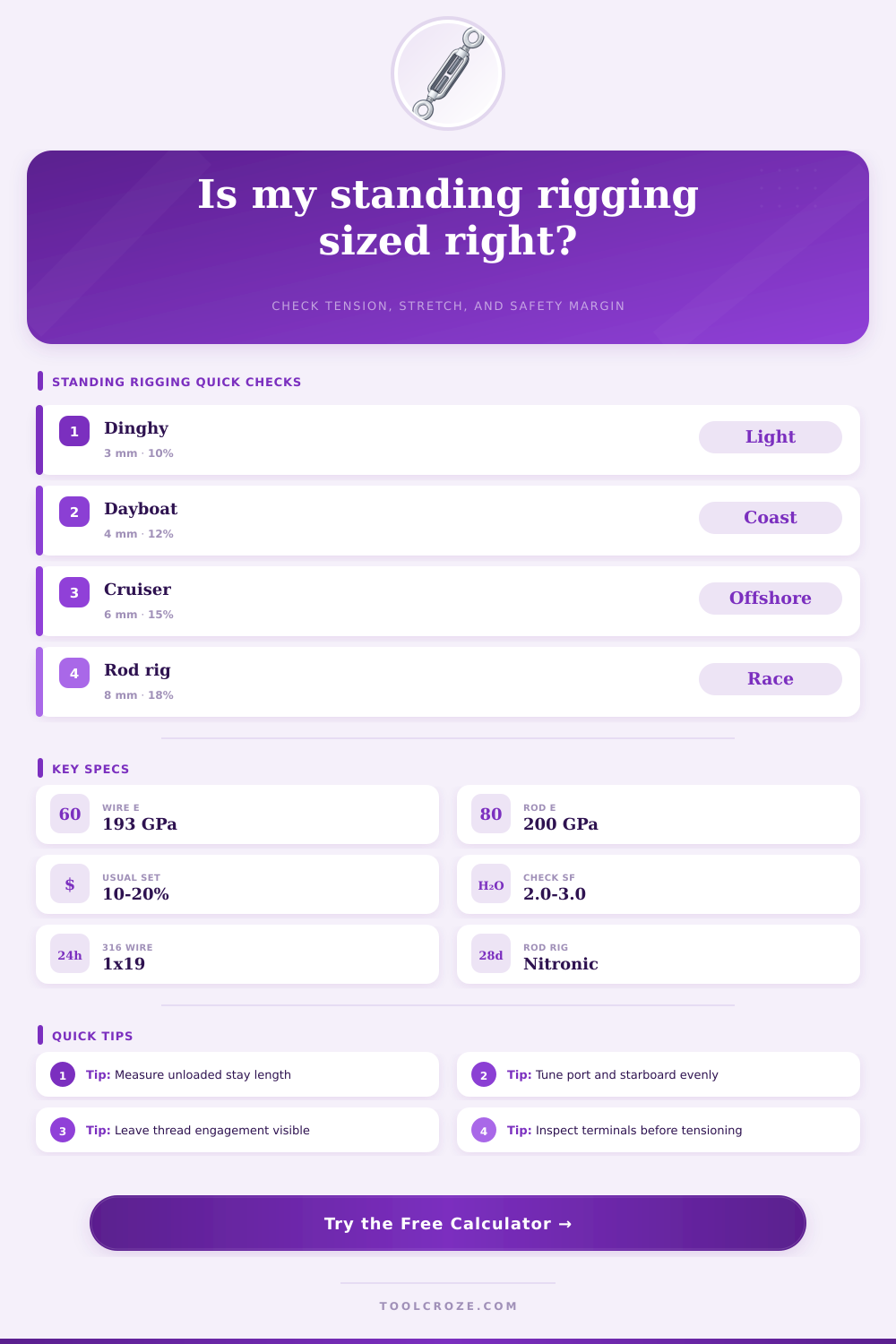
The person can adjust this value by using the turnbuckles that is attached to the standing rigging. The pretension should be set between ten and twenty percent of the published breaking strength of the standing rigging; boats that race may have a pretension closer to twenty percent of the published breaking strength. If the pretension is too low, the mast may pump and the forestay may sag.
If the pretension is too high, the chainplates and the spreaders may be continuously under load even when the boat is not experiencing wind or other external loads. The individual can use the force indicated by the calculator to compare the standing rigging to the tension gauge on the boat. Elastic stretch is the lengthening that will occur in the standing rigging as the standing rigging is subject to loads.
Even wires and rods are made of stiff materials, they will stretch when they are subject to loads. The turnbuckles will absorb this elastic stretch. The elastic stretch of the standing rigging is dependent upon the modulus of the material of the standing rigging, the length of the standing rigging, and the stress that is placed into the standing rigging.
Rods have a higher material modulus than 1×19 wire, meaning that rod will stretch less than 1×19 wire of the same diameter. For these reasons, many performance boats utilize rod stands for their standing rigging systems. The downside to this material choice is that rod is more expensive than 1×19 wire and requires more maintenance to stay in good standing rigging shape.
Safety factor is the number that is calculated to indicate how much extra strength the standing rigging system has compared to the loads that are placed into it. The safety factor should be between two and three for the standing rigging system. A safety factor lower than the recommended factors indicates that the standing rigging system does not have much room for errors or external loads.
However, this does not mean that the standing rigging system will fail. The calculator can calculate the safety factor so that the crew can understand if the standing rigging system has a sufficient margin of safety. Turnbuckle adjustment refers to the adjustment of the tension of the standing rigging by adjusting the turnbuckles.
The calculator allows the person to determine the number of turns that will be required to maintain the rig tune. The elastic movement of the standing rigging will affect the number of turns that will be required; if the elastic movement is high, the person may run out of travel for the turnbuckle adjustments. The boats manufacturer will specify a minimum number of threads of engagement for the turnbuckles.
To be conservative in the adjustment of the turnbuckles, the calculator will use a multiple of the diameter of the standing rigging. The material of the standing rigging will have an effect upon the functioning of the standing rigging. Materials can have different strengths and elastic movement.
Common standing rigging materials include 316 stainless 1×19 wire; this material is relatively inexpensive and resists corrosion. Compact strand wire has higher strength and less elastic movement than 1×19 wire, making it useful for backstays. Nitronic rod has a very high modulus; it will stretch less than other standing rigging materials.
However, rod requires maintenance to ensure that the standing rigging system remains in good standing condition; the surface defects in Nitronic rod may lead to cracks. Galvanized wire is used on many traditional boats. The zinc on the wire can corrode; thus, regular inspection is required.
There are many variables of the standing rigging that the calculator does not measure. For example, the chainplates, toggles, and spreaders will impact how the standing rigging is loaded. The temperature of the standing rigging may change due to the temperature of the water; thus, the standing rigging may need to be retuned if the water temperature changes.
In addition to these variables, the standing rigging and tension gauge are required tools for any boat crew; a calculator cannot replace the necessity of these tools. A common mistake in the adjustment of the standing rigging system is to not understand that the published breaking strength of the standing rigging is not the same as the working load. Other common mistakes include the failure to understand that the terminals into which the standing rigging is attached may be weaker than the standing rigging itself.
In this situation, the terminals may fail, not the standing rigging. Another common mistake is to adjust only one side of the boat. Both the port and starboard standing rigging components should be adjusted together so that the mast stays in a straight column.
If only one side of the boat is adjusted, the boat may develop a permanent list, as well as mast fatigue spots. The standing rigging calculator is a helpful tool for those that design boats or adjust the standing rigging on boats. The calculator cannot replace a qualified rigger, but it does provide assistance to those that would like to learn more about standing rigging systems.
In any case, with the information from the calculator, a person can begin to solve standing rigging problems before they develop into expensive repairs.