Soft Shackle Calculator
Estimate synthetic soft shackle working capacity from rope diameter, fiber, rated strength, bury length, knot efficiency, bend radius, derates, load demand, and safety factor.
1 Soft shackle presets
2 Inputs
3 Synthetic rope spec comparison
4 Fiber and rope comparison table
| Fiber / construction | Strength behavior | Bury target | Soft shackle use |
|---|---|---|---|
| HMPE Dyneema SK78 12-strand | Very high strength, low stretch | 72 rope diameters | Common recovery and marine soft shackles |
| HMPE Dyneema SK99 12-strand | Higher strength, compact diameter | 72 rope diameters | Race boats, compact high-load links |
| Spectra / HMPE utility braid | High strength with brand-specific ratings | 72 rope diameters | General synthetic rigging when tagged |
| Technora blend | Better heat tolerance, lower peak MBS | 50 rope diameters | Hot or abrasion-prone contact zones |
| Vectran single braid | Low creep, firm hand | 50 rope diameters | Precision marine control links |
| Polyester double braid | Moderate strength, good UV stability | 42 rope diameters | Utility soft links, not compact recovery |
| Nylon utility braid | Lower strength, high stretch | 36 rope diameters | Only light duty or elastic restraint |
5 Knot, bury, and bend reference
| Feature | Typical factor | What improves it | What reduces it |
|---|---|---|---|
| Commercial tested soft shackle | 0.80 | Proof test, batch data, controlled splice | Untested copies or altered closure |
| Double diamond button knot | 0.72 | Even dressing and long tails | Loose button or crossed strands |
| Single diamond button knot | 0.65 | Firm set, smooth entry, buried tails | Sharp bend at button throat |
| HMPE bury at 72 diameters | 1.00 | Tapered bury and locked construction | Short bury, no lock, slick contamination |
| Bend D/d at 4:1 or more | 1.00 | Large rounded hardware | Narrow hook, square edge, small pin |
| Bend D/d below 2:1 | 0.65 to 0.85 | Thimble, bigger pin, dogbone | Repeated loading over tight radius |
6 Safety factor planning table
| Use case | Typical SF | Use only when | Extra caution |
|---|---|---|---|
| Controlled static pull | 2:1 to 3:1 | Load is measured and no shock is expected | Do not stand in recoil path |
| Off-road recovery planning | 3:1 to 4:1 | Recovery points are rated and aligned | Shock loads can exceed estimates |
| Marine standing rigging aid | 4:1 to 5:1 | Loads are known and inspected often | Salt, UV, and chafe age rope |
| Hoisting-style rigging | 5:1 or higher | Qualified rigging plan verifies every component | Use certified hardware and local rules |
| Personnel-adjacent exclusion zone | 7:1 or more | Engineered system and redundant controls exist | Soft shackles are not fall-arrest gear |
7 Example soft shackle sizes
| Finished shackle | Common rope | Approx MBS range | Common application |
|---|---|---|---|
| Small sailboat loop | 5 to 6 mm HMPE | 4,000 to 7,000 lb | Low-friction rigging and deck fittings |
| ATV recovery link | 1/4 in HMPE | 7,000 to 9,000 lb | Light recovery, tie points, bridle links |
| 4x4 winch shackle | 3/8 in HMPE | 18,000 to 22,000 lb | Recovery points and synthetic winch lines |
| Heavy truck recovery | 1/2 in HMPE | 30,000 to 40,000 lb | Large bridle and recovery assemblies |
| Heavy equipment link | 3/4 in HMPE | 70,000 to 90,000 lb | Oversized recovery and utility pulls |
8 Practical notes
Soft shackles is often used in place of steel shackles due to the fact that soft shackles are typically lighter in weight than steel shackles. Additionally, soft shackles dont rust like steel shackles. Furthermore, in the case of a soft shackle break, the synthetic rope is less likely to become a dangerous projectile than could occur with the breakage of a steel shackle.
A soft shackle typically consist of a length of synthetic rope that has a buried splice at one end, and a knot or button at the other end. The strength of a soft shackle can be broken down into several different variable. For instance, the diameter of the rope, the fiber type, the length of the bury, the type of knot that is used, and the bend radius of the hardware can influence the strength of the rope.
How to Use and Check Soft Shackles
Each of these variables has the potential to alter the working capacity of a soft shackle if any of those variable are altered. A calculator are available that will help to determine the working capacity of the soft shackle if the user enters the variables of the rope into the calculator. The calculator will remove the guesswork in determining the working capacity of the shackle, as it can perform the mathematical calculation for the user.
However, the calculator cannot determine the condition of the rope. Additionally, the calculator cannot determine if the anchor point will be able to support the load that is to be applied to the shackle. HMPE ropes, such as Dyneema, are among the strongest type of synthetic rope available.
HMPE ropes are typically stronger than polyester or nylon ropes of the same diameter. However, the strength of the HMPE rope is only as good as the bury and knot that is used with the rope. For instance, if the bury is too short or the knot is loosely tied, the effective strength of the soft shackle will diminish.
The calculator accounts for these types of loss in the calculation of the working capacity of the soft shackle. Another critical variable is the bend radius of the hardware to which the soft shackle is attached. Many individuals do not consider this variable when using a soft shackle.
The radius of the bend in the rope could lead to damage the rope due to the way in which the rope is not designed to experience these types of bends. The D/d ratio that can be observed in the calculator will allow the user to see how the hardware they are using is helping or harming the rope. If more than one shackle is used to recover a vehicle, then each shackle will share the load.
If the geometry of the shackles and hardware is not perfect, then the load will not be shared equally. This imperfection in load sharing can be accounted for in the calculator, but only if the user can provide the proper measurement of the geometric variables. A safety factor is used in the planning of the recovery of a vehicle.
For example, a 2-to-1 safety factor in a controlled recovery of a vehicle may be used. For example, a 3-to-1 safety factor could be used for the recovery of a vehicle. For instance, if people will be working near the load or if the recovery will involve overhead work, then a 5-to-1 safety factor can be used.
A higher safety factor will be required in these situation due to the fact that the load will increase to a higher factor than that which was calculated for the soft shackle. The condition of a soft shackle also have an effect on its working capacity. For instance, if the rope has been exposed to the sun, if the rope has become dirty with dirt that has entered the rope, or if the rope has experienced many bend, the working capacity of the rope will diminish.
This derate of the working capacity of the soft shackle can be accounted for in the calculator. However, it may be more beneficial to retire the soft shackle altogether due to wear and tear on the rope. For instance, if the rope has glazed spot or fuzzy spot, it will not regain its strength.
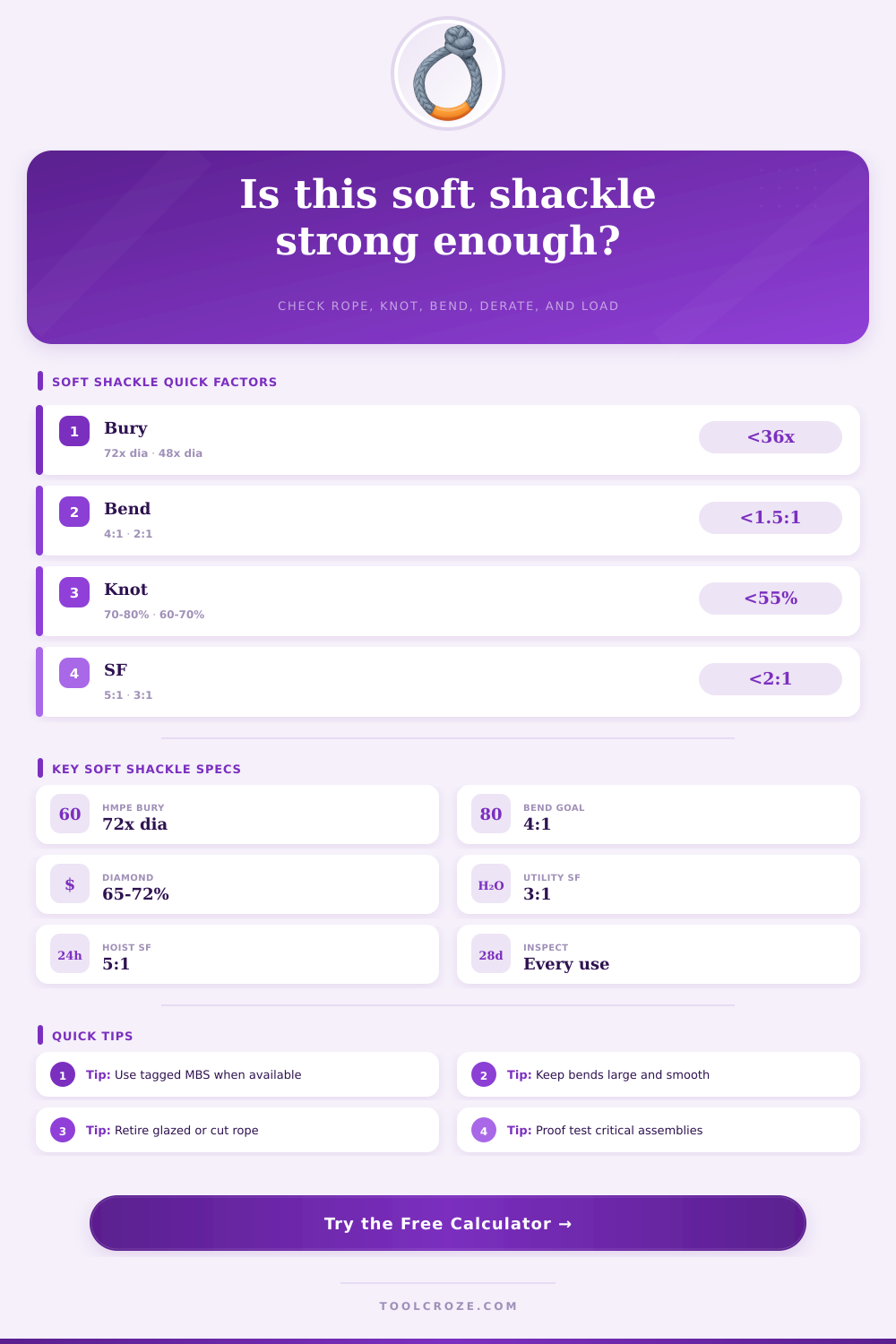
There are also reference tables that provide information that can be used as a means of determining the variables for the calculator. The reference tables include information about the targets for the bury length, the efficiency of the knots, and the safety factor that are established in several industries. These reference tables do not replace the minimum breaking strength that is provided by the rope manufacturer, but they can help the user to determine if the factors that are established for the soft shackle are realistic.
Soft shackles are not an interchangeable term for steel shackles, even if the diameters of the shackles are similar. For instance, if one experiences a break in the shackle, the failure mode for steel shackles is visible, whereas there is no way to know if the synthetic rope has lost its strength. Therefore, it is necessary to perform an inspection of the soft shackle prior to each use of that particular shackle.
If the soft shackle is found to be stiff, if it has melted spot, or if the shackle has any cut strand, the calculator will not render the soft shackle as safe to use. Overall, one of the main values of using the calculator is that it forces the user to consider each of the variable that can impact the strength and working capacity of the soft shackle. By performing each of these calculations, people often begin to notice detail about the recovery site that the calculator cannot see for itself.
For instance, details about the anchor point or recovery point, or even the condition in which the rope has been stored will begin to become obvious to the user. These details can have a major impact upon the actual use of the shackle. Thus, the calculator cannot force the user to perform their recovery as it wish, but the user should use their own judgment when employing the soft shackle.