WHC Sling Calculator
Estimate working hook capacity, wire rope WLL, hitch configuration, sling angle tension, hardware derates, center-of-gravity shift, and safety margin for a rigging plan.
1 WHC rigging presets
2 Sling, hook, hitch, and load inputs
3 Hardware and sling spec grid
4 Hitch and angle reference tables
| Hitch | Base factor | Typical WHC use | Watch item |
|---|---|---|---|
| Vertical straight | 1.00 per leg | Direct pick points | No sling protection from sharp edges |
| Choker | 0.75 before throat angle | Pipe, bundled stock, rough shapes | Choke point, rotation, and throat angle |
| Basket | 2.00 before angle | Cradled beam or balanced load | Load can slide if basket is not captured |
| Multi-leg bridle | 1.00 per leg | Machinery with rated lift eyes | COG imbalance and unequal leg length |
| Sling angle | Sine factor | Tension multiplier | Practical note |
|---|---|---|---|
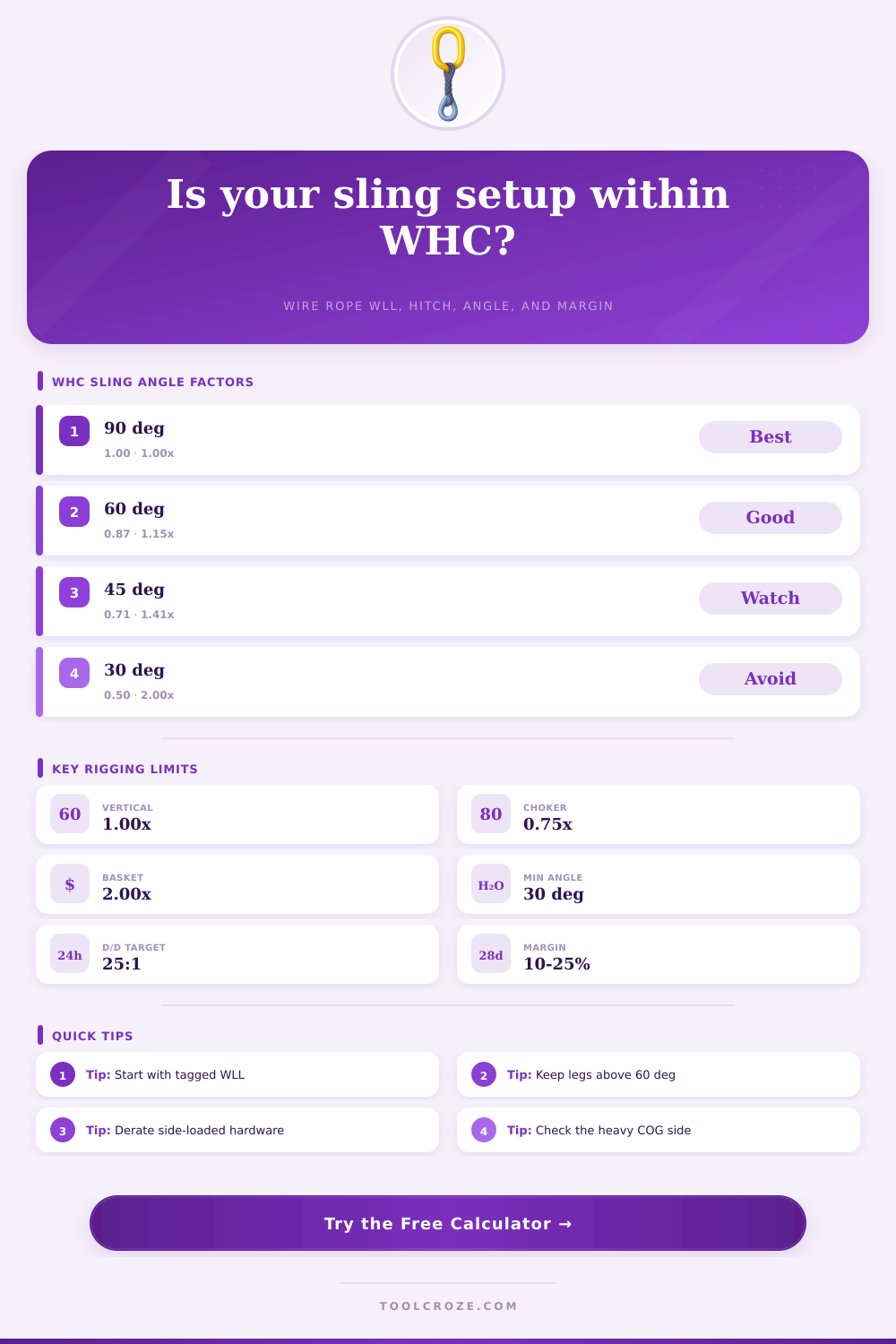
| 90 deg from horizontal | 1.000 | 1.00x | Vertical legs, lowest tension for the load share |
| 60 deg from horizontal | 0.866 | 1.15x | Common controlled rigging target |
| 45 deg from horizontal | 0.707 | 1.41x | Needs capacity review before lifting |
| 30 deg from horizontal | 0.500 | 2.00x | Avoid unless engineered and documented |
5 Wire rope and hardware derate references
| D/d ratio | Efficiency factor | Typical contact | WHC note |
|---|---|---|---|
| 25:1 or higher | 1.00x | Large sheave or wide hook bowl | Preferred for maintaining tagged WLL |
| 20:1 to 24:1 | 0.95x | Fair sheave or round load edge | Small reduction for bend stress |
| 15:1 to 19:1 | 0.90x | Moderate bend contact | Review rope construction and tag data |
| 10:1 to 14:1 | 0.80x | Tight hook or small diameter load | Often needs padding or larger bearing |
| Below 10:1 | 0.70x | Sharp or tight wrap | Do not rely on this without competent review |
| Hardware condition | Derate used | Applies to | Field check |
|---|---|---|---|
| In-line, seated | 1.00x | Hook, shackle, master link | Pin and saddle aligned with load path |
| Minor angular pull | 0.90x | Shackles and master links | Angle is visible but controlled |
| Shackle side pull | 0.80x | Bow shackle body or pin | Use maker chart when available |
| Hook side loading | 0.75x | Hook throat or latch area | Avoid side pull where possible |
| Unverified hardware | 0.60x | Unknown or unreadable markings | Remove from critical lifts |
| Spec item | What to read | Calculator field | Do not assume |
|---|---|---|---|
| Wire rope sling tag | Vertical, choker, basket WLL | Sling WLL per leg | That all hitches share one rating |
| Hook block | Rated capacity and reeving | Hook block rated WHC | That hoist line capacity equals hook rating |
| Shackle or link | Working load limit and angle chart | Shackle or master link WLL | That side load is acceptable |
| Lift points | Rated direction and thread depth | Use as limiting hardware | That eyebolt ratings are omnidirectional |
6 Practical WHC rigging tips
The WHC sling calculator is a tool that will assist a person with calculating the tension and the capacity of a lifting operation. A lifting operation has many different variables that interact with each other to create a certain tension placed upon the rigging equipment. For instance, if a person changes the angle of the sling, the sling will change the load on each of the legs of the sling, which will change the capacity of the hook and shackle.
Thus, each of these variables interact to create the safety of the lifting operation, and a person must account for each of these variables with the WHC sling calculator as calculating each of these variables manually can lead to errors. To operate the WHC sling calculator, a person must enter four different variables into the calculation. These four variables are the weight of the load to be lifted, the number of legs of the sling, the type of hitch that will be used, and the angle of the sling from the horizontal.
How to Use the WHC Sling Calculator
For instance, if a person uses a vertical hitch, the tension multiplier will be set to one. If a person uses a basket hitch, the multiplier will begin at two. Should a person use a choker hitch, the multiplier will begin at three-quarters.
These two multipliers will be further affected by the throat angle for choker hitches. The angle from the horizontal is used to calculate the sine of the angle, which will determine how much of the strength of the sling is fighting against the gravitational pull of the earth. If the angle is sixty degrees, the load will have a small tension multiplier.
If the angle is thirty degrees, the tension will double. However, the WHC sling calculator will automatically calculate the sine of the angle so that a person dont have to reference a sine table for the calculation. Another variable to consider with the WHC sling calculator is the dynamic factor of the lift.
In a shop with controlled environments, the dynamic factor may be set to one point one for the sling. However, for more blind picks of loads or lifts where the load may get stuck during lifting, the dynamic factor will be set to one point four. This dynamic factor will be applied to the load prior to calculating the capacity of the rigging equipment.
Thus, if a dynamic factor is selected, it will impact the capacity of the hook. Additionally, the WHC sling calculator will allow a person to select the dynamic condition that is applied to the load to be lifted so that the required working hook capacity accounts for the dynamic load. One of the most important variables to consider is the derating of the hardware.
The capacity of the hardware may not always be to it’s full capacity. For instance, a hook rated at twelve thousand pounds may only have a capacity of seventy-five percent if it is performing side loading of the load. Additionally, shackles may not have the same capacity if they are performing angular pulls.
The WHC sling calculator will account for these deratings and compare the adjusted capacity of the hardware with the adjusted load. This comparison will reveal if the hook will be the limiter of the sling or if the sling will be the limiter. Another variable that the WHC sling calculator will account for is the center of gravity of the load.
The sling will exert more tension on some legs of the sling than others if the center of gravity of the load is not centered within the middle of the load. The WHC sling calculator will allow a person to enter the percentage of the load that will be on the heavy leg of the sling. For instance, three or four legs can distribute the weight better than two legs.
However, there will still be an effect upon the tension that is exerted by the sling. The calculator will use this percentage to calculate the tension on the highest leg of the sling. This calculation will allow a person to ensure that no leg of the sling will exceed the capacity of that sling leg.
D divided by d (D/d) ratio is used for wire rope slings to account for the drop in efficiency of the wire rope when it is under sharp bends. If the ratio is above twenty-five to one, the wire rope will have its full capacity. However, if the ratio is below ten to one, the capacity will drop to seventy percent.
This ratio can be entered into the sling calculator prior to calculating the angle and hitch factors so that the effect of the D/d ratio will compound with each of the other sling factors. The last variable for the WHC sling calculator is the reserve margin. This value can be any percentage, but many people will use a fifteen percent reserve margin for routine lifting operations.
However, for lifting operations that may involve unknown variables, a twenty-five percent reserve margin may be used. The required hook capacity will be calculated based on the chosen reserve margin. Additionally, the sling calculator will calculate the actual margin of the sling operation.
If the actual margin is less than the target reserve margin, the sling operation will be flagged as “tight” or “over the limit.”
Many people make mistakes when utilizing the WHC sling calculator. For instance, the most common mistake is to use the vertical rating of the sling for every type of hitch. Additionally, people often do not use the angle of the sling until the lifting operation has begun.
Other mistakes are using the hook capacity for the line capacity of the sling. Additionally, people often make the same mistake of assuming that the center of gravity of the load is centered simply because it is represented as such on the drawing of the lifting operation. These mistakes all remove a safety factor from the lifting operation.
Using the WHC sling calculator with conservative variables does not eliminate the need of a qualified and experienced rigger. However, it does allow for better and precise communication between the rigger and the other members of the lifting operation. The reference tables included on the webpage are used to provide the coefficients for the WHC sling calculator.
The table for the hitch types explains why a basket hitch starts at two while a choker hitch starts at three-quarters. Additionally, the angle table explains the sine of the angle and the resulting tension multipliers for various working sling angles. The D/d ratio table and the hardware derate table provide an explanation for the reduction in capacity of the equipment.
These tables dont have to be memorized by the users of the calculator, but they do provide a means of determining whether or not the values that are entered into the calculator are realistic for the types of slings and hardware that will be used in the lifting operation. The WHC sling calculator is a lifting operation planning aid and does not model every variable that can exist in the field. For instance, the calculator does not model the potential for wind to create a side load on the load to lift.
Additionally, the slings may twist under the hook during lifting. Additionally, the load may settle in a different position than that which is represented on the drawing of that load. Thus, the sling calculator does not model each of these variables.
However, the calculations will eliminate any arithmetic errors that may be made by the person planning the lift so that a competent and experienced rigger can account for the variables that cannot be entered into the sling calculator. After the sling calculator indicates that the sling operation has a comfortable margin for the load and each of the deratings have been accounted for in the calculations, it is still necessary to physically inspect the hardware. The hook, shackle pins, and hook throats must be inspected so that the tags and the numbers for each piece of hardware match what is entered into the sling calculator.
The plan that the WHC sling calculator created may have indicated a scenario that is not true of the load that is to be lifted. Thus, a rigger should of checked the equipment manually. The modern equipment can be luxuruis but its still important to be careful.
When you are working on a project, you’re need to check the hardware for any damages. The equipment needs to be checked for any problems before you start. The rigger must verify that the equipment is in good condition.
This is very important to ensure safety. It can be alot of work but it is worth it. To make sure the job is done right, the rigger will inspect the equipment after teh load is lifted.
Most people dont realize how important this is. The rigger will also check the sling lengths to make sure they are correct. This is a naturaly important part of the process.