2 Leg Sling Calculator
Estimate two-leg bridle sling tension from load weight, geometry, included angle, per-leg WLL, hitch type, D/d bend reduction, center-of-gravity offset, and safety factor.
⚙Two-leg rigging presets
📐Load, geometry, and sling data
🧰Sling material and spec grid
📊Reference tables
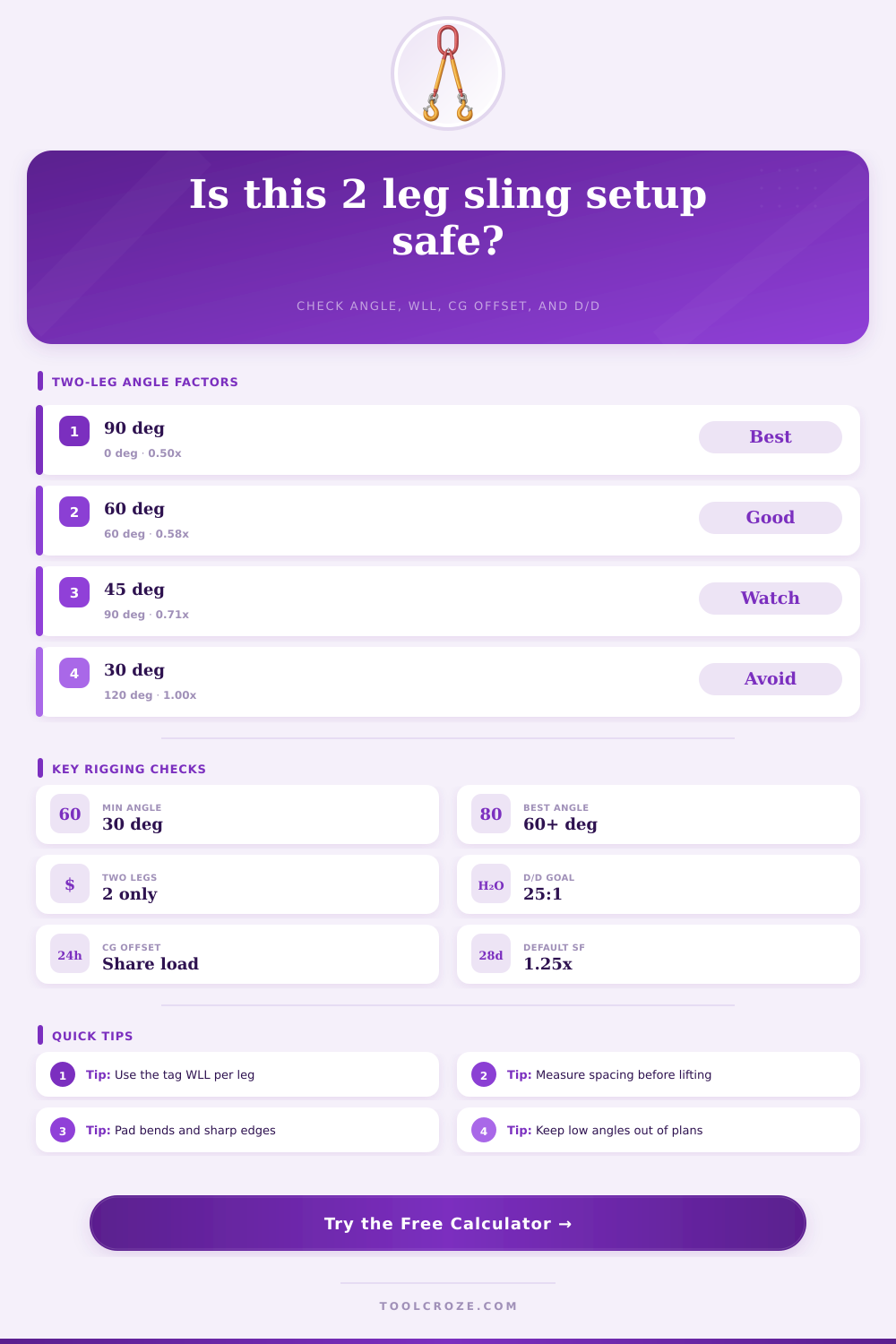
| Sling angle from horizontal | Included angle | Tension per leg for centered load | Rigging note |
|---|---|---|---|
| 90 deg | 0 deg | Load x 0.50 | Vertical two-leg lift; least leg tension |
| 60 deg | 60 deg | Load x 0.58 | Common preferred bridle target |
| 45 deg | 90 deg | Load x 0.71 | Usable only with enough WLL margin |
| 30 deg | 120 deg | Load x 1.00 | High tension; avoid unless planned by qualified rigging personnel |
| Hitch or connection | Planning factor used | Typical use | Field caution |
|---|---|---|---|
| Direct vertical eye | 1.00 | Two-leg bridle to rated hardware | Use the actual tag WLL and hardware rating |
| Choker hitch pair | 0.75 to 0.80 | Wrapped load with choking action | Choke angle and sling material may reduce further |
| Basket at each pickup | 1.50 | Cradled support at two points | Both basket legs must be controlled and seated |
| Hardware-limited | 0.90 | When shackles, eyes, or lugs govern | Small pins and side loading can control the lift |
| D/d ratio at bearing point | Factor used | Meaning | Planning action |
|---|---|---|---|
| 25:1 or better | 1.00 | Large bearing diameter | Still inspect edge radius and sling path |
| 20:1 | 0.95 | Light bend reduction | Good for many wire and synthetic checks |
| 10:1 | 0.85 | Moderate loss from tight bend | Add pads, thimbles, or larger shackles |
| 5:1 or lower | 0.75 or less | Heavy bend reduction | Review before lift and improve contact geometry |
| CG offset as percent of half spacing | Leg A share | Leg B share | Use in calculator |
|---|---|---|---|
| 0% | 50% | 50% | Centered load between pick points |
| 25% toward B | 37.5% | 62.5% | Higher B tension controls WLL |
| 50% toward B | 25% | 75% | Strong imbalance; check lugs and rotation |
| 75% toward B | 12.5% | 87.5% | Usually needs revised pick plan or spreader |
ℹPlanning tips
Two-leg slings are used in rigging applications in which a person need to lift a load from more than one point at the same time. There are several variable in a two-leg sling that can change the tension in each leg of the sling. These variables include the angle of the sling, the hitch type, the center of gravity of the load being lifted, and the material of the sling.
Each of these variables can change the tension in a two-leg sling in such a way that the tension in the sling can exceed the Working Load Limit of the sling. For these reasons, a planning tool is necessary to calculate each of these variables to ensure that a person does not exceed the Working Load Limit of the sling. The tension in each leg of the two-leg sling will rarely be half of the total load weight.
How to Check Tension in Two-Leg Slings
The angle at which the legs of the sling are attached to the load can have a tremendous effect on the tension in each leg. If the person moves the angle of the two-leg sling away from vertical, the tension in the legs increase. If the person makes the angle shallow, the tension in each leg increases.
Additionally, the load that is being lifted may not have its center of gravity in the middle of the load. In these cases, each leg of the two-leg sling will experience a different tension force. A calculator can manage these computations if the person knows the weight of the load, the angle of the sling, the hitch type, sling material, and the D/d bend ratio of the sling.
This will provide the tension in each leg of the two-leg sling, the adjusted working load limit, and the utilization percentage of the sling. The angle at which many underappreciate rig the two-leg sling is a variable. If the angle of the two-leg sling is 60 degrees from the horizontal, the increase in tension in each leg is modest.
If the two-leg sling is at a 30 degree angle from the horizontal, the tension in each leg can double. This angle can be entered in degrees into a calculator, or the angle of each leg of the sling from the horizontal or the length of each leg can be entered in the calculator. A reference table can also be used to determine the increase of tension that will result from each of the common angle increments of a two-leg sling.
The table can show a person that the tension of the sling increases steeply if the angle of the sling becomes shallower than 45 degrees from the horizontal. The type of hitch that a person uses can also increase or decrease the capacity of a two-leg sling. For instance, if a person uses a choker hitch, the sling will have less capacity than if the person used the basket hitch or other hitch.
A basket hitch has the potential to increase the capacity of the two-leg sling, but it will only do so if the sling does not allow the load to roll within the basket. Additionally, hardware limited connections will have a limit that is less than the two-leg slings capacity. A calculator will apply a planning factor to each hitch type so that the adjusted Working Load Limit for each sling is correct.
Another factor that may affect the tension in a two-leg sling is the offset of the center of gravity of the load. If the loads center of gravity is not even with the center of the sling, one leg of the sling will have more tension in that leg than the other. A calculator can take this offset into account when calculating the tension in each leg of a two-leg sling.
A small offset may allow each leg of the sling to remain within its limits. A large offset, however, may cause one leg of the sling to be exceeding its limits. The leg with the higher tension value will be the controlling leg for the load being lifted.
Another factor in the calculation of each leg of a two-leg sling is the D/d ratio of that sling. The strength of the sling may decrease if the sling is bending around a diameter that is too small for the thickness of the sling. The loss of strength of a two-leg sling is gradual at first when the D/d ratio is decreasing, but the loss of strength increases rapidly once the ratio drops to 10 to 1.
A calculator will apply a factor for the D/d ratio of the sling and apply the hitch factor and safety factor to arrive at the adjusted Working Load Limit for the two-leg sling. If the utilization percentage of the sling is too high, the person may want to use a larger sling or increase the bearing diameter, use a different hitch type, or even use larger slings. The material used in the sling has an influence on the Working Load Limit of that sling.
For instance, chain slings have a high degree of strength, will stretch very little, and can tolerate high temperatures. However, each link and each grab hook of a chain sling will need to be inspected to ensure that it is not damaged. Wire rope slings can stand the rigors of heavy use and wear.
However, if the wire rope has broken wires or kinks in the rope, it will lose strength. Synthetic web slings and round slings are lightweight and can be used on a variety of surfaces. However, the synthetic slings will need to be protected from cuts, heat, and chemicals.
A two-leg sling calculator will use the data for each of these materials so that a person does not have to remember each of the limits for each material. The dynamic and safety factors are included in a calculation plan for a two-leg sling. However, these factors are not physical aspects of the sling.
For static lifts, the higher end of the dynamic factor can be used. If there is any chance of shock or lateral loading of the load, a higher dynamic factor will need to be used. A sling calculator will use the dynamic factor to multiply the calculated load to find the tension that each leg of the two-leg sling must be able to support.
The calculator will divide the adjusted working load limit by the safety factor of the sling. This will produce the utilization percentage. The numbers that are calculated for a two-leg sling must be verified with the actual rigging that will be used.
The measurements taken from the load will be different than the drawings of the rig. Using the same sling calculator, a person can enter the field measurements for the angle of the sling, the pickup point spacing, and the offset of the center of gravity to find the updated utilization percentage. If this percentage is too high, shortening the legs of the sling will increase the angle of the sling.
Using a spreader bar will even out the tension between the two legs of the sling. Using larger slings will also help to even out the load on each leg of the sling. Common mistakes are made with two-leg slings when rigging them.
One of the most common mistakes is using the Working Load Limit of the sling without applying any factors for the angle of the sling, the hitch, or the D/d ratio of the sling. The second most common mistake is ignoring the offset of the center of gravity of the load. A third common mistake is to think that each of the legs of a two-leg sling will share the same portion of the load because they are the same size.
A sling calculation calculator will calculate for each of these factors so that the person is unable to make these mistakes. A two-leg sling can be considered a machine that uses the geometry of the rigging and the physical condition of the sling to perform its task. The sling calculator makes the geometry of the sling and the physical condition of the sling visible to the person in the form of numbers.
If the utilization percentage is within the limits of the sling and the field measurements of the sling match the calculations, the two-leg sling can be used to lift the load. If the numbers indicate that the sling may fail, the calculator will provide suggestions for how to adjust the sling to ensure its strength.