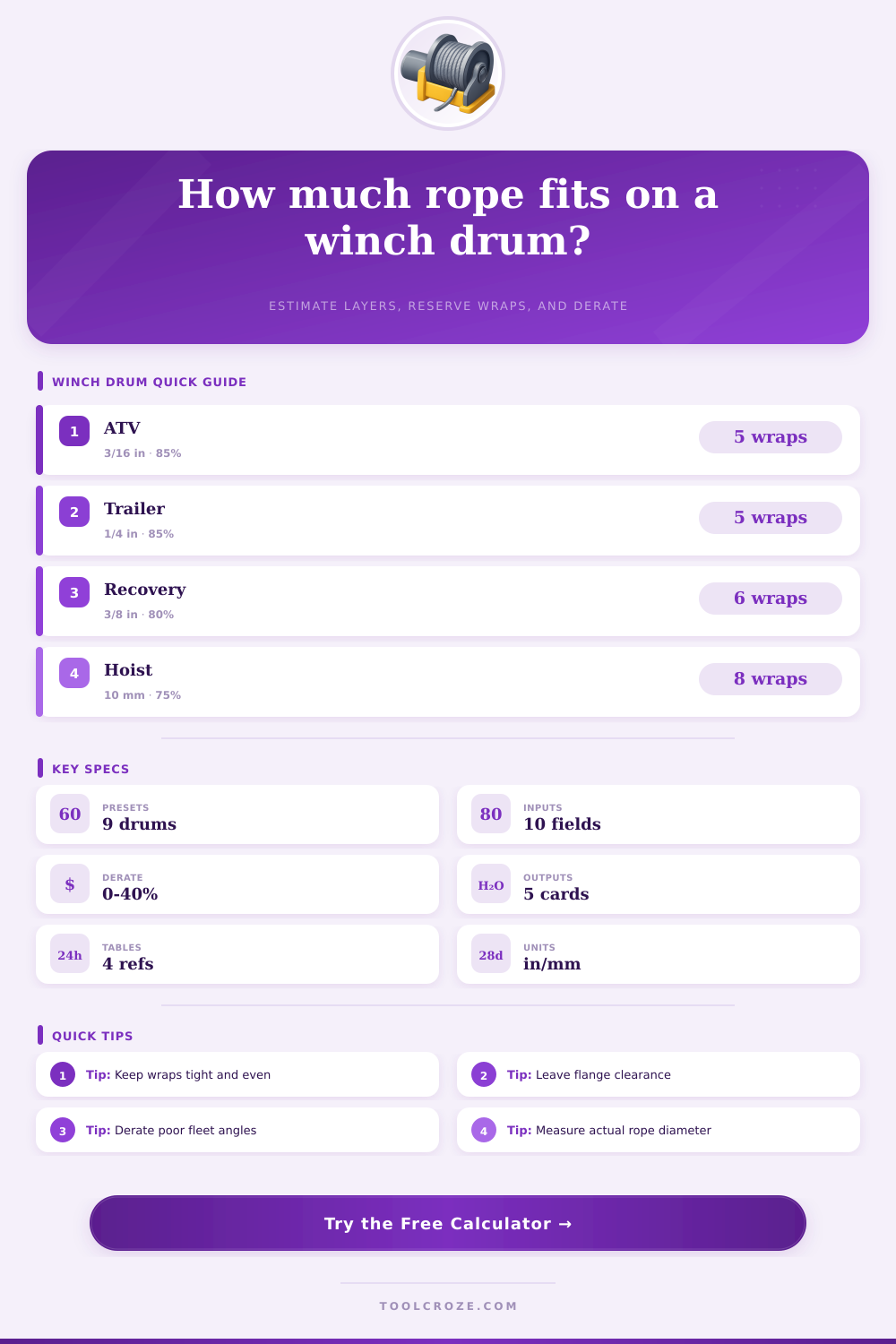
Winch Drum Capacity Calculator
Estimate how much wire rope, synthetic rope, or cable will fit on a drum after layer packing, minimum wraps, flange fill, and fleet-angle derating.
⚙Drum and winch presets
Use a preset as a realistic starting point, then replace the dimensions with your drum drawing or measured spool.
📏Calculator inputs
Winch drum result
📊Cable, drum, and spec comparison grid
📄Reference tables
| Rope or cable | Typical planning diameter | Packing factor | Capacity note |
|---|---|---|---|
| 3/16 in wire rope | 0.1875 in / 4.8 mm | 86-90% | Small utility and ATV winches |
| 1/4 in wire rope | 0.250 in / 6.4 mm | 84-89% | Trailer, shop, and light pulling drums |
| 3/8 in wire rope | 0.375 in / 9.5 mm | 82-88% | Vehicle recovery and light industrial drums |
| 10 mm synthetic rope | 0.394 in / 10 mm | 78-86% | Capacity varies with tension and cover wear |
| 1/2 in wire rope | 0.500 in / 12.7 mm | 80-86% | Industrial hoists and larger pulling drums |
| Drum use | Usable fill | Reserve wraps | Planning comment |
|---|---|---|---|
| Storage reel | 88-92% | 2-4 | Best with guided winding and low load |
| Trailer winch | 82-88% | 4-5 | Leave clearance for uneven hand tension |
| Recovery winch | 78-85% | 5-6 | Shock loading and side pulls need margin |
| Lifting hoist | 70-80% | 6-8 | Use the approved hoist drum specification |
| Forestry drum | 75-84% | 5-8 | Mud, crush, and cross-winding reduce packing |
| Fleet angle condition | Suggested derate | Visible symptom | Capacity effect |
|---|---|---|---|
| Lead fairlead aligned | 0-3% | Even wraps across width | Near calculated capacity |
| Small side lead | 4-8% | Light build-up at one flange | Minor loss of full-width packing |
| Moderate fleet angle | 9-15% | Frequent side piling | Lower fill before flange contact |
| Severe side pull | 16-30% | Rope stacks or crosses hard | Capacity can fall sharply |
| Uncontrolled winding | 30-40% | Loose, uneven layers | Use a measured spool test |
| Formula item | Expression | Units | Why it matters |
|---|---|---|---|
| Allowed top diameter | Db + (Df - Db) x fill% | in or mm | Limits rope below the flange edge |
| Layer count | floor((Dtop - Db) / (2d)) | layers | Counts complete radial layers only |
| Wraps per layer | floor(W / d x pack%) | wraps | Models how many side-by-side wraps fit |
| Layer length | wraps x pi x (Db + (2i - 1)d) | in or mm | Uses centerline circumference per layer |
| Usable length | (gross - reserve) x derate | ft or m | Subtracts anchor wraps and winding loss |
💡Planning tips
Winch drum capacity are not just the length of the rope that can fit on the winch; rather, winch drum capacity is the result of several different measurement that go into calculating that capacity. If the calculations is made incorrectly or with inaccurate measurements, the winch may find itself in a situation where the rope runs out of room before the job is completed, or the rope may climb the flange off of the winch drum altogether. The first of the measurements that must be accounted for is the diameter of the winch drum’s barrel.
The diameter of this barrel will ultimately determine the circumference of the first layer of rope that can be place upon the winch drum. As additional layer of rope are placed upon the winch drum, the diameter of the winch drums installed rope will increase accordingly. Additionally, a percentage of the winch drums capacity that is to be filled will need to be chosen.
How to Calculate Winch Drum Capacity
A percentage that is set to a low figure will allow for some margin for error such that the rope does not climb the flange of the winch, but a higher percentage indicate that the rope will be under tension during operation of the winch, and the fleet angle of the winch will remain steady. The diameter of the rope that is to be used will impact the total length of the rope that can be stored on the winch drum. It is possible for the rope that is rated at a specific diameter to be more slightly larger in measurement, especially if the rope is synthetic in its construction, or if the rope has become fuzzy with extensive use.
A factor that accounts for the length of the rope that can be stored based off the diameter of the winch drum can include a packing factor for the rope. A higher packing factor indicates that the rope will have a lower degree of friction against the winch drum, such as if the rope is stiff in nature, which can allow for fewer wrap of the rope to be stored on the winch drum before the rope becomes overloaded. The number of wraps of the rope that will remain on the winch drum as a result of the winch anchor indicates the number of reserve wraps of the rope that should be accounted for in the calculation of the winch drums capacity.
In jobs that are to be performed with winch and rope setups, the number of reserve wraps can be more than the number of wraps that are stored on reels of rope that are used for storage of the winchs rope; jobs that involve the recovery of winchs and their attached objects will require more reserve wraps than jobs in which the winch is used for storage purposes alone. The number of reserve wraps can be accounted for in the winch drum capacity calculator to determine the usable length of the rope. The angle at which the winch’s lead sheave is positioned in relation to the winch drum can cause issue for the rope; the rope may climb the flange of the winch drum if it is not aligned with the centerline of the winch drum.
In these situations, the winch manufacturer may provide a fleet angle derate to account for the portion of the rope that will travel along the flange instead of wrapping around the winch drum; if applied to the winch drum capacity calculations, the usable length of the rope can be reduced to accurately reflect the length of the rope that will actualy wind around the winch drum. Finally, different profile may be used for winch drums that will experience different types of use. Profiles can account for different loading conditions of winches and drums; winches that perform lifting work may use a different duty profile than winches that perform forestry skidding work.
For example, forestry skidding winches are often exposed to mud and sudden changes in the direction in which the winch is moving; such changes in direction may lead to the loosening of the ropes that are wrapped around the winch drum. Thus, each winch drum will have a different duty profile based upon the different types of work in which it will be utilized. It is easy for many people to make the mistake of choosing the gross capacity of the winch drum over the usable length of the rope.
The gross capacity of the winch drum is the total length of the rope that can be accounted for in the winch drum if every inch of the winch drum is utilized by the rope. To account for the number of reserve wraps of the rope that is to remain on the winch drum, and for the effect that the fleet angle may have upon the length of the rope that can wrap around the winch drum, the gross capacity of the winch drum must be reduced to determine the usable length of the rope that can actually wind around the winch drum. Additionally, the diameter of the rope that is to be used should be measured with the winch, rather than utilizing the nominal diameter of the rope as the measurement that impacts the winch drum capacity calculations; the actual diameter of the rope will impact the length of the rope that can fit within the winch drum altogether.
If the calculated usable length of the rope is shorter than the length of rope that is required to accomplish the task that will be performed, there are several options for correcting such a situation. The number of reserve wraps of the rope can be reduced. The fill percentage of the winch drum can be reduced to allow for additional wraps of rope to be accounted for.
Finally, the diameter of the rope can be reduced to allow for the winch to incorporate the same number of wraps of rope around the winch drum. In addition to the factors that are accounted for in the capacity calculations for the winch drum, there are a few additional factors in the real world that can affect the winch and winch drum. For instance, changes in the temperature at which the winch and rope are utilized will lead to changes in the stiffness of the rope.
Additionally, dirt that adheres to the rope can change the friction that the rope has against the winch drum. Due to the fact that the winch drum capacity calculator does not account for these factors, it is always best to perform a test run of the winch and rope in the location at which it will be utilized. These calculations should of been performed prior to ordering the winch rope.
The diameter of the winch drum’s barrel can be measured. The winch’s flange can be measured, as well as the clear width between the winch’s barrel and flange. The actual diameter of the rope can be measured, as well as the duty profile that will best account for the type of use of the winch.
Finally, the calculated usable length of the rope can be compared to the length that is required to perform the task that will be performed with the winch and its rope to ensure that the rope will be able to fit within the winch drum altogether.