
When a person walks into a professional shop or a person walks into an high-end garage, that person often feel as if that person is entering a different world. The air in these shops often smells of oil and is filled with the sound of metallic thumping. These metallic thumping sounds are the sound of pneumatic power, which is the use of compressed air to perform heavy lifting task.
While cordless battery tools have become increasingly common in the last few decades, pneumatic tools are still some of the best tools to use in tasks in which endurance, power, and lifespan are the most important factor. The effectiveness of pneumatic tools is based off the simplicity of those tools. Because pneumatic tools rely upon an external air compressor for their power instead of an internal motor or battery, pneumatic tools are typically smaller and lighter than motor or battery powered tools.
Additionally, since there is no internal motor or battery within the tool, pneumatic tools is less likely to burn out after a ten-hour shift. There are no batteries that will die partway through a project, and there is no fatigue caused by the weight of a motor. Instead, air is continuously supplied to the pneumatic tool and the tool can continue to perform until the task is complete.
When choosing the right tool for a task, it is important to determine what kind of task will be performed with that tool. For instance, are the tools that will be purchased must perform precision tasks? Or are the tools to be purchased for applying force to components to remove them?
Understanding these category ensures that individuals dont purchase a tool that is too delicate for the tasks that will be performed with it, or that will ruin the workpiece due to being too powerful for that object.
Common Types of Pneumatic Tools to Use
1. Air Impact Wrenches
Air impact wrenches are a category of tool that is often used to remove or tighten bolts and nuts. Air impact wrenches are among the most powerful tools in the toolbox in that they can generate a level of force that would injure a human wrist.
The hammering action of the tool, which is the component of the wrench that delivers the tightening force, is the component that create the rattling noise that is often heard from air impact wrenches when they are being used to remove a tire from a car. An air impact wrench is the only tool that will be able to loosen a bolt that has become rusted to a frame of a car for ten year. Air impact wrenches are the standard tool within automotive shops for good reason.
Air impact wrenches can provide the speed and power that is necessary to loosen bolts that a set of manual sockets cannot loosen. One of the disadvantages of air impact wrenches is the potential for over-tightening a bolt to the point of stripping the thread of that bolt. However, after some practice with an air impact wrench, individuals will be able to learn to master the timing of the wrenchs impacts to loosen an engine of an automobile in less time then it would of taken to perform the same task without the tool.
2. Pneumatic Nailers
Pneumatic nailers are a tool that works in a slightly different way than air impact wrenches. Pneumatic nailers use a piston to push fasteners into their desired materials at high speeds. For these reasons, pneumatic nailer are the tool of choice for individuals that perform framing, roofing, and cabinetry work.
Instead of having to hammer every single nail that needs to be driven into a piece of wood, an individual can simply squeeze the trigger on the pneumatic nail gun to perform the task of driving ten nails in a fraction of a second. There are various version of pneumatic nail guns for different types of materials. For instance, there are pneumatic nail guns that fire brad nails for delicate trim work, and there are pneumatic nail guns that fire large framing nails for constructing the skeleton of a house.
Additionally, pneumatic nail guns have the benefit of being able to ensure that all nails of a gun have the same depth. This prevents the nail heads from protruding from the material that is being nailable by the tool, or the nail heads from sinking too deep into the wood. The downside to pneumatic nail guns is the requirement of a steady supply of air to ensure the consistency in the depth of the driven nails.
If the air compressor is too weak, the pneumatic nail gun will not be able to produce consistent results.
3. Air Grinders
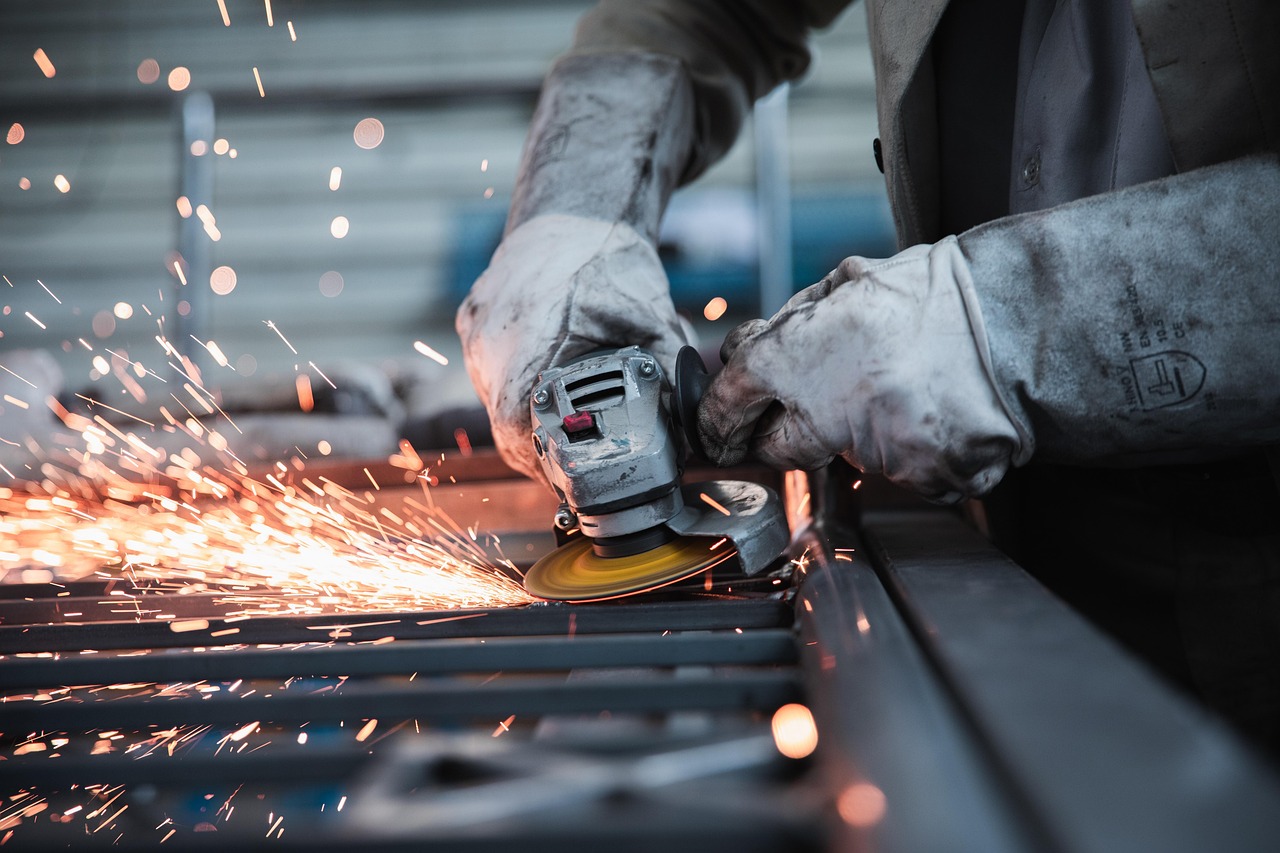
Air grinders are used to remove excess material from a workpiece, or to polish that workpiece to a smooth finish. Air grinders use rotating discs or burrs to remove metal, plastic, or stone from a project.
Air grinders can operate at a higher level of RPMs than a standard electric grinder. Because air grinders do not use a heavy motor within the tool, air grinders are relatively lightweight. This makes them ideal for working on vertical surfaces as they will not shake your arm.
Air grinders are often used to remove welds or to shape metal parts as needed for a fabrication shop project. Air grinders do create alot of dust and debris when in operation. The high-speed rotating discs will fling sparks and metal shards in many directions.
Although using an air grinder can be messy, the efficiency of the air grinder is very high when smoothing large areas of metal.
4. Pneumatic Chisels
Pneumatic chisels are high-speed hammers that will allow the worker to cut through concrete, stone, and metal without the use of a mallet. The reciprocating motion of a pneumatic chisel can turn a job that may take one hour of manual labor into a five-minute job.
Pneumatic chisels are used in demolition or in the repair of heavy machinery. The chisel is used to shear a rivet or to break a slab of cement. The vibration of the tool is often strong, so quality pneumatic chisels will feature some form of dampening to reduce the vibration in the tool that is held.
Using the pneumatic chisel for long periods will result in the vibration in the hand for hours afterwards. However, the increase in productivity makes the vibration in the hand a fair trade.
5. Air Sanders
Air sanders use a rotating and orbital motion to sand down metal or wood projects.
Air sanders are better than hand sanding for large projects. Air sanders use compressed air to spin the sanding disc that sands the project. By spinning the sander disc, air sanders can quickly and even remove material from a project.
This is important for tasks such as preparing a car body for paint. Air sanders will provide an even sanding without gouges that might be caused by the uneven pressure of hand sanding. The most common air sander is the random orbital sander.
Random orbital sanders will prevent the creation of swirl marks on the sanded project. The only disadvantage of air sanders is the consumption of air. Air sanders will use a lot of air to spin the sanding disc.
If the air compressor is too small, the air sander will slow down when applying any weight to the sander.
6. Pneumatic Spray Guns
Pneumatic spray guns will allow a worker to achieve a flawless finish on a project such as furniture or a vehicle. By using a pneumatic spray gun instead of a paint brush, the high-velocity air will atomize the paint.
The atomized paint will allow even lay the paint flat on the project. This even lay of the paint will result in the paint bonding evenly to the project. The result will be a professional look to the painted project.
Pneumatic spray guns require adjustments to the air pressure and fluid flow to achieve the best results. It takes time to get used to the spray gun to find the best settings to avoid paint defects. Once you find the best settings, large areas can be covered in a few seconds.
Although using a pneumatic spray gun requires a dedicated process to clean the gun after use, the visual result of the painted project is the reason for which people use these tools. From rebuilding a classic car to constructing a new home, the right air tool will make it easier to get the job done. These air tools will not only save you time but will also save your joints from the wear and tear that comes with manual labor.
All you need is an air compressor to power your tool of choice. As soon as you feel a bolt begin to loosen or a perfect coat of paint begins to dry, you will know that the pneumatic tools have made your work easier.
