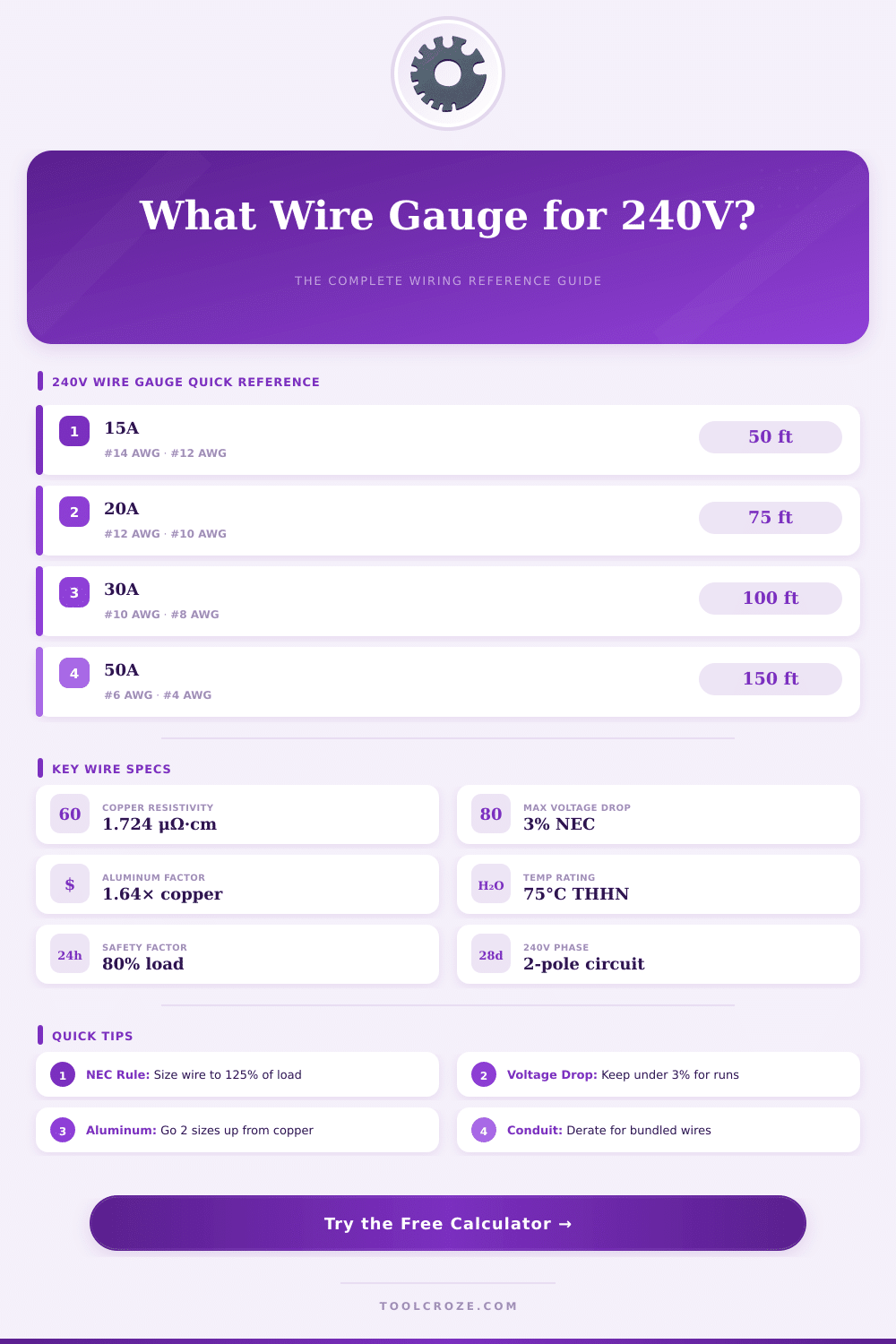
⚡ 240V Wire Gauge Calculator
Find the correct wire size for any 240V circuit — NEC-compliant, voltage drop verified
| AWG Size | Copper 60°C (A) | Copper 75°C (A) | Copper 90°C (A) | Aluminum 75°C (A) | Wire Dia (in) | Typical Use |
|---|---|---|---|---|---|---|
| #14 AWG | 15 | 15 | 15 | — | 0.064" | Lighting, small appliances |
| #12 AWG | 20 | 20 | 20 | 15 | 0.081" | General outlets, AC units |
| #10 AWG | 30 | 30 | 30 | 25 | 0.102" | Dryers, A/C, ranges |
| #8 AWG | 40 | 50 | 55 | 40 | 0.128" | Large A/C, small ranges |
| #6 AWG | 55 | 65 | 75 | 50 | 0.162" | Electric ranges, EV chargers |
| #4 AWG | 70 | 85 | 95 | 65 | 0.204" | Large feeders, hot tubs |
| #3 AWG | 85 | 100 | 110 | 75 | 0.229" | Heavy feeders |
| #2 AWG | 95 | 115 | 130 | 90 | 0.258" | Sub-panels, service entry |
| #1 AWG | 110 | 130 | 150 | 100 | 0.289" | Sub-panels |
| #1/0 AWG | 125 | 150 | 170 | 120 | 0.325" | 200A service components |
| #2/0 AWG | 145 | 175 | 195 | 135 | 0.365" | 200A service entry |
| #3/0 AWG | 165 | 200 | 225 | 155 | 0.410" | 200A main, 100A sub-panels |
| #4/0 AWG | 195 | 230 | 260 | 180 | 0.460" | Large service, 200A panels |
| 250 kcmil | 215 | 255 | 290 | 205 | 0.520" | Heavy commercial service |
| AWG Size | Ohms / 1000 ft | 30A @ 50ft V-Drop | 30A @ 100ft V-Drop | 50A @ 50ft V-Drop | 50A @ 100ft V-Drop |
|---|---|---|---|---|---|
| #14 AWG | 3.14 Ω | 9.4V (3.9%) | 18.8V (7.8%) | 15.7V (6.5%) | 31.4V (13.1%) |
| #12 AWG | 1.98 Ω | 5.9V (2.5%) | 11.9V (4.9%) | 9.9V (4.1%) | 19.8V (8.3%) |
| #10 AWG | 1.24 Ω | 3.7V (1.5%) | 7.4V (3.1%) | 6.2V (2.6%) | 12.4V (5.2%) |
| #8 AWG | 0.778 Ω | 2.3V (0.97%) | 4.7V (1.9%) | 3.9V (1.6%) | 7.8V (3.2%) |
| #6 AWG | 0.491 Ω | 1.5V (0.61%) | 2.9V (1.2%) | 2.5V (1.0%) | 4.9V (2.1%) |
| #4 AWG | 0.308 Ω | 0.9V (0.39%) | 1.8V (0.77%) | 1.5V (0.64%) | 3.1V (1.3%) |
| #2 AWG | 0.194 Ω | 0.6V (0.24%) | 1.2V (0.48%) | 0.97V (0.4%) | 1.9V (0.8%) |
| Appliance | Typical Amps | NEC Derated (125%) | Min Wire (Cu) | Breaker Size | Typical Run |
|---|---|---|---|---|---|
| Clothes Dryer | 24A | 30A | #10 AWG | 30A | 25–40 ft |
| Electric Range/Oven | 40–50A | 50–62A | #6 AWG | 50A | 20–35 ft |
| Central A/C (3-ton) | 17A | 21A | #12 AWG | 20A | 50–100 ft |
| Heat Pump (3-ton) | 30A | 37A | #8 AWG | 40A | 50–100 ft |
| EV Charger (Level 2) | 32–48A | 40–60A | #8–#6 AWG | 40–60A | 25–150 ft |
| Water Heater | 18.75A | 23.5A | #10 AWG | 30A | 20–60 ft |
| Hot Tub / Spa | 50A | 62A | #6 AWG | 60A | 30–80 ft |
| Sub-Panel (60A) | 60A | — | #4 AWG | 60A | 50–200 ft |
| Sub-Panel (100A) | 100A | — | #4 AWG (Al #2) | 100A | 50–200 ft |
| Welder (240V) | 40–50A | 50–62A | #6 AWG | 50A | 15–40 ft |
| AWG | mm² (metric) | Diameter (mm) | Resistance (mΩ/m Cu) | Resistance (mΩ/m Al) |
|---|---|---|---|---|
| #14 AWG | 2.08 mm² | 1.628 mm | 8.28 | 13.59 |
| #12 AWG | 3.31 mm² | 2.053 mm | 5.21 | 8.55 |
| #10 AWG | 5.26 mm² | 2.588 mm | 3.28 | 5.38 |
| #8 AWG | 8.37 mm² | 3.264 mm | 2.06 | 3.38 |
| #6 AWG | 13.3 mm² | 4.115 mm | 1.30 | 2.13 |
| #4 AWG | 21.2 mm² | 5.189 mm | 0.815 | 1.34 |
| #2 AWG | 33.6 mm² | 6.544 mm | 0.513 | 0.842 |
| #1/0 AWG | 53.5 mm² | 8.252 mm | 0.322 | 0.529 |
| #2/0 AWG | 67.4 mm² | 9.266 mm | 0.256 | 0.420 |
| #3/0 AWG | 85.0 mm² | 10.40 mm | 0.203 | 0.333 |
| #4/0 AWG | 107 mm² | 11.68 mm | 0.161 | 0.264 |
The rating of wire is basically the usual way, as we discuss the size of wire. Know the rating tells you about something basic: how much electrical current the wire can last without dangerously warming. Actually, various regions of the world use different methods for this rating.
In North America one uses AWG, the old British style SWG and also the metric version, that measures the cross section area in square millimeters.
How to Choose the Right Wire Size
United States depend on the AWG system, the American wire gauge, that exists since 1857. It originally intended for round, solid, metal wire leads for electrical flows, and the technical details stay in the standard ASTM B 258. The electrical and wire industries of North America stayed faithful to it, because it actually is the mainstream standard, that you will meet here.
Here where folks commonly mix everything. Lower wire gauge numbers point actually to thicker wires. Like this, 10 wire gauge wire is thicker than 14 wire gauge.
The logic seems backwards, but it comes directly from the making of wire. One draws metal poles through slowly more small holes in plate, what shrinks them in every step. It is simply cold pushing in practice.
When you wire a house, 12 wire gauge wire is the most commonly used for outlets, and that has good reason. For speakers it works with 16 to 18 AWG for short distances in low power setups. 14 AWG is a good middle, as solid ore flexible option.
If you plan longer ways or bigger power demands, going to 12 AWG or thicker truly helps. Distances matter more than many think, when one chooses wire gauge.
Voltage drop is another part, that is worth to consider. Using 12 wire gauge wire in 40 feet (so 80 feet with going and return), with 1.6 amps common, you get around 0.2 volt drop. Go to thinner and it gets bad quickly.
14 wire gauge gives 0.3 volt drop, while 16 wire gauge is around 0.5. Going to 18 wire gauge, it reaches 0.81 volt, and 20 wire gauge pushes to 1.2 volt.
To choose the right wire gauge, first count the Voltage Drop Index, then check the amp ratings of wires, to make sure that your choice has the lowest VDI and range that beats the actual flow.
To physically check wire, use a gauge tool, simply metal strip with slots around the edge, each marked with a number. Vernier calipers work well, if you want to measure the diameter directly. 8 AWG wire has 0.1285 inches in diameter, while 10 AWG is close to 0.1019 inches.
The most common wire jackets have printed codes, thatpoints the material, wire gauge and voltage rating correctly here.