⚡ 12 Volt DC Wire Gauge Calculator
Calculate the correct AWG wire size, voltage drop & power loss for any 12V DC circuit
| AWG | Diameter (mm) | Resistance (mΩ/ft) | Max Amps (Open Air) | Max Amps (Conduit) | Area (mm²) | Common Application |
|---|---|---|---|---|---|---|
| 4 AWG | 5.19 | 0.2485 | 85 | 65 | 21.15 | Battery cables, winches, large inverters |
| 6 AWG | 4.11 | 0.3951 | 65 | 50 | 13.30 | High-current feeds, 300W+ inverters |
| 8 AWG | 3.26 | 0.6282 | 40 | 35 | 8.37 | Sub amp power, fridge, solar |
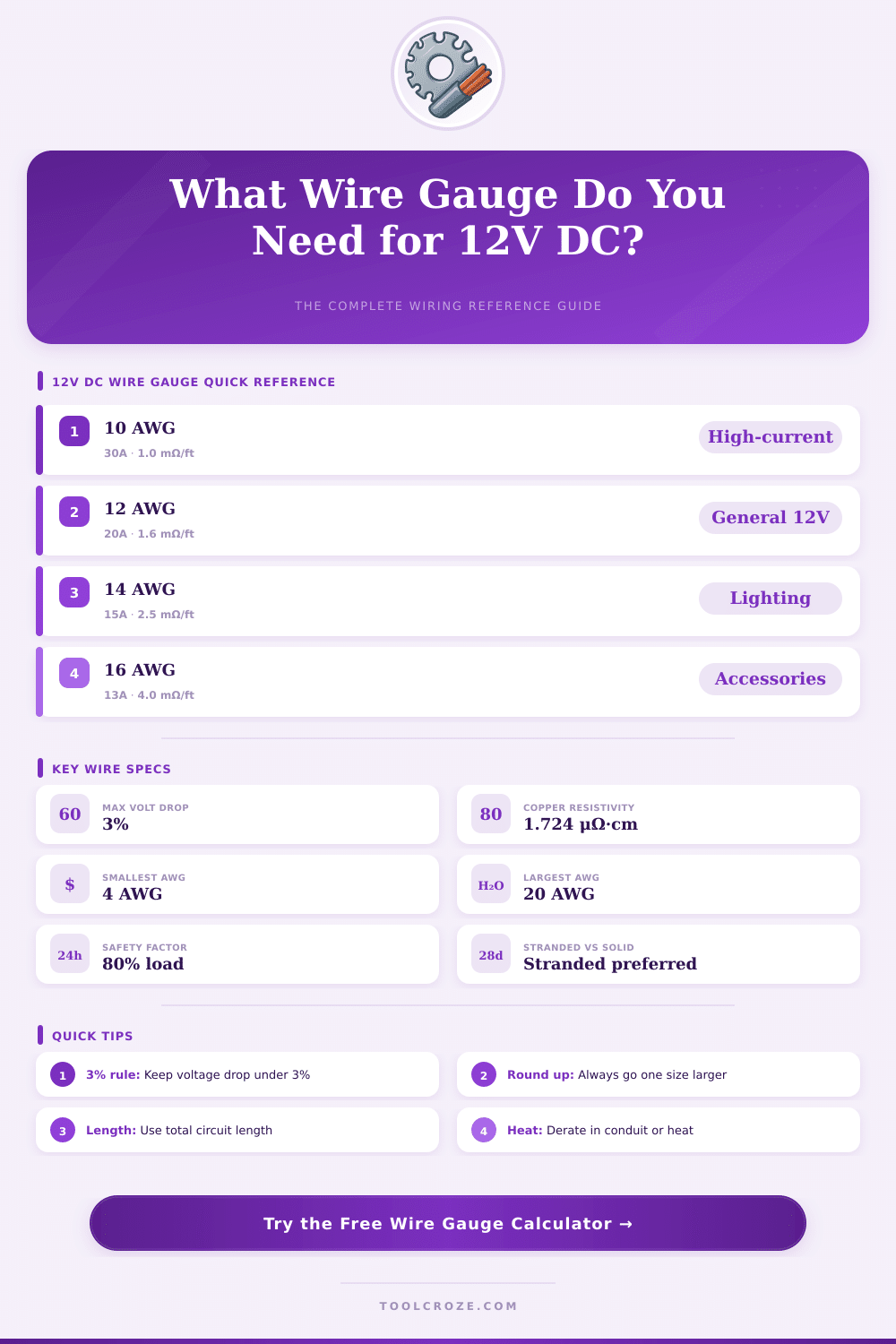
| 10 AWG | 2.59 | 0.9989 | 30 | 25 | 5.26 | Car audio, motor feeds |
| 12 AWG | 2.05 | 1.588 | 20 | 17 | 3.31 | General automotive circuits |
| 14 AWG | 1.63 | 2.525 | 15 | 13 | 2.08 | Lighting, accessories |
| 16 AWG | 1.29 | 4.016 | 13 | 10 | 1.31 | Small lights, sensors |
| 18 AWG | 1.02 | 6.385 | 10 | 7 | 0.823 | Signal wires, low-current |
| 20 AWG | 0.812 | 10.15 | 7 | 5 | 0.519 | Sensors, data, control |
| 22 AWG | 0.644 | 16.14 | 5 | 3.5 | 0.326 | Low power sensors, LED pilots |
| AWG | 5A / 10ft | 10A / 10ft | 20A / 10ft | 20A / 20ft | 30A / 10ft | 30A / 20ft |
|---|---|---|---|---|---|---|
| 4 AWG | 0.012V | 0.025V | 0.050V | 0.099V | 0.075V | 0.149V |
| 6 AWG | 0.020V | 0.040V | 0.079V | 0.158V | 0.119V | 0.237V |
| 8 AWG | 0.031V | 0.063V | 0.126V | 0.251V | 0.189V | 0.377V |
| 10 AWG | 0.050V | 0.100V | 0.200V | 0.400V | 0.300V | 0.599V |
| 12 AWG | 0.079V | 0.159V | 0.318V | 0.635V | 0.476V | 0.952V |
| 14 AWG | 0.126V | 0.253V | 0.505V | 1.010V | 0.757V | 1.514V |
| 16 AWG | 0.201V | 0.401V | 0.803V | 1.606V | Exceeds | Exceeds |
| Application | Typical Current | Typical Run | Min. AWG | Rec. AWG | Fuse Size |
|---|---|---|---|---|---|
| Car Audio Amplifier (500W) | 50A | 10 ft | 6 AWG | 4 AWG | 60A |
| LED Light Bar (100W) | 8.5A | 15 ft | 14 AWG | 12 AWG | 15A |
| 12V Compressor Fridge | 5-10A | 8 ft | 14 AWG | 12 AWG | 15A |
| Electric Winch (3500 lb) | 80-100A | 6 ft | 4 AWG | 2 AWG | 125A |
| CB / Ham Radio | 10-15A | 6 ft | 14 AWG | 12 AWG | 20A |
| 300W Inverter | 30A | 5 ft | 8 AWG | 8 AWG | 40A |
| Solar Charge Controller | 20-30A | 5 ft | 10 AWG | 8 AWG | 30A |
| Tail / Marker Lights | 5A | 12 ft | 16 AWG | 14 AWG | 10A |
| Cooling Fan (12V 120W) | 10A | 8 ft | 14 AWG | 12 AWG | 15A |
| Starter Motor | 100-200A | 3 ft | 2 AWG | 1/0 AWG | Fusible Link |
| Conductor Type | Resistivity (μΩ·cm) | vs. Copper (%) | Best For | Corrosion |
|---|---|---|---|---|
| Copper Stranded | 1.724 | 100% (baseline) | Automotive, general | Average |
| Copper Solid | 1.724 | 100% | Fixed installations | Average |
| Tinned Copper (Marine) | 1.724 | 100% | Marine, wet environments | Excellent |
| Aluminum | 2.824 | 61% conductivity | Overhead runs, RV | Poor |
Wire gauge helps to describe the size of wire. The rating of wire gauge cables helps to count how many heat that wire can safely bear. There are several ways to measure wire gauge size, also the AWG, the SWG (also called British Standard Wire Gauge) and the metric cross-section area in square millimeters.
In the United States one sizes wires by means of the AWG system, which stands for American Wire Gauge. This system works since about 1857 and one uses it mainly in North America. It counts for round, solid, non-iron and electrical wires.
What is wire gauge?
The exact sizes are described in the ASTM standard called B 258. Common confusion for folks is that a lower gauge number actually points to bigger wire diameter. Like this 10 wire gauge is thicker than 14 gauge.
It seems backward but it makes sense, when one understands the process that stands behind it.
The number system comes from the way one makes wire. One draws metal rod through a plate, and every time it passes through it, it exits a bit more thin. Imagine that as cold pressure.
The more times one draws the wire through the plate, the thinner it becomes and the higher its gauge number becomes.
In everyday use wire gauge ratings matter a lot. Thin wires have high gauge numbers and they can cause bigger voltage loss along distance. For instance, 12 gauge wire at 40 feet loses only 0.2 volts.
On the other hand, 14 gauge wire loses 0.3 volts, 16 gauge 0.5, 18 gauge 0.81 and 20 gauge around 1.2 volts. That adds up quickly for longer runs.
For audio systems, 16 to 18 AWG work well for short, low power runs. 14 AWG forms a good everyday solution. At longer runs, low impedance or high power, 12 AWG or thicker wire is better.
Ratings really matter especially for long distances, when one connects speakers.
To measure wire gauge, one uses physical tools. They usually are made of round or oval metal discs with slots of various sizes around the edge. Every slot bears a stamped number.
One slides the wire in a slot to check its size. The tool also works well four direct measurement of wire diameter. With copper and aluminum wires, gauge tools for non-iron metals are the right choice.
On wire gauge covers, letter marks show info about material, rating and voltage. The National Electrical Code uses letter codes to point out what wire handles, with common codes as THHN, XHHW and THW. Twelfth gauge wire worksquite well for normal home wiring until bigger devices come in.